


Uterine smooth muscle tumour of uncertain malignant potential and in vitro fertilization treatment in an infertile patient
- PMID: 33996092
- PMCID: PMC8107659
- DOI: 10.1177/2050313X211012516
Uterine smooth muscle tumour of uncertain malignant potential and in vitro fertilization treatment in an infertile patient
Abstract
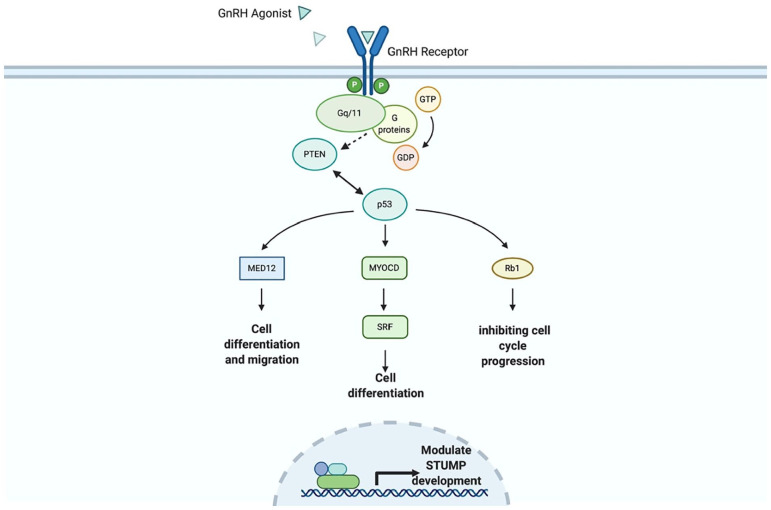
The term smooth uterine muscle of uncertain malignant potential (STUMP) indicates a group of uterine smooth muscle tumours that cannot be diagnosed unequivocally as malignant but does not fulfil the criteria for leiomyoma, or its variants. In this case, we present a woman treated for infertility who presented with an asymptomatic cervical mass, diagnosed as STUMP after three cycles of controlled ovarian stimulation. We reviewed the literature with particular emphasis on the effects of STUMP upon fertility, up-to-date guidance regarding the management of patients' wishing fertility-sparing approaches and obstetric outcomes. To the best of our knowledge, this is the first case report of STUMP in a patient that has undergone multiple in vitro fertilization treatments as well as the first to provide a putative biological basis for the efficacy of gonadotropin-releasing hormone agonists, in this patient group.
Keywords: Obstetrics/gynaecology; bioinformatics; genetics; oncology.
© The Author(s) 2021.
Conflict of interest statement
Declaration of conflicting interests: The author(s) declared the following potential conflicts of interest with respect to the research, authorship, and/or publication of this article: The authors state that the manuscript is original; all the authors were active participants, and take full responsibility for this article, which they have read and approved, and that it is not simultaneously under consideration by other publication. The authors report no conflicts of interest. Contribution to the paper of each author is indicated.
Figures
References
-
- Lu Z, Chen J. WHO classification of tumours of female reproductive organs. Zhonghua Bing Li Xue Za Zhi 2014; 43: 649–650. - PubMed
-
- Ip PP, Tse KY, Tam KF. Uterine smooth muscle tumors other than the ordinary leiomyomas and leiomyosarcomas: a review of selected variants with emphasis on recent advances and unusual morphology that may cause concern for malignancy. Adv Anat Pathol 2010; 17(2): 91–112. - PubMed
-
- Bell SW, Kempson RL, Hendrickson MR. Problematic uterine smooth muscle neoplasms: a clinicopathologic study of 213 cases. Am J Surg Pathol 1994; 18(6): 535–558. - PubMed
Publication types
LinkOut - more resources
Full Text Sources
Other Literature Sources
