. 2021 Apr 20:18:66-73.
doi: 10.1016/j.jcot.2021.04.015. eCollection 2021 Jul.

Primary total elbow arthroplasty

Affiliations

Primary total elbow arthroplasty

Armin Badre et al. J Clin Orthop Trauma. .

Erratum in

  • Erratum regarding previously published articles.
    [No authors listed] [No authors listed] J Clin Orthop Trauma. 2021 Jul 30;20:101539. doi: 10.1016/j.jcot.2021.101539. eCollection 2021 Sep. J Clin Orthop Trauma. 2021. PMID: 34405084 Free PMC article.

Abstract

There have been significant improvements in surgical techniques and implant designs of elbow arthroplasty over the last five decades. These advances have resulted in improved outcomes and expansion of indications for total elow arthroplasty (TEA). As the proportion of TEAs being performed for inflammatory arthritis has been decreasing in recent years, TEAs are being performed more commonly for the management of acute distal humerus fractures in the elderly, post-traumatic sequelae, and primary osteoarthritis. Appropriate patient selection and meticulous attention to surgical technique including the surgical approach, implant positioning and fixation will result in acceptable outcomes. Future advances in the design, instrumentation, and surgical technique will allow for further improvement in outcomes as the indications for TEA continue to expand.

Keywords: Arthroplasty; Convertible; Elbow; Linked; Replacement; Unlinked.


Figures

Fig. 1
Fig. 1
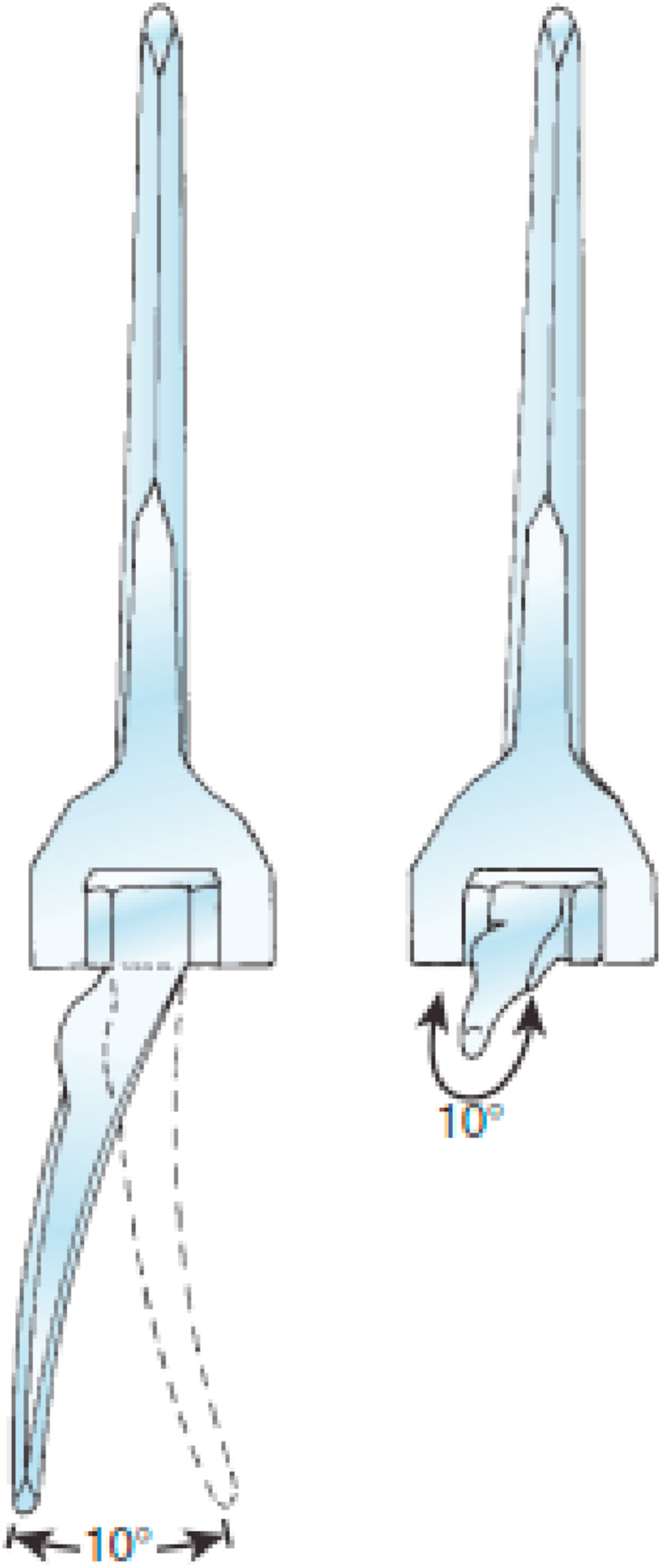
A “sloppy” hinge semi-constrained prosthesis allows for 5–10° of varus-valgus and internal-external rotation laxity. (Reproduced with permission from Morrey BF, Sanchez-Sotelo J, ed. The Elbow and Its Disorders, Fourth ed., Page 766, Philadelphia: Saunders Elsevier, 2009).
Fig. 2
Fig. 2
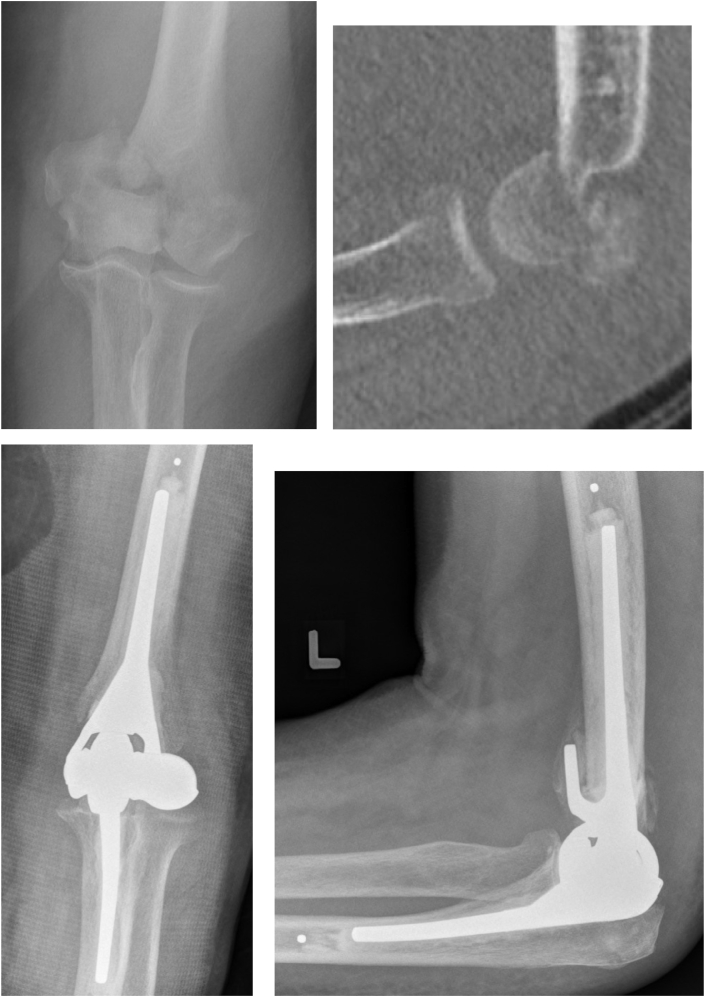
Pre and postoperative images of an 88-year-old male with a comminuted intra-articular distal humerus fracture treated with total elbow arthroplasty. A linked arthroplasty system allows for stability without the need for fixation of condylar fragments.
Fig. 3
Fig. 3
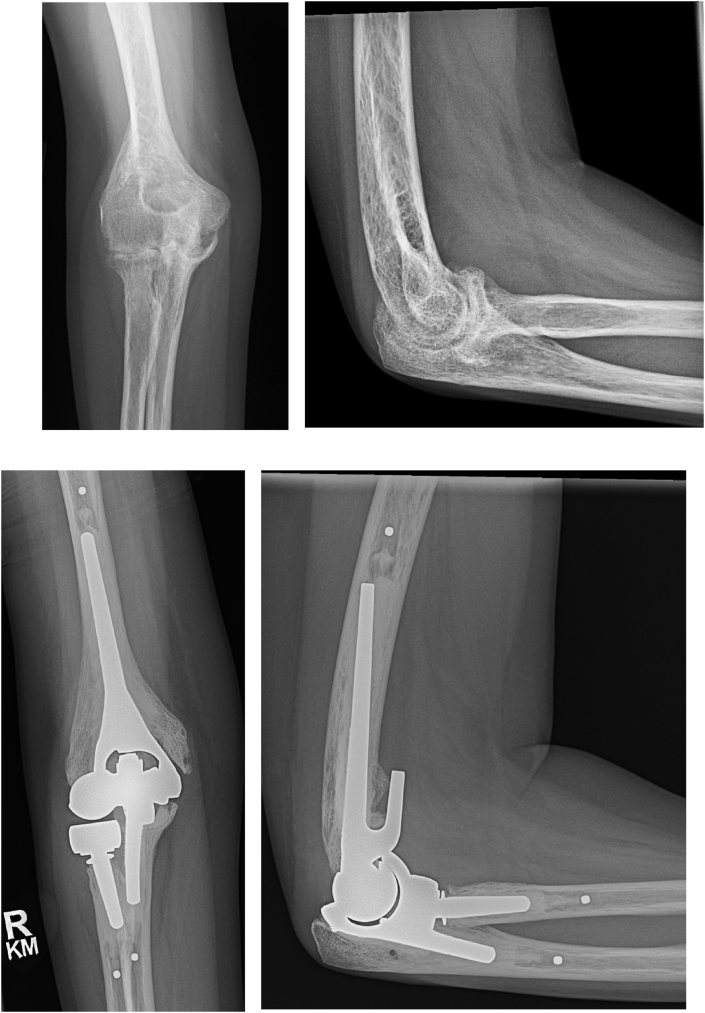
Pre and postoperative images of a 41-year-old female with end-stage rheumatoid arthritis and significant preoperative stiffness (arc of motion 40–75°) affecting even activities of daily living. An unlinked total elbow arthroplasty was used due to the patient’s young age and potential for reduced wear. At one-year postoperative follow-up, the patient is pain-free with an arc of motion of 20–135°.
Fig. 4
Fig. 4
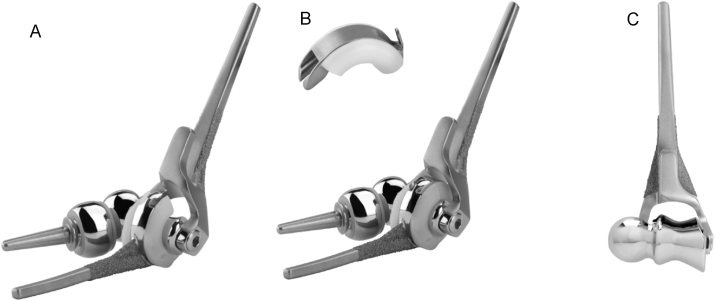
Latitude convertible elbow prosthesis has the option to be used as A) unliked, B) linked, or C) distal humerus hemiarthroplasty. (Reproduced with permission from Wright Medical).
Fig. 5
Fig. 5
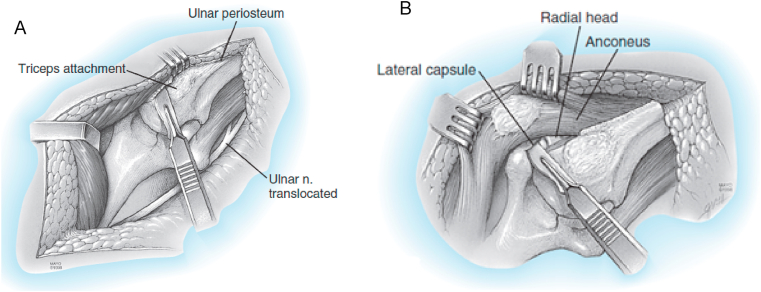
Bryan-Morrey triceps reflection approach. A) Once the ulnar nerve is identified and protected, the extensor mechanism and the anconeus are reflected from medial to lateral by releasing the Sharpeys fibers from the tip of the olecranon. B) Once the extensor mechanism is subluxated to the lateral aspect of the lateral epicondyle, the collateral ligaments are released to allows for appropriate exposure to perform the arthroplasty. (Copyright © 2018 Mayo Foundation for Medical Education and Research. Published by Elsevier Inc. All rights reserved.)
Fig. 6
Fig. 6
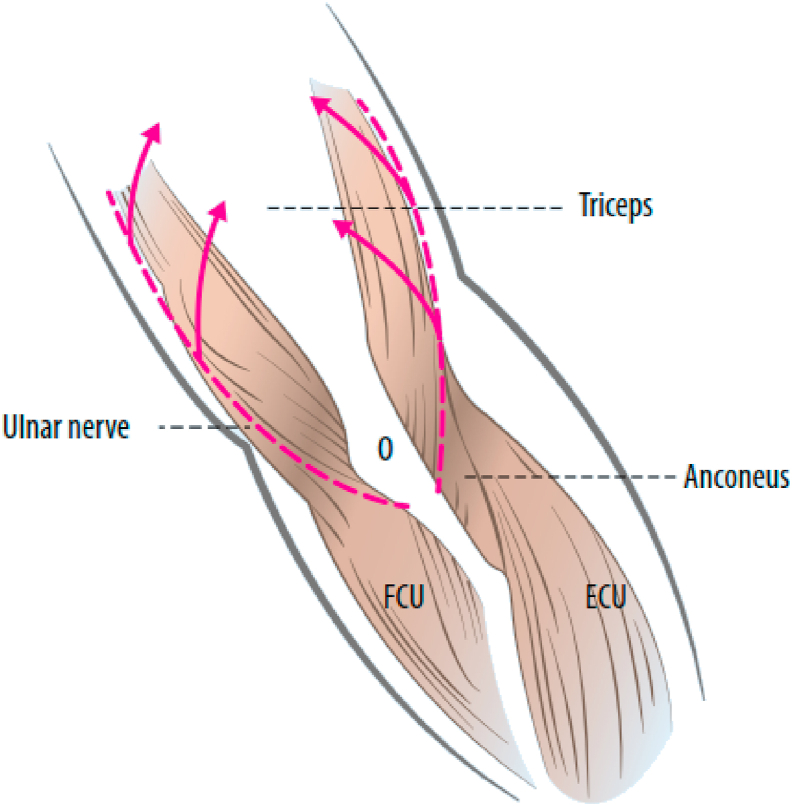
Paratricipital approach. Medial and lateral windows are made by elevating the triceps from the intermuscular septa and posterior humerus. Medially, the ulnar nerve is identified, and the dissection is continued distally through the floor of the ulnar nerve. Laterally, the dissection is continued distally between the anconeus and olecranon. (Reproduced with permission from Dey Hazra RO, Lill H, Jensen G, Imrecke J, Ellwein A. Fracture-pattern-related therapy concepts in distal humeral fractures. Obere Extrem. 2018; 13(1):23–32.).
Fig. 7
Fig. 7
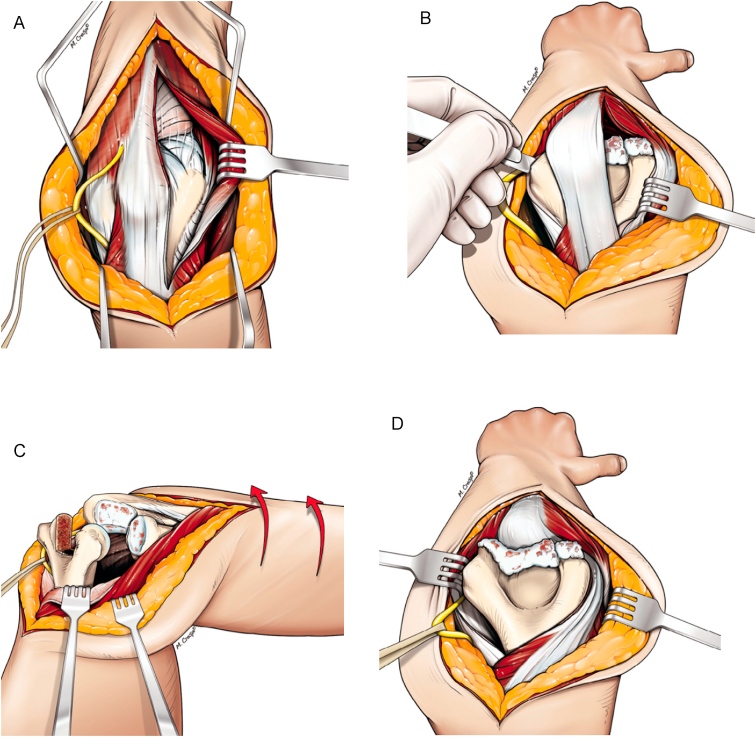
Lateral paraolecranon approach. A) The lateral window involves the Boyd approach distally along the lateral margin of the ulna which is extended proximally as a triceps split. B) The medial and lateral collateral ligaments and the common flexor and extensor origins are sectioned from their insertions to allow for dislocation of the elbow. C) Supination of the forearm allows for visualization of the trochlear notch and radius for preparation. D) The distal humerus can be dislocated through the triceps split or medially for preparation. (Reproduced with permission from Studer A, Athwal GS, MacDermid JC, Faber KJ, King GJ. The lateral para-olecranon approach for total elbow arthroplasty. J Hand Surg Am. 2013 Nov; 38(11):2219–2226).
Fig. 8
Fig. 8
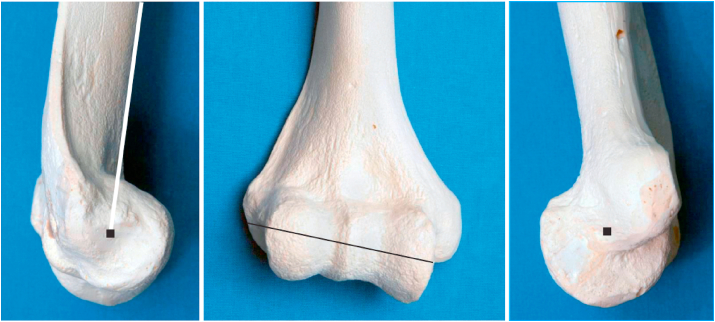
The flexion-extension axis of the elbow extending from the site of origin of the lateral collateral ligament to that of the ulnar collateral ligament. (Copyright © 2018 Mayo Foundation for Medical Education and Research. Published by Elsevier Inc. All rights reserved.)

References

    1. Dee R., Sweetnam D.R. Total replacement arthroplasty of the elbow joint for rheumatoid arthritis: two cases. Proc Roy Soc Med. 1970;63(7):653–655. - PMC - PubMed
    1. Dee R. Total replacement arthroplasty of the elbow for rheumatoid arthritis. J Bone Joint Surg Br. 1972;54(1):88–95. - PubMed
    1. Dee R. Total replacement of the elbow joint. Orthop Clin N Am. 1973;4(2):415–433. - PubMed
    1. Souter W.A. Arthroplasty of the elbow with particular reference to metallic hinge arthroplasty in rheumatoid patients. Orthop Clin N Am. 1973;4(2):395–413. - PubMed
    1. Garrett J.C., Ewald F.C., Thomas W.H., Sledge C.B. Loosening associated with G.S.B. hinge total elbow replacement in patients with rheumatoid arthritis. Clin Orthop Relat Res. 1977;127:170–174. - PubMed

LinkOut - more resources