


Infectious disease, human capital, and the BRICS economy in the time of COVID-19
- PMID: 33996518
- PMCID: PMC8105046
- DOI: 10.1016/j.mex.2020.101202
Infectious disease, human capital, and the BRICS economy in the time of COVID-19
Abstract
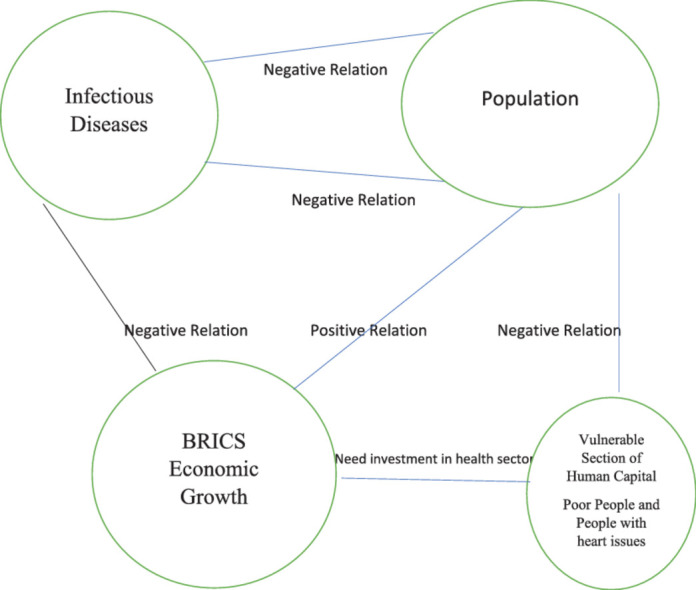
We develop empirical models using difference-in-difference method to find out how COVID-19 testing and infection rates impact the BRICS economy. Our results show that strict government measures, areas of poor people and people with heart diseases have resulted in high COVID-19 testing due to the increasing infections, However, economic development and population density are not found to be rather insignificant towards the COVID-19 testing rates. Hence, both from policy and pandemic perspectives, it is inferred that these developing economies need to divert more resources and infuse more investment in the healthcare sector in the coming days.•Governments must give due stress to the health sector along with development irrespective of nature of the economy.•Our results show that strict government measures, areas of poor people and people with heart diseases have resulted in high COVID-19 testing due to the increasing infections.•Both from policy and pandemic perspectives, it is inferred that these BRICS economies need to divert more resources and infuse more investment in the healthcare sector.
Keywords: BRICS; COVID-19; Infectious Disease; Population; Poverty.
© 2020 The Authors. Published by Elsevier B.V.
Conflict of interest statement
The authors declare that they have no known competing financial interests or personal relationships that could have appeared to influence the work reported in this paper.
References
-
- Ashenfelter O., Card D. Using the longitudinal structure of earnings to estimate the effect of training programs. Rev. Econ. Stat. 1985;67:648–660.
LinkOut - more resources
Full Text Sources
Other Literature Sources
