


ApoE and ApoE Nascent-Like HDL Particles at Model Cellular Membranes: Effect of Protein Isoform and Membrane Composition
- PMID: 33996741
- PMCID: PMC8117676
- DOI: 10.3389/fchem.2021.630152
ApoE and ApoE Nascent-Like HDL Particles at Model Cellular Membranes: Effect of Protein Isoform and Membrane Composition
Abstract
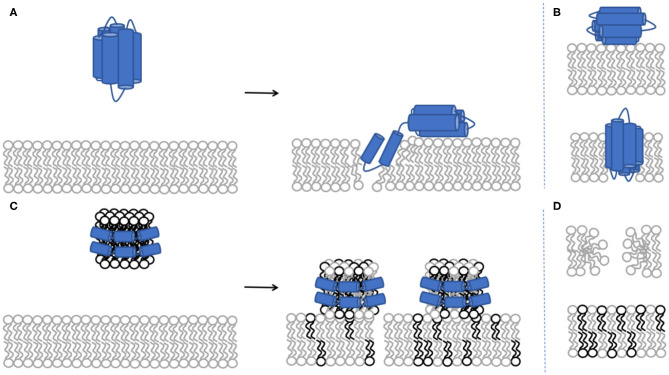
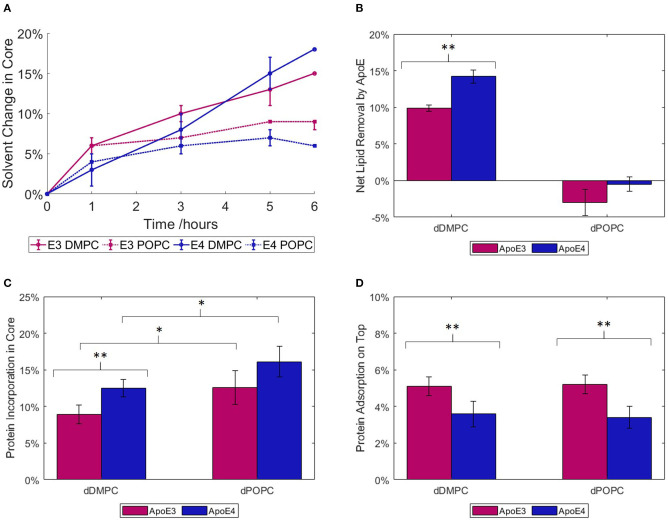
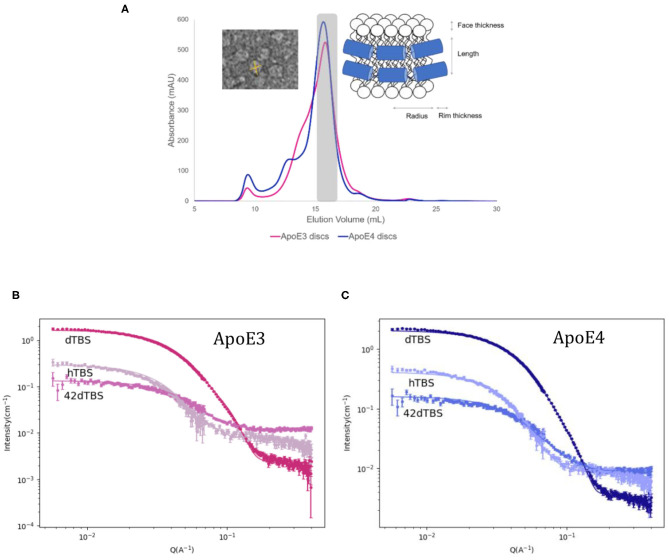
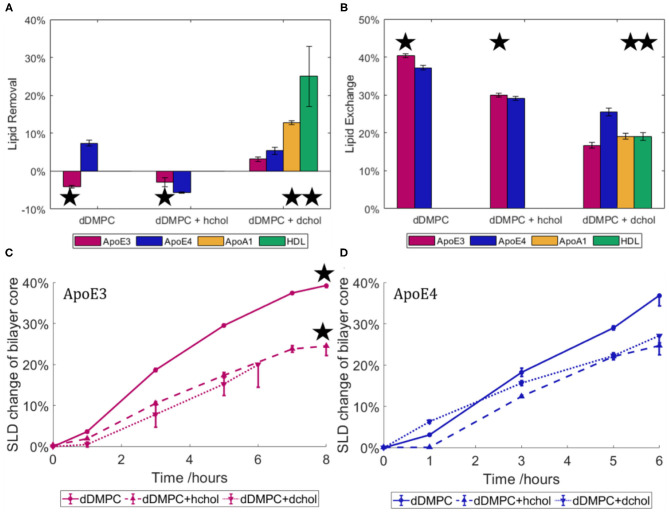
Apolipoprotein E (ApoE), an important mediator of lipid transportation in plasma and the nervous system, plays a large role in diseases such as atherosclerosis and Alzheimer's. The major allele variants ApoE3 and ApoE4 differ only by one amino acid. However, this difference has major consequences for the physiological behaviour of each variant. In this paper, we follow (i) the initial interaction of lipid-free ApoE variants with model membranes as a function of lipid saturation, (ii) the formation of reconstituted High-Density Lipoprotein-like particles (rHDL) and their structural characterisation, and (iii) the rHDL ability to exchange lipids with model membranes made of saturated lipids in the presence and absence of cholesterol [1,2-dimyristoyl-sn-glycero-3-phosphocholine (DMPC) or 1-palmitoyl-2-oleoyl-glycero-3-phosphocholine (POPC) with and without 20 mol% cholesterol]. Our neutron reflection results demonstrate that the protein variants interact differently with the model membranes, adopting different protein conformations. Moreover, the ApoE3 structure at the model membrane is sensitive to the level of lipid unsaturation. Small-angle neutron scattering shows that the ApoE containing lipid particles form elliptical disc-like structures, similar in shape but larger than nascent or discoidal HDL based on Apolipoprotein A1 (ApoA1). Neutron reflection shows that ApoE-rHDL do not remove cholesterol but rather exchange saturated lipids, as occurs in the brain. In contrast, ApoA1-containing particles remove and exchange lipids to a greater extent as occurs elsewhere in the body.
Keywords: ApoE isoforms; lipid exchange; model membranes; neutron reflection; reconstituted HDL; small-angle neutron scattering.
Copyright © 2021 Waldie, Sebastiani, Moulin, Del Giudice, Paracini, Roosen-Runge, Gerelli, Prevost, Voss, Darwish, Yepuri, Pichler, Maric, Forsyth, Haertlein and Cárdenas.
Conflict of interest statement
The authors declare that the research was conducted in the absence of any commercial or financial relationships that could be construed as a potential conflict of interest. The reviewer DH declared a past co-authorship with one of the authors VF.
Figures
References
-
- Åkesson A., Lind T., Ehrlich N., Stamou D., Wacklin H., Cárdenas M. (2012a). Composition and structure of mixed phospholipid supported bilayers formed by POPC and DPPC. Soft Matter. 8, 5658–5665. 10.1039/c2sm00013j - DOI
-
- Barrett M. A., Zheng S., Toppozini L. A., Alsop R. J., Dies H., Wang A., et al. (2013). Solubility of cholesterol in lipid membranes and the formation of immiscible cholesterol plaques at high cholesterol concentrations. Soft Matter. 9, 9342–9351. 10.1039/c3sm50700a - DOI
LinkOut - more resources
Full Text Sources
Other Literature Sources
Miscellaneous
