


Continuous Lumbar Plexus Block vs Continuous Lumbar Erector Spinae Plane Block for Postoperative Pain Control After Revision Total Hip Arthroplasty
- PMID: 33997205
- PMCID: PMC8099915
- DOI: 10.1016/j.artd.2021.03.016
Continuous Lumbar Plexus Block vs Continuous Lumbar Erector Spinae Plane Block for Postoperative Pain Control After Revision Total Hip Arthroplasty
Abstract
Background: Optimal pain management is key to successful recovery in revision total hip arthroplasty. Lumbar plexus blocks (LPBs) have traditionally been used for postoperative pain management. Recently, the lumbar erector spinae plane block (LESPB) has emerged as a promising regional anesthesia technique and is relatively simple to perform. Our study aimed to evaluate whether continuous LESPB provided better analgesia and clinical outcomes than continuous LPB in revision hip arthroplasty.
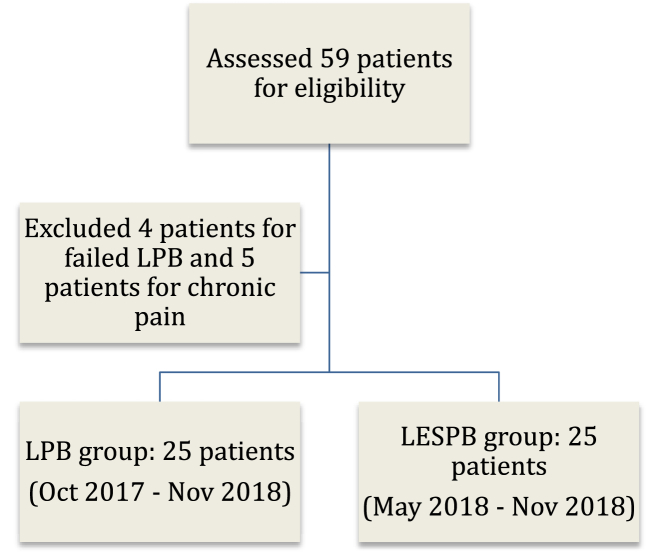
Material and methods: We compared 25 LPBs with 25 LESPBs performed from October 2017 to November 2018 for revision hip arthroplasty. The primary outcome of this study was difference in opioid consumption between the groups at 24 hours postoperatively. Secondary outcomes include pain scores, hospital lengths of stay, pain adjunct consumption, and incidence of postoperative nausea and vomiting.
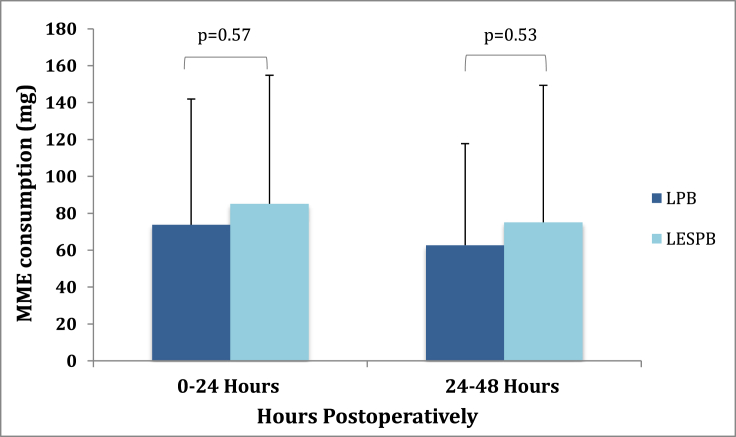
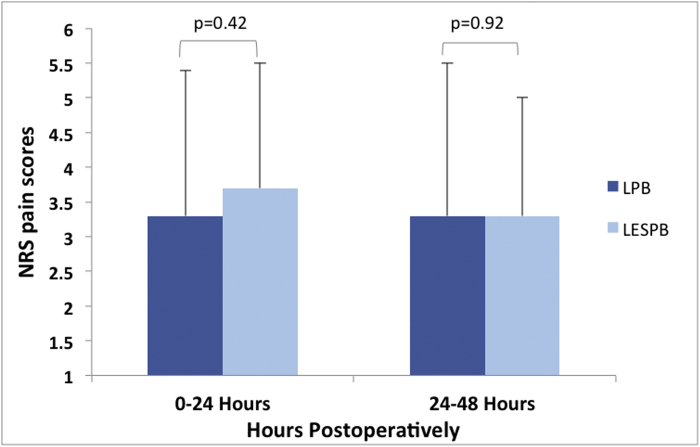
Results: There was no significant difference in average opioid consumption between the LPB and LESPB groups during the first 24 hours postoperatively (73.8 ± 68.1 mg vs 85.1 ± 69.7 mg, respectively, P = .57). Similarly, there was no significant difference in average pain scores (3.3 ± 2.1 vs 3.7 ± 1.8, respectively, P = .42).
Conclusions: There was no significant difference in opioid consumption and pain scores in patients with continuous LESPB compared with those with continuous LPB. While our study did not show a difference in these outcomes, the LESPB is a straightforward regional block that avoids many of the risks of LPBs and may be as effective for pain control.
Keywords: Analgesia; Erector spinae plane block; Hip arthroplasty; Lumbar plexus block; Nerve block; Regional anesthesia.
© 2021 The Authors.
Figures
References
-
- Hebl J.R., Dilger J.A., Byer D.E. A pre-emptive multimodal pathway featuring peripheral nerve block improves perioperative outcomes after major orthopedic surgery. Reg Anesth Pain Med. 2008;33:510. - PubMed
-
- Horlocker T.T., Kopp S.L., Pagnano M.W., Hebl J.R. Analgesia for total hip and knee arthroplasty: a multimodal pathway featuring peripheral nerve block. J Am Acad Orthop Surg. 2006;14:126. - PubMed
-
- Gaffney C.J., Pelt C.E., Gililland J.M., Peters C.L. Perioperative pain management in hip and knee arthroplasty. Orthop Clin North Am. 2017;48:407. - PubMed
-
- Stein B.E., Srikumaran U., Tan E.W., Freehill M.T., Wilckens J.H. Lower-extremity peripheral nerve blocks in the perioperative pain management of orthopaedic patients. J Bone Joint Surg Am. 2012;94:e167. - PubMed
LinkOut - more resources
Full Text Sources
