


The impact of COVID-19 on the well-being and cognition of older adults living in the United States and Latin America
- PMID: 33997742
- PMCID: PMC8100067
- DOI: 10.1016/j.eclinm.2021.100848
The impact of COVID-19 on the well-being and cognition of older adults living in the United States and Latin America
Abstract
Background: In the COVID-19 pandemic, older adults from vulnerable ethnoracial groups are at high risk of infection, hospitalization, and death. We aimed to explore the pandemic's impact on the well-being and cognition of older adults living in the United States (US), Argentina, Chile, Mexico, and Peru.
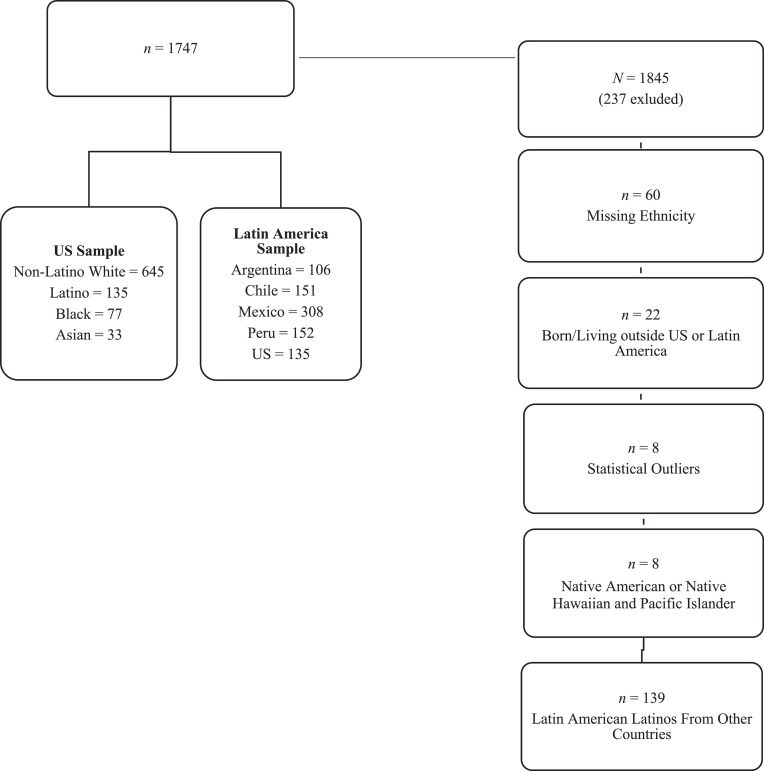
Methods: 1,608 (646 White, 852 Latino, 77 Black, 33 Asian; 72% female) individuals from the US and four Latin American countries aged ≥ 55 years completed an online survey regarding well-being and cognition during the pandemic between May and September 2020. Outcome variables (pandemic impact, discrimination, loneliness, purpose of life, subjective cognitive concerns) were compared across four US ethnoracial groups and older adults living in Argentina, Chile, Mexico, and Peru.
Findings: Mean age for all participants was 66.7 (SD = 7.7) years and mean education was 15.4 (SD = 2.7) years. Compared to Whites, Latinos living in the US reported greater economic impact (p < .001, ηp 2 = 0.031); while Blacks reported experiencing discrimination more often (p < .001, ηp 2 = 0.050). Blacks and Latinos reported more positive coping (p < .001, ηp 2 = 0.040). Compared to Latinos living in the US, Latinos in Chile, Mexico, and Peru reported greater pandemic impact, Latinos in Mexico and Peru reported more positive coping, Latinos in Argentina, Mexico, and Peru had greater economic impact, and Latinos in Argentina, Chile, and Peru reported less discrimination.
Interpretation: The COVID-19 pandemic has differentially impacted the well-being of older ethnically diverse individuals in the US and Latin America. Future studies should examine how mediators like income and coping skills modify the pandemic's impact.
Funding: Massachusetts General Hospital Department of Psychiatry.
Keywords: COVID-19; Cognition; Diversity; Latin America; Older adults; US; Well-being.
© 2021 The Authors.
Conflict of interest statement
Dr. Thumala reports personal fees from National Agency for Research and Development, during the conduct of the study. Dr. Miranda-Castillo reports grants and personal fees from National Agency for Research and Development, during the conduct of the study. Dr. Gatchel reports grants from NIH/NIA, grants from Alzheimer's Association, and served as a one-time consultant with Huron Consulting, outside the submitted work. Dr. Sperling reports personal fees from Roche, Takeda Pharmaceuticals, Eisai, Biogen, AC Immune, Neurocentria, Janssen, Neuraly, Alnylam Pharmaceuticals, Renew, JOMDD, Acumen, Prothena, Cytox, Oligomerix, Inc., and Genentech; grants from Eisai, Eli Lilly, Janssen, NIA, and Alzheimer's Association; personal fees and honorarium (consulting) for Dr. Sperling's spouse (Dr. Keith Johnson) from Novartis, AC Immune, Janssen, and Cerveau, outside the submitted work. Dr. Rentz reports consulting from Digital Cognition Technologies, Neurotrack, and Biogen Idec, outside the submitted work. All other authors have nothing to declare.
Figures


References
-
- World Health Organization. WHO Director-General's opening remarks at the media briefing on COVID-19-11 March 2020. 2020. https://www.who.int/dg/speeches/detail/who-director-general-s-opening-re... 19—11-march-2020 (accessed September 6, 2020).
-
- Johns Hopkins University. COVID-19 dashboard by the center for systems science and engineering at Johns Hopkins University: global Map. 2020. https://coronavirus.jhu.edu/map.html (accessed September 6, 2020).
-
- Centers for Disease Control and Prevention. CDC COVID Data Tracker: united States COVID-19 Cases and Deaths by State. 2020. https://covid.cdc.gov/covid-data-tracker/#cases (accessed September 6, 2020).
-
- Schröder I. COVID-19: a risk assessment perspective. ACS Chem Health Saf. 2020;27(3):160–169. - PubMed
Grants and funding
LinkOut - more resources
Full Text Sources
Other Literature Sources
