


Latitudinal variation in long-term stability of North American rocky intertidal communities
- PMID: 34002377
- PMCID: PMC8518646
- DOI: 10.1111/1365-2656.13504
Latitudinal variation in long-term stability of North American rocky intertidal communities
Abstract
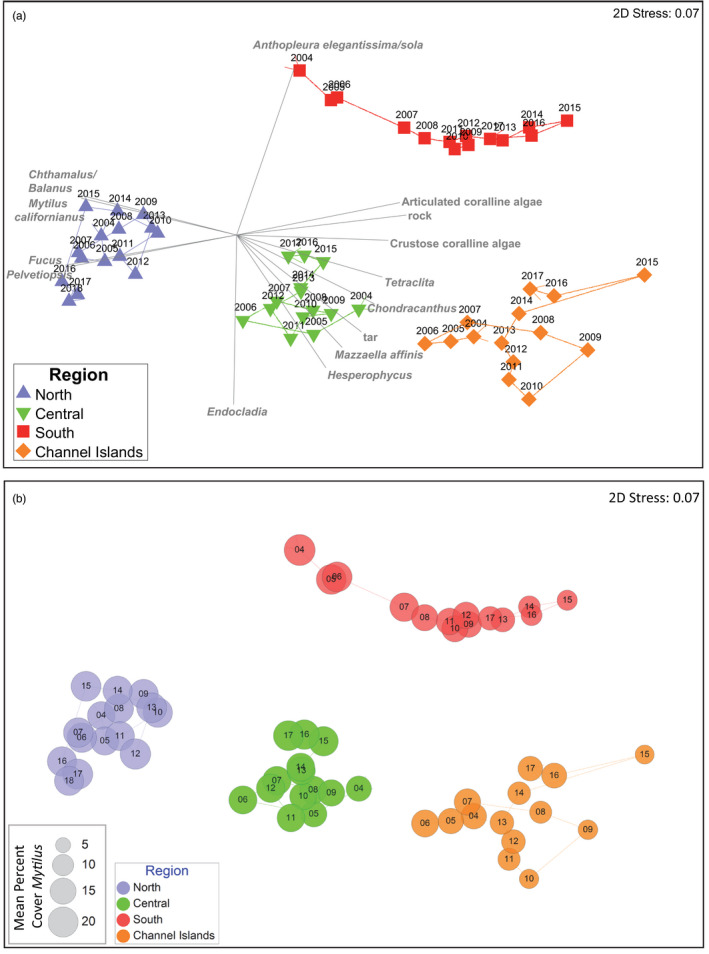
Although long-term ecological stability is often discussed as a community attribute, it is typically investigated at the species level (e.g. density, biomass), or as a univariate metric (e.g. species diversity). To provide a more comprehensive assessment of long-term community stability, we used a multivariate similarity approach that included all species and their relative abundances. We used data from 74 sites sampled annually from 2006 to 2017 to examine broad temporal and spatial patterns of change within rocky intertidal communities along the west coast of North America. We explored relationships between community change (inverse of stability) and the following potential drivers of change/stability: (a) marine heatwave events; (b) three attributes of biodiversity: richness, diversity and evenness and (c) presence of the mussel, Mytilus californianus, a dominant space holder and foundation species in this system. At a broad scale, we found an inverse relationship between community stability and elevated water temperatures. In addition, we found substantial differences in stability among regions, with lower stability in the south, which may provide a glimpse into the patterns expected with a changing climate. At the site level, community stability was linked to high species richness and, perhaps counterintuitively, to low evenness, which could be a consequence of the dominance of mussels in this system. Synthesis. Assessments of long-term stability at the whole-community level are rarely done but are key to a comprehensive understanding of the impacts of climate change. In communities structured around a spatially dominant species, long-term stability can be linked to the stability of this 'foundation species', as well as to traditional predictors, such as species richness.
Keywords: Mytilus californianus; community stability; foundation species; global change ecology; long-term monitoring; mussels; temperate rocky intertidal.
© 2021 The Authors. Journal of Animal Ecology published by John Wiley & Sons Ltd on behalf of British Ecological Society.
Figures




References
-
- Alheit, J. , & Bakun, A. (2010). Population synchronies within and between ocean basins: Apparent teleconnections and implications as to physical–biological linkage mechanisms. Journal of Marine Systems, 79(3), 267–285. 10.1016/j.jmarsys.2008.11.029 - DOI
-
- Ambrose, R. F. , Engle, J. M. , Raimondi, P. T. , Wilson, M. , & Altstatt, J. A. (1995). Rocky intertidal and subtidal resources: Santa Barbara County mainland. Final Report to the Minerals Management Service. (No. OCS Study MMS 95‐0067).
-
- Ambrose, R. F. , & Smith, J. R. (2005). Restoring rocky intertidal habitats in Santa Monica Bay. Technical Report for the Santa Monica Bay Restoration Commission.
-
- Angelini, C. , Altieri, A. H. , Silliman, B. R. , & Bertness, M. D. (2011). Interactions among foundation species and their consequences for community organization, biodiversity, and conservation. BioScience, 61(10), 782–789. 10.1525/bio.2011.61.10.8 - DOI
Publication types
MeSH terms
LinkOut - more resources
Full Text Sources
Other Literature Sources
