


First tick and tick damage perception survey among sedentary and transhumant pastoralists in Burkina Faso and Benin
- PMID: 34004071
- PMCID: PMC8294391
- DOI: 10.1002/vms3.414
First tick and tick damage perception survey among sedentary and transhumant pastoralists in Burkina Faso and Benin
Abstract
Background: Transhumance, a main ancestral animal production strategy of the West African Countries (WAC), can favour the spread of vectors and vector-borne diseases within and/or across countries. Transhumance has been implicated in such spread as well as that of related tick-borne diseases (TBD).
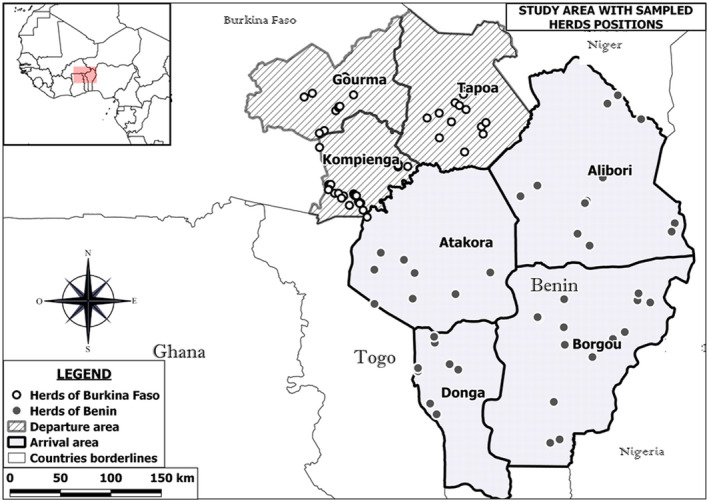
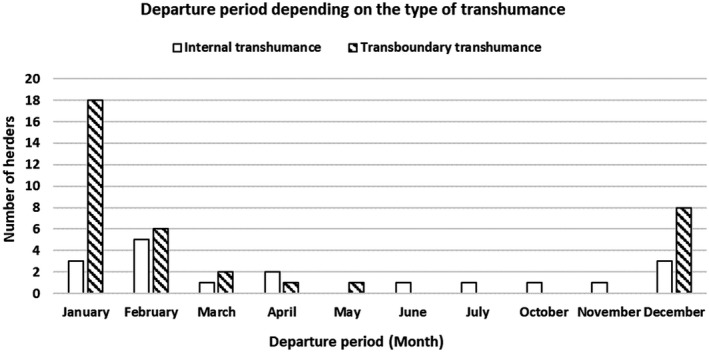
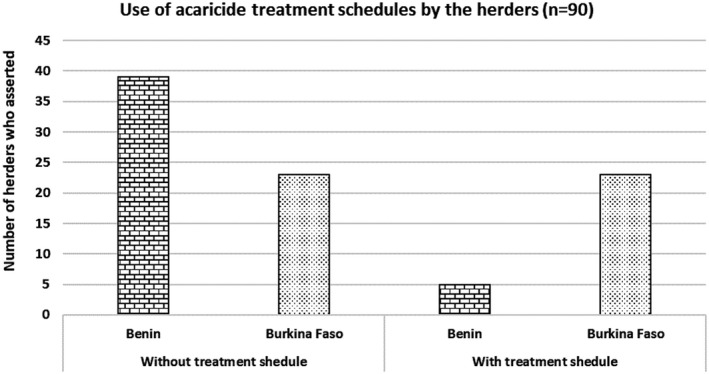
Methods and principal findings: Using a questionnaire survey and statistical modelling, this study explores the perception of herders about ticks and TBD in cattle, their practices in tick control and the social groups involved in cattle farming in eastern Burkina Faso (46 random herds) and in the northern Benin (44 random herds). Results show that most of the herders (79%) are from the Fulani social group. The principal and secondary activities of herders are respectively cattle farming and agriculture. The mean age of pastoralists is between 40 and 50 years depending on the province of origin and 60% of the surveyed herds practice internal or transboundary transhumance. Herders have a clear knowledge of different genus of ticks except the genus Rhipicephalus. Their knowledge of TBD is very limited. These results also reveal that herders in Benin use less acaricides treatment calendar compared with those in Burkina Faso. Transhumant pastoralists (i.e. transhumant cattle farmers) plan more acaricide treatment and have more cows with lost teats (i.e. tick damage) than the sedentary ones. In addition, amitraz appears to be the main acaricide compound used by herders for tick control (68%) but its use is inappropriate and its source is frequently the unregulated market.
Conclusions and significance: All of these findings can induce acaricide resistance especially as the inefficacy of amitraz against Rhipicephalus (Boophilus) microplus has already been reported in previous studies. Such results would help to elaborate suitable strategies of control and prevention of ticks and TBD in Burkina Faso and Benin.
Keywords: Benin; Burkina Faso; pastoralist; socio-epidemiological survey; tick-borne diseases; ticks; transboundary diseases; transhumance.
© 2021 The Authors Veterinary Medicine and Science Published by John Wiley & Sons Ltd.
Conflict of interest statement
The authors declare no conflict of interest.
Figures
References
-
- Portail sur le développement du Burkina Faso . (2008). Géographie du Burkina.
-
- Abiola, F. A. (2005). Impact socio‐économiques et zoosanitaires de la transhumance. Presented at the Conf. OIE, 89–103.
-
- Adakal, H. , Biguezoton, A. , Zoungrana, S. , Courtin, F. , De Clercq, E. M. , & Madder, M. (2013). Alarming spread of the Asian cattle tick Rhipicephalus microplus in West Africa—another three countries are affected: Burkina Faso, Mali and Togo. Experimental and Applied Acarology, 61, 383–386. 10.1007/s10493-013-9706-6 - DOI - PubMed
-
- Adam, K. S. (1993). Le Bénin, Les éditions du. , Flambloyant. ed. EDICEF.
-
- Adedayo, A. F. , & Olukunle, F. B. (2018). First evidence of an established Rhipicephalus (Boophilus) microplus population in Nigeria. Alexandria Journal of Veterinary Sciences, 56(1), 182–186.
Publication types
MeSH terms
LinkOut - more resources
Full Text Sources
Other Literature Sources
Medical
