. 2021 May 18;21(1):568.
doi: 10.1186/s12885-021-08320-7.

Genomic features of rapid versus late relapse in triple negative breast cancer

Affiliations

Genomic features of rapid versus late relapse in triple negative breast cancer

Yiqing Zhang et al. BMC Cancer. .

Abstract

Background: Triple-negative breast cancer (TNBC) is a heterogeneous disease and we have previously shown that rapid relapse of TNBC is associated with distinct sociodemographic features. We hypothesized that rapid versus late relapse in TNBC is also defined by distinct clinical and genomic features of primary tumors.

Methods: Using three publicly-available datasets, we identified 453 patients diagnosed with primary TNBC with adequate follow-up to be characterized as 'rapid relapse' (rrTNBC; distant relapse or death ≤2 years of diagnosis), 'late relapse' (lrTNBC; > 2 years) or 'no relapse' (nrTNBC: > 5 years no relapse/death). We explored basic clinical and primary tumor multi-omic data, including whole transcriptome (n = 453), and whole genome copy number and mutation data for 171 cancer-related genes (n = 317). Association of rapid relapse with clinical and genomic features were assessed using Pearson chi-squared tests, t-tests, ANOVA, and Fisher exact tests. We evaluated logistic regression models of clinical features with subtype versus two models that integrated significant genomic features.

Results: Relative to nrTNBC, both rrTNBC and lrTNBC had significantly lower immune signatures and immune signatures were highly correlated to anti-tumor CD8 T-cell, M1 macrophage, and gamma-delta T-cell CIBERSORT inferred immune subsets. Intriguingly, lrTNBCs were enriched for luminal signatures. There was no difference in tumor mutation burden or percent genome altered across groups. Logistic regression mModels that incorporate genomic features significantly outperformed standard clinical/subtype models in training (n = 63 patients), testing (n = 63) and independent validation (n = 34) cohorts, although performance of all models were overall modest.

Conclusions: We identify clinical and genomic features associated with rapid relapse TNBC for further study of this aggressive TNBC subset.

Keywords: Breast Cancer; Machine learning; Triple-negative breast cancer.


Conflict of interest statement

E.P.W. has received research grants from Genentech and Roche. N.U.L. has received research grants from Genentech, Array Biopharma, GlaxoSmithKline, Kadmon and Novartis. R.W. has received research support from Acerta and Astra Zeneca and served on advisory boards for PUMA and Pfizer.

Figures
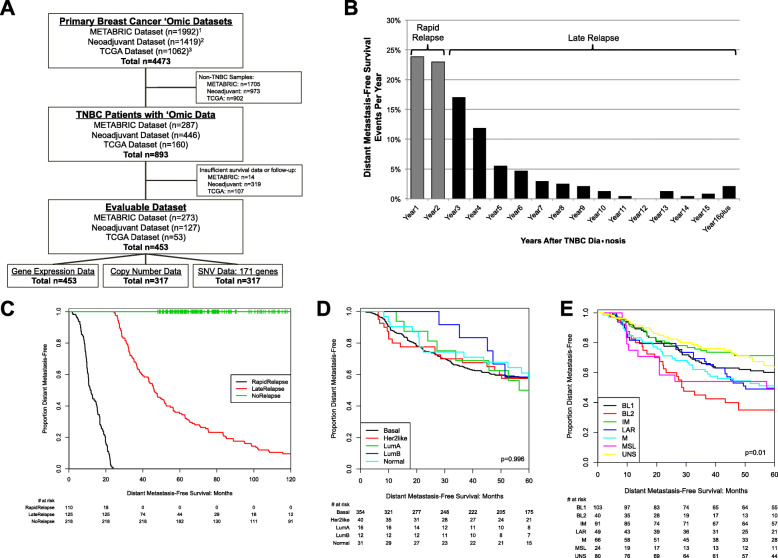
Fig. 1
Fig. 1
Study design and definition of triple-negative breast cancer (TNBC) rapid vs. late relapse. a REMARK diagram. b Proportion of distant metastasis-free survival (DMFS) events per year after diagnosis among evaluable dataset. ‘Rapid relapse’ was defined as DMFS events within the 2 years of diagnosis and ‘late relapse’ DMFS events beyond 2 years. c-e Kaplan-Meier diagram of DMFS in study cohort reflecting TNBC group definitions (c), compared with DMFS by intrinsic subtype approaches PAM50 subtype (d), and Lehmann TNBC subtype (e). P-value indicates log-rank test
Fig. 2
Fig. 2
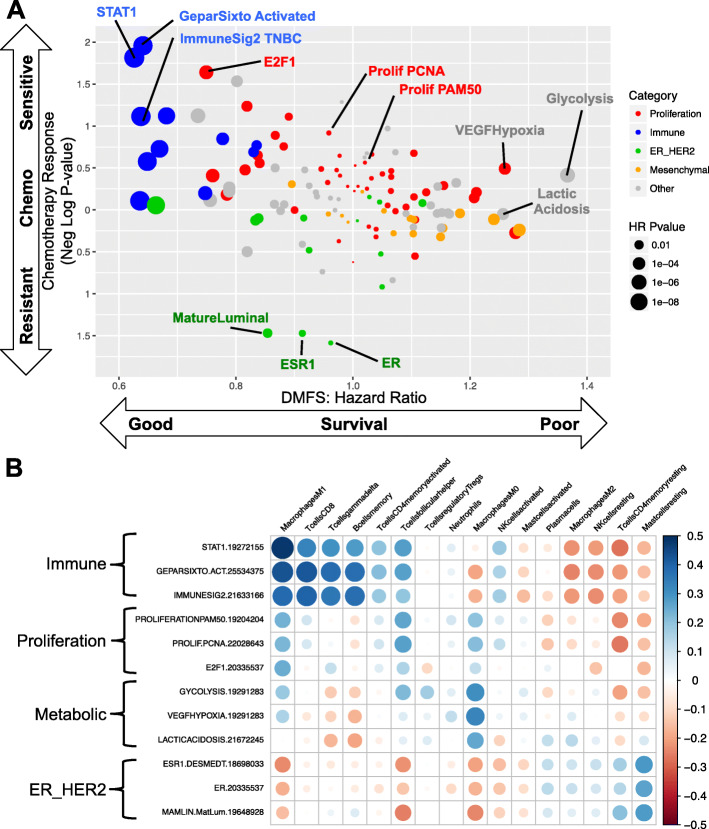
Immune and Expression Signatures and Response to Neoadjuvant Chemotherapy and Survival in TNBC. a The calculated score for 125 published gene expression signatures for 127 patients with data on response to neoadjuvant chemothrapy and distant metastasis-free survival (DMFS). Each signature is a point. The association of each signature with neoadjuvant chemotherapy response (pathologic complete response vs. RD) by simple linear regression (y-axis) and hazard ratio for each signature using DMFS (x-axis) are displayed. Signatures were grouped by phenotype (as previously described [7]), identified by color: proliferation signatures (red), immune signatures (blue), ER/HER2 signatures (green), mesenchymal signatures (orange), others (grey). Size of each point relates to the hazard ratio p-value for each signature. b The association of three representative signatures from each group (immune, proliferation, ER/HER2, mesenchymal) with the relative proportion of 22 inferred immune cell subsets via CIBERSORT across all samples with gene expression data (n = 453) are visualized using CorrPlot [26, 29].
Fig. 3
Fig. 3
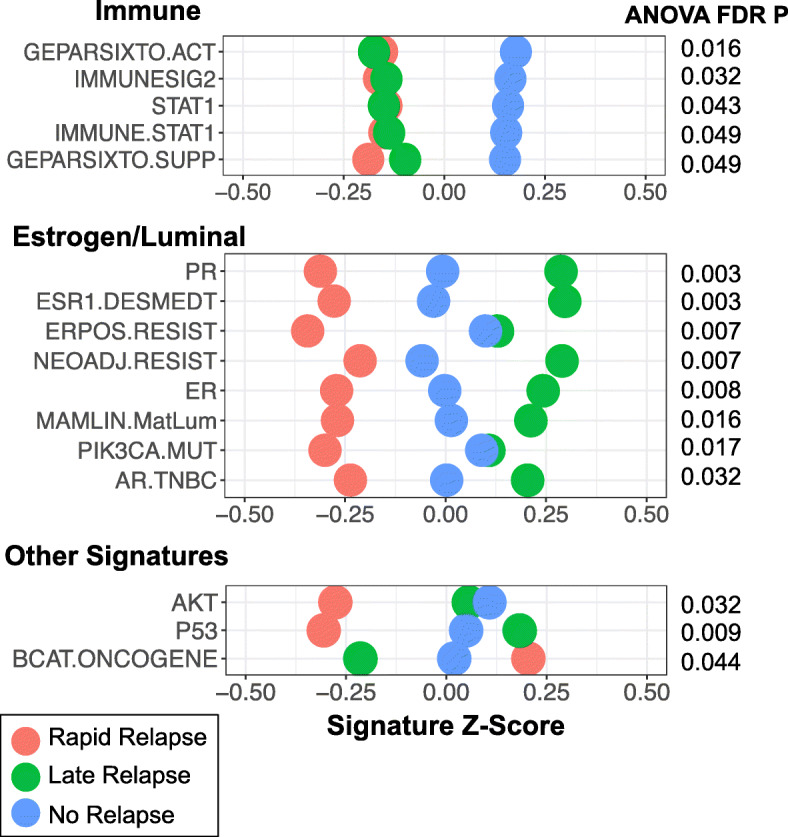
Expression Signatures in Rapid vs. Late vs. No Relapse TNBC. The calculated score for 16 published gene expression signatures that demonstrated statistical significance (ANOVA FDR p < 0.05) comparing rapid vs. late vs. no relapse. Signatures visualized as relative values (Z-score) with rapid relapse (red), late relapse (green), and no relapse (blue)
Fig. 4
Fig. 4
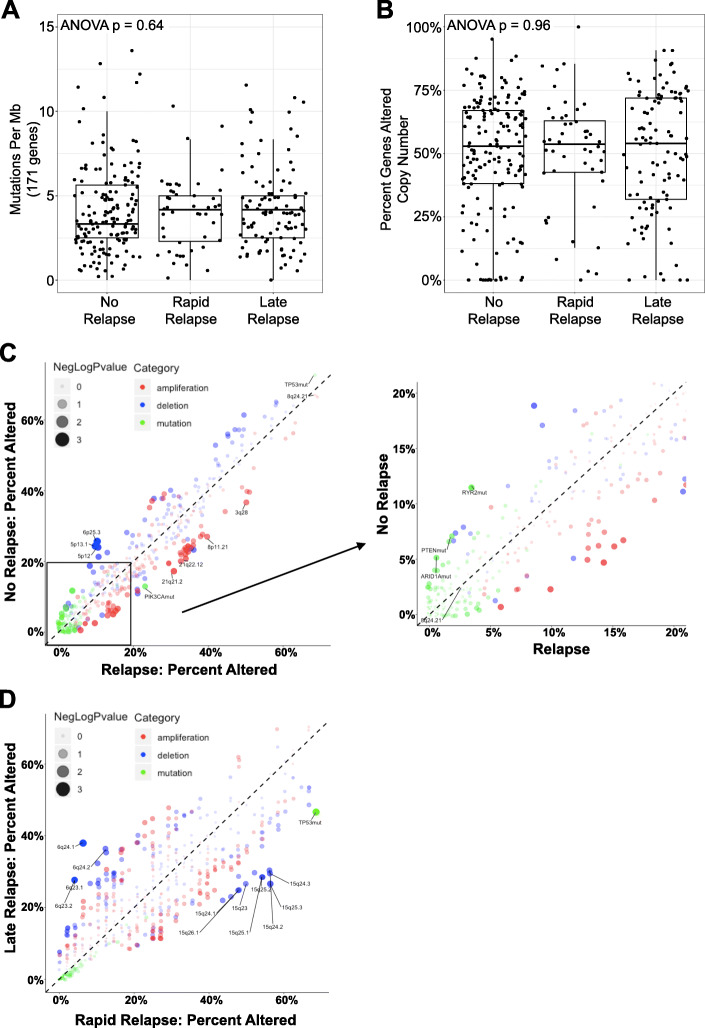
Mutations and copy number alterations in rapid vs. late vs. no relapse TNBCs. a Mutations per megabase of 171 cancer-related genes. b Percent genes altered by copy number gain (GISTIC 1 or 2) or loss (GISTIC −1 or − 2). c Frequency of alteration of 171 cancer-related genes (green dots), copy number gains (red dots) or losses (red dots) by cytoband among rapid relapse (x-axis) vs. no relapse (y-axis) TNBCs (c) or rapid relapse (x-axis) vs. late relapse (y-axis) TNBCS (d). Size of dot indicates negative log of p-value for Fisher exact test with those genes and cytobands indicated demonstrate nominal p < 0.05. Zoomed-in image of those alterations with < 20% frequency indicated in right panel
Fig. 5
Fig. 5
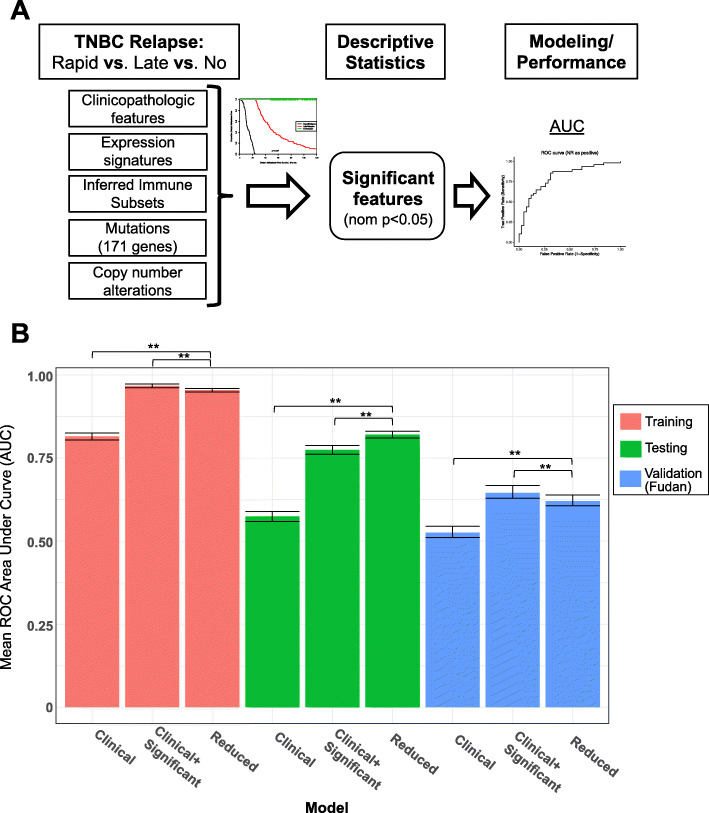
Developing an optimal clinical and multi-‘omic model of rapid vs. late relapse in TNBC. a Schematic of experimental steps including definition of variables, descriptive statistics, comparative modeling including model tuning, and assessment of model performance. b Receiver-operator characteristic (ROC) plots for each model’s performance, measured by average area under the curve (AUC) of 25 independent runs of the train-test split. Each model was tuned to ensure optimal performance. Models are grouped and colored by cohort—red indicates training data (n = 63), green indicates testing data (n = 63), and blue indicates the independent validation Fudan cohort (n = 34). For each grouping, the three models shown are: 1) “null model”, including only clinical variables; 2) “null plus significant features”, adding any feature significantly different between rrTNBC and lrTNBC with a nominal p-value < 0.05; and 3) “null plus significant features reduced”, including only features from model 2 that are among the top 25 most important genes in at least half of the independent runs. Asterisks indicate significance by Wilcoxon rank sum, * indicates p < 0.05, ** indicates p < 0.01, NS indicates “not significant” (p > 0.05)

References

    1. Bauer KR, Brown M, Cress RD, Parise CA, Caggiano V. Descriptive analysis of estrogen receptor (ER)-negative, progesterone receptor (PR)-negative, and HER2-negative invasive breast cancer, the so-called triple-negative phenotype: a population-based study from the California cancer registry. Cancer. 2007;109(9):1721–1728. doi: 10.1002/cncr.22618. - DOI - PubMed
    1. Lin NU, Claus E, Sohl J, Razzak AR, Arnaout A, Winer EP. Sites of distant recurrence and clinical outcomes in patients with metastatic triple-negative breast cancer: high incidence of central nervous system metastases. Cancer. 2008;113(10):2638–2645. doi: 10.1002/cncr.23930. - DOI - PMC - PubMed
    1. Lin NU, Vanderplas A, Hughes ME, Theriault RL, Edge SB, Wong YN, Blayney DW, Niland JC, Winer EP, Weeks JC. Clinicopathologic features, patterns of recurrence, and survival among women with triple-negative breast cancer in the national comprehensive Cancer network. Cancer. 2012;118(22):5463–5472. doi: 10.1002/cncr.27581. - DOI - PMC - PubMed
    1. Haffty BG, Yang Q, Reiss M, Kearney T, Higgins SA, Weidhaas J, Harris L, Hait W, Toppmeyer D. Locoregional relapse and distant metastasis in conservatively managed triple negative early-stage breast cancer. J Clin Oncol. 2006;24(36):5652–5657. doi: 10.1200/JCO.2006.06.5664. - DOI - PubMed
    1. Kassam F, Enright K, Dent R, Dranitsaris G, Myers J, Flynn C, Fralick M, Kumar R, Clemons M. Survival outcomes for patients with metastatic triple-negative breast cancer: implications for clinical practice and trial design. Clin Breast Cancer. 2009;9(1):29–33. doi: 10.3816/CBC.2009.n.005. - DOI - PubMed

MeSH terms

Substances