. 2021 May 18;11(1):10493.
doi: 10.1038/s41598-021-89965-z.

Pharmacokinetics of anti-infective agents during CytoSorb hemoadsorption

Affiliations

Pharmacokinetics of anti-infective agents during CytoSorb hemoadsorption

Antoine G Schneider et al. Sci Rep. .

Abstract

Cytokine hemoadsorption might be beneficial in patients with sepsis. However, its effect on anti-infective agents' disposition remains largely unknown. We sought to determine the influence of hemoadsorption on the pharmacokinetics of common anti-infective agents. This is an interventional experimental study, conducted in 24 healthy pigs. Animals were randomly allocated to either hemoadsorption (cases) or sham extracorporeal circuit (controls) and to drug combinations (3 cases and 3 controls for each combination). Hemoadsorption was performed with CytoSorb (CytoSorbents Corporation, USA). We evaluated 17 drugs (clindamycin, fluconazole, linezolid, meropenem, piperacillin, anidulafungin, ganciclovir, clarithromycin, posaconazole, teicoplanin, tobramycin, ceftriaxone, ciprofloxacin, metronidazole, liposomal amphotericin B, flucloxacillin and cefepime). Repeated blood sampling from the extracorporeal circulation (adsorber inlet/outlet, sham circuit) was performed over six hours following administration. Total clearance and adsorber-specific clearance were computed. Hemoadsorption was associated with increased clearance of all study drugs, except ganciclovir. Its impact on total body clearance was considered as moderate for fluconazole (282%) and linezolid (115%), mild for liposomal amphotericin B (75%), posaconazole (32%) and teicoplanine (31%) and negligible for all other drugs. Hemoadsorber clearance declined over time, with even delayed desorption for beta-lactams. It was moderately correlated with drug's lipophilicity (p = 0.01; r2 = 0.43). Hemoadsorption with CytoSorb appears to increase to a clinically significant extent the clearance of five among 17 tested anti-infectives. Studies in human patients are required to confirm the need for dosage adjustment of these agents.


Conflict of interest statement

JS is Senior Director Medical & Clinical of CytoSorbents Europe. AS and DKM have received speaking honorarium from CytoSorbents Europe. All other authors stated that they have no conflict of interest.

Figures
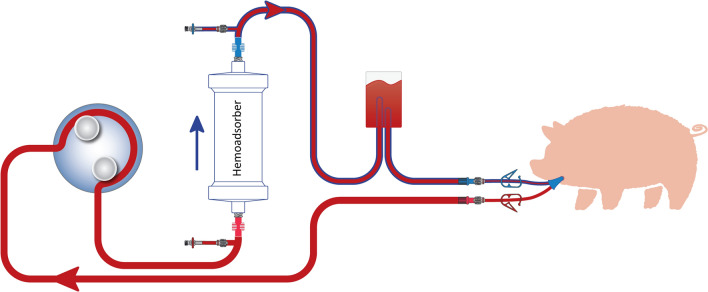
Figure 1
Figure 1
Extra-corporeal circuit. According to study protocol, 1 h following anti-infective administration, study animals were randomly allocated to either CytoSorb hemoadsorption or sham procedure on a 1:1 basis. For animals allocated to the sham procedure, a similar circuit without hemoadsorber was used.
Figure 2
Figure 2
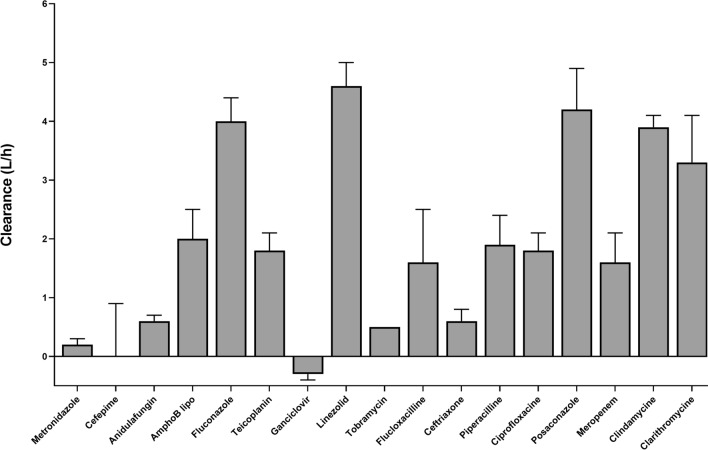
Total Adsorber Clearance. Clearance attributable to CytoSorb (mean and SD). Values were calculated based on pre and post adsorber measurements at different timepoints. AmphoB lipo: liposomal amphotericin B.
Figure 3
Figure 3
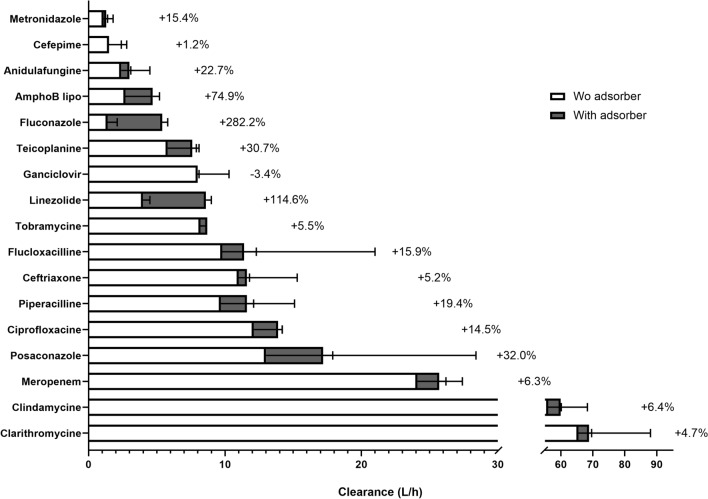
Additional clearance provided by adsorber. The white areas of the bars represent endogenous drug clearance (without adsorber) while the grey areas represent the additional clearance provided by the adsorber under the experimental conditions. Percentage refer to the relative increase in clearance associated with adsorber insertion. AmphoB lipo: liposomal amphotericin B.
Figure 4
Figure 4
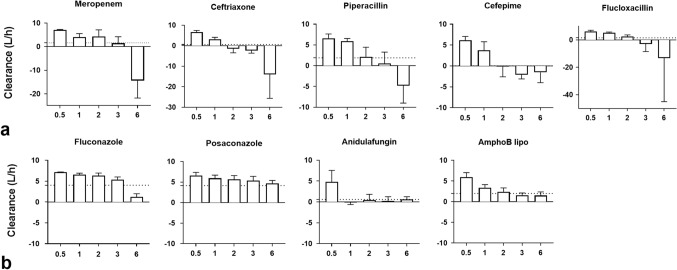
Kinetics of adsorber clearance of beta-lactams (a) and antifungals (b). Bars represent instantaneous clearance at the different study time points: 30 min (0.5 h), 1, 2 and 3 h after therapy initiation as well as the last measure obtained (6 h). Dotted lines represent total clearance (also represented in Fig. 2). Reported values are mean and standard deviation. AmphoB lipo: liposomal amphotericin B.
Figure 5
Figure 5
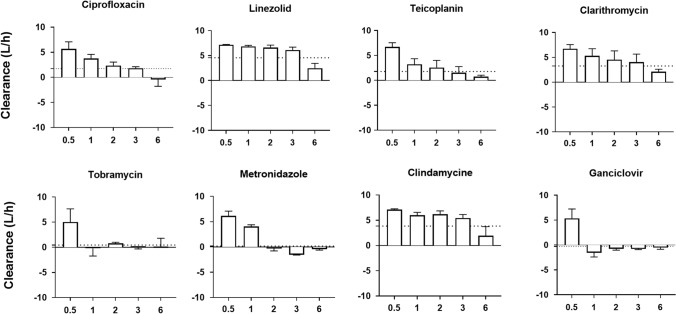
Kinetics of adsorber clearance of other anti-infective agents. Bars represent instantaneous clearance at the different study time points: 30 min (0.5 h), 1, 2 and 3 h after therapy initiation as well as the last measure obtained (6 h). Dotted lines represent total clearance (also represented in Fig. 2). Reported values are mean and standard deviation.

References

    1. Rudd KE, et al. Global, regional, and national sepsis incidence and mortality, 1990–2017: Analysis for the Global Burden of Disease Study. Lancet. 2020;395:200–211. doi: 10.1016/S0140-6736(19)32989-7. - DOI - PMC - PubMed
    1. Singer M, et al. The third international consensus definitions for sepsis and septic shock (Sepsis-3) JAMA. 2016;315:801–810. doi: 10.1001/jama.2016.0287. - DOI - PMC - PubMed
    1. Tisoncik JR, et al. Into the eye of the cytokine storm. Microbiol. Mol. Biol. Rev. 2012;76:16–32. doi: 10.1128/MMBR.05015-11. - DOI - PMC - PubMed
    1. Poli EC, Rimmele T, Schneider AG. Hemoadsorption with CytoSorb((R)) Intensive Care Med. 2018 doi: 10.1007/s00134-018-5464-6. - DOI - PubMed
    1. Rimmelé T, Kellum JA. Clinical review: Blood purification for sepsis. Crit. Care. 2011;15:205–205. doi: 10.1186/cc9411. - DOI - PMC - PubMed

Publication types

Substances

LinkOut - more resources