. 2021 May 18;11(1):10560.
doi: 10.1038/s41598-021-89892-z.

Radular force performance of stylommatophoran gastropods (Mollusca) with distinct body masses

Affiliations

Radular force performance of stylommatophoran gastropods (Mollusca) with distinct body masses

Wencke Krings et al. Sci Rep. .

Abstract

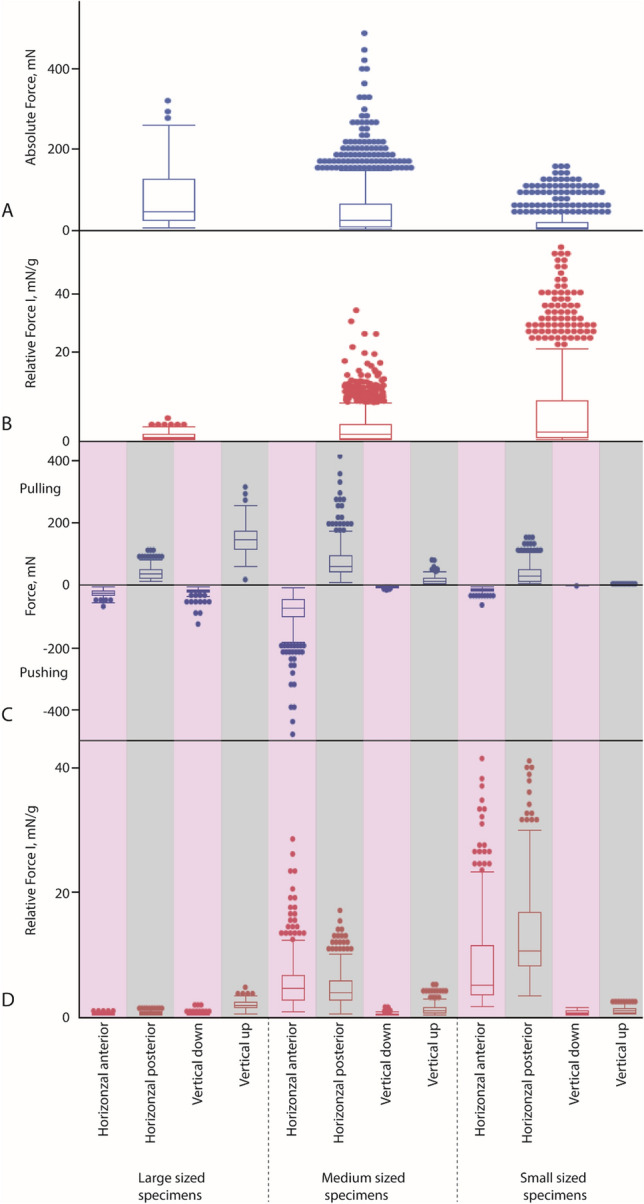
The forces exerted by the animal's food processing structures can be important parameters when studying trophic specializations to specific food spectra. Even though molluscs represent the second largest animal phylum, exhibiting an incredible biodiversity accompanied by the establishment of distinct ecological niches including the foraging on a variety of ingesta types, only few studies focused on the biomechanical performance of their feeding organs. To lay a keystone for future research in this direction, we investigated the in vivo forces exerted by the molluscan food gathering and processing structure, the radula, for five stylommatophoran species (Gastropoda). The chosen species and individuals have a similar radular morphology and motion, but as they represent different body mass classes, we were enabled to relate the forces to body mass. Radular forces were measured along two axes using force transducers which allowed us to correlate forces with the distinct phases of radular motion. A radular force quotient, AFQ = mean Absolute Force/bodymass0.67, of 4.3 could be determined which can be used further for the prediction of forces generated in Gastropoda. Additionally, some specimens were dissected and the radular musculature mass as well as the radular mass and dimensions were documented. Our results depict the positive correlation between body mass, radular musculature mass, and exerted force. Additionally, it was clearly observed that the radular motion phases, exerting the highest forces during feeding, changed with regard to the ingesta size: all smaller gastropods rather approached the food by a horizontal, sawing-like radular motion leading to the consumption of rather small food particles, whereas larger gastropods rather pulled the ingesta in vertical direction by radula and jaw resulting in the tearing of larger pieces.


Conflict of interest statement

The authors declare no competing interests.

Figures
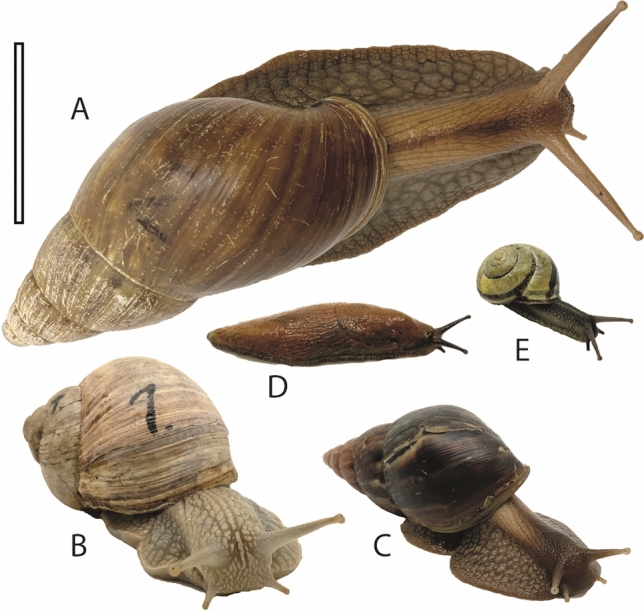
Figure 1
Figure 1
Mollusc species used in this study. (A) Mature Lissachatina fulica. (B) Helix pomatia. (C) Immature Lissachatina fulica. (D) Arion vulgaris. (E) Cepaea nemoralis. Scale bar = 4 cm.
Figure 2
Figure 2
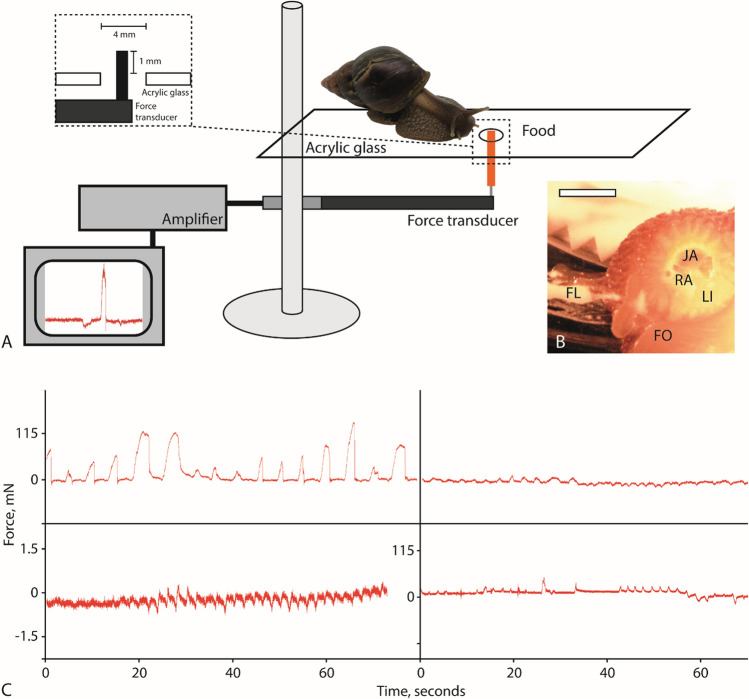
Experimental set-up (drawn with Adobe Illustrator CS 6 and modified from) and characteristic radular force measurements. (A) Gastropods were placed on an acrylic platform with a hole of 2 mm diameter. The sliced food (e.g. carrot), glued to a needle, was firmly mounted to a force transducer connected with an amplifier and computer-based data acquisition and processing system. The food was stuck through the hole, so that animals could feed on it without involving their foot. (B) Image of the mouth opening taken through the glass platform, scale bar = 1 cm. (C) Characteristic radular force measurement curves, mN, of mature Lissachatina fulica, (above) and Arion vulgaris (below); left side: vertical direction (positive peaks = pulling up, negative peaks = pushing down), right side: horizontal direction (positive peaks = posterior direction, negative peaks = anterior direction). JA = jaw, FL = flour, FO = foot, LI = lip, RA = radula.
Figure 3
Figure 3
Absolute Force (blue boxplots) and Relative Force I (red boxplots) for distinct body mass classes (large-, medium-, and small-sized gastropods). (A) Absolute Force (regardless of the direction of measurement). (B) Relative Force I (regardless of the direction of measurement). (C) Absolute Force sorted to directions) (D) Relative Force I sorted to directions. Pink = pushing of radula, grey = pulling of radula.
Figure 4
Figure 4
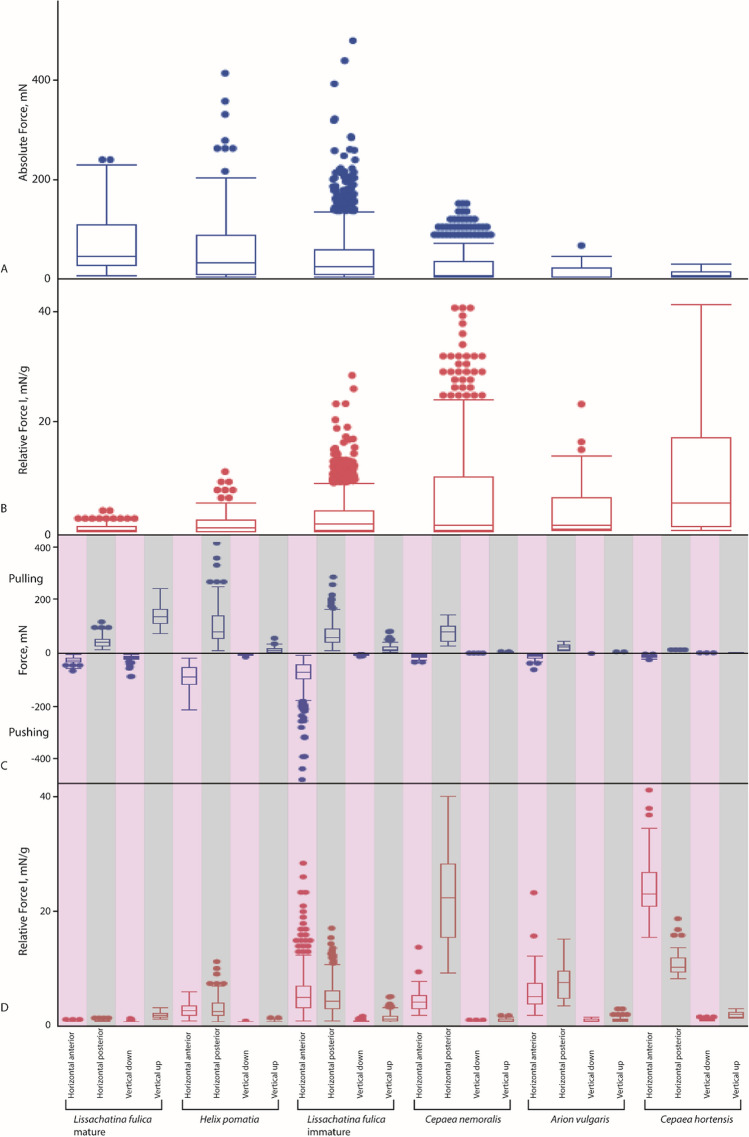
Absolute Force (blue boxplots) and Relative Force I (red boxplots) for distinct cohorts. (A) Absolute Force (regardless of the direction of measurement). (B) Relative Force I (regardless of the direction of measurement). (C) Absolute Force sorted to directions. (D) Relative Force I sorted to directions. For values of C and D see Supplementary Table 2. Pink = pushing of radula, grey = pulling of radula.
Figure 5
Figure 5
Linear regression, displayed on logarithmic axes, with trend lines (black = real trend line; red = calculated trend line for the factors 4.25 and 4.35), regardless of the direction. (A) Mean Absolute Force versus mean whole body mass. A radular force quotient, AFQ = mean Absolute Force/Bodymass0.67, of 4.25 was determined. (B) Mean Relative Force I versus mean whole body mass. A Relative Force Quotient, RFQ = mean Relative Force I/Bodymass−0.33, of 4.35 was determined. (C) Variance of Absolute Force versus mean whole body mass. (D) Variance of Relative Force I versus mean whole body mass. For C and D a force quotient of 3.00 was determined.
Figure 6
Figure 6
Linear regression, displayed on logarithmic axes, with trend lines (black = real trend line; red = calculated trend line for the factors 4.25 and 4.35), for each direction (AB: horizontal anterior, CD: horizontal posterior, EF: vertical down, GH: vertical up). Left side (A, C, E, G). Variance of Absolute Force versus mean whole body mass. Right side (B, D, F, H). Variance of Relative Force I versus mean whole body mass.

References

    1. Kiltie R. Bite force as a basis for niche differentiation between rain forest peccaries (Tayassu tajacu and T. pecari) Biotropica. 1982;14(3):188–195. doi: 10.2307/2388025. - DOI
    1. Anderson PSL. Making a point: Shared mechanics underlying the diversity of biological puncture. J. Exp. Biol. 2018;221:jeb187294. doi: 10.1242/jeb.187294. - DOI - PubMed
    1. Lappin AK, Jones MHE. Reliable quantification of bite-force performance requires use of appropriate biting substrate and standardization of bite out-lever. J. Exp. Biol. 2014;217:4303–4312. doi: 10.1242/jeb.106385. - DOI - PubMed
    1. Aguirre LF, Herrel A, van Damme R, Matthysen E. Ecomorphological analysis of trophic niche partitioning in a tropical savannah bat community. Proc. R. Soc. B. 2002;269(1497):1271–1278. doi: 10.1098/rspb.2002.2011. - DOI - PMC - PubMed
    1. Wroe S, McHenry C, Thomason J. Bite club: comparative bite force in big biting mammals and the prediction of predatory behaviour in fossil taxa. Proc. R. Soc. B. 2005;272(1563):619–625. doi: 10.1098/rspb.2004.2986. - DOI - PMC - PubMed

Publication types

LinkOut - more resources