. 2021 Jul;22(1):722.
doi: 10.3892/etm.2021.10154. Epub 2021 May 3.

Prognostic value of MTA1, SOX4 and EZH2 expression in esophageal squamous cell carcinoma

Affiliations

Prognostic value of MTA1, SOX4 and EZH2 expression in esophageal squamous cell carcinoma

Wenying Liu et al. Exp Ther Med. 2021 Jul.

Abstract

Esophageal cancer has always been one of the major malignant tumor types affecting the health of the Chinese population. Metastasis-associated protein 1 (MTA1), SOX4 and enhancer of zeste homolog 2 (EZH2) are all potent inducers of invasion and metastasis in esophageal squamous cell carcinoma (ESCC). However, the role of these signaling molecules and their implication in ESCC have remained largely elusive. In the present study, the effects of MTA1, SOX4 and EZH2 on the prognosis of patients with ESCC were explored. Immunohistochemistry was used to examine the expression levels of MTA1, SOX4 and EZH2. The χ2 test was used to analyze the association between protein expression and clinicopathological parameters. Kaplan-Meier curves and Cox proportional hazards model survival analysis was performed to investigate the effects of the three proteins examined on disease prognosis. The results indicated that MTA1 may be used as a prognostic and diagnostic marker for ESCC. To the best of our knowledge, the present study was the first to demonstrate that MTA1-SOX4 signaling is associated with prognosis in ESCC. However, no significant association was noted between SOX4 and EZH2 in the present study, which was inconsistent with previously reported findings. The function of the MTA1-SOX4-EZH2 axis and the interactions of the proteins involved require further investigation.

Keywords: SOX4; enhancer of zeste homolog 2; esophageal squamous cell carcinoma; immunohistochemistry; metastasis-associated protein 1; prognosis.


Conflict of interest statement

The authors declare that they have no competing interests.

Figures
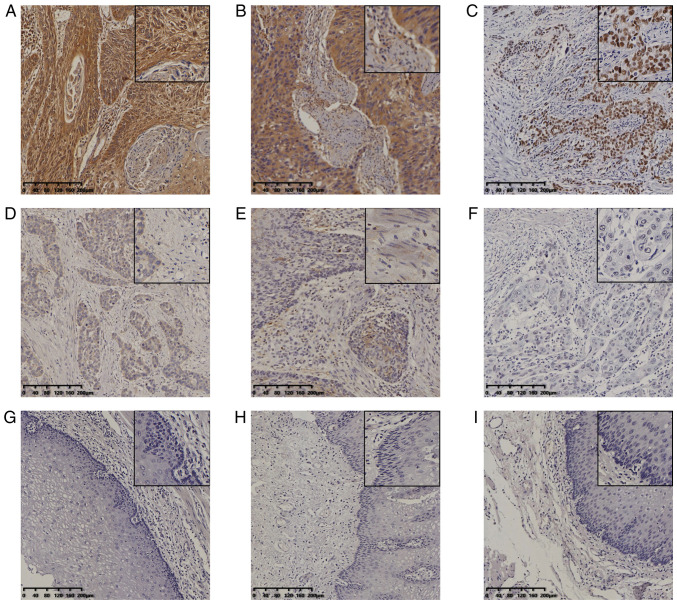
Figure 1
Figure 1
Expression of MTA1, SOX4 and EZH2 in ESCC and normal esophageal tissues. Immunohistochemical staining of ESCC for (A) MTA1 (positive), (B) SOX4 (positive), (C) EZH2 (positive), (D) SOX4 (negative), (E) SOX4 (negative) and (F) EZH2 (negative). Staining of normal esophageal tissues for (G and H) SOX4 (negative) and (I) EZH2 (negative) (magnification, x100 or x400 in magnified window; scale bar, 200 µm). ESCC, esophageal squamous cell carcinoma; MTA1, metastasis-associated protein 1; EZH2, enhancer of zeste homolog 2.
Figure 2
Figure 2
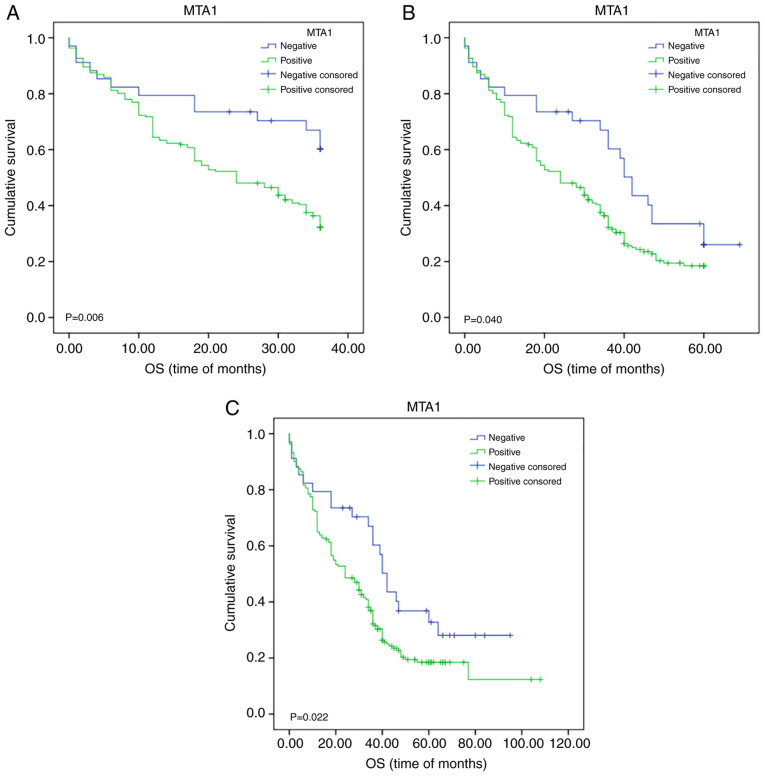
Kaplan-Meier survival analysis for patients with ESCC. (A) OS over three years; patients with ESCC and MTA1-positive status had poor OS. (B) OS over five years; patients with ESCC and MTA1-positive status had poor OS. (C) OS at the follow-up date; high expression of MTA1 in ESCC was associated with poor OS. OS, overall survival; ESCC, esophageal squamous cell carcinoma; MTA1, metastasis-associated protein 1.
Figure 3
Figure 3
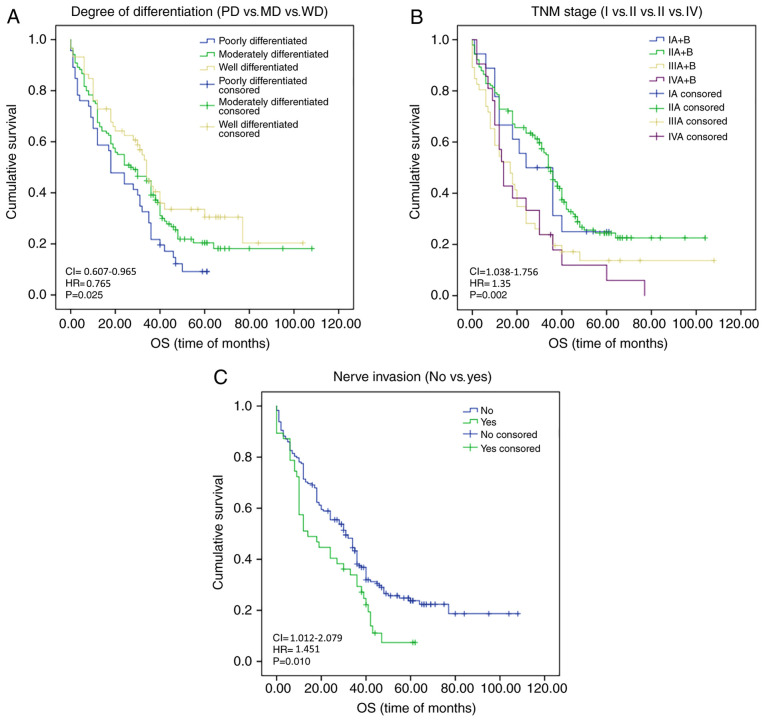
Kaplan-Meier survival analysis for OS (months). (A) Effect of degree of differentiation on OS in patients with ESCC. (B) Effect of TNM stage on OS in patients with ESCC. (C) Effect of nerve invasion status on OS in patients with ESCC. OS, overall survival; ESCC, esophageal squamous cell carcinoma; PD, poorly differentiated; MD, moderately differentiated; WD, well differentiated; HR, hazard ratio.

References

    1. Lin DC, Hao JJ, Nagata Y, Xu L, Shang L, Meng X, Sato Y, Okuno Y, Varela AM, Ding LW, et al. Genomic and molecular characterization of esophageal squamous cell carcinoma. Nat Genet. 2014;46:467–473. doi: 10.1038/ng.2935. - DOI - PMC - PubMed
    1. Jain R, Gupta S, Pasricha N, Faujdar M, Sharma M, Mishra P. ESCC with metastasis in the young age of caustic ingestion of shortest duration. J Gastrointest Cancer. 2010;41:93–95. doi: 10.1007/s12029-009-9121-8. - DOI - PubMed
    1. Liu Q, Liang M, Liu T, Vuitton L, Zheng S, Gao X, Lu M, Li X, Sheyhidin I, Lu X. M2 isoform of pyruvate kinase (PKM2) is upregulated in Kazakh's ESCC and promotes proliferation and migration of ESCC cells. Tumour Biol. 2016;37:2665–2672. doi: 10.1007/s13277-015-4073-z. - DOI - PubMed
    1. Encinas de la Iglesia J, Corral de la Calle MA, Fernandez Perez GC, Ruano Perez R, Alvarez Delgado A. Esophageal cancer: Anatomic particularities, staging, and imaging techniques. Radiologia. 2016;58:352–365. doi: 10.1016/j.rx.2016.06.004. - DOI - PubMed
    1. Liu B, Bo Y, Wang K, Liu Y, Tang X, Zhao Y, Zhao E, Yuan L. Concurrent neoadjuvant chemoradiotherapy could improve survival outcomes for patients with esophageal cancer: A meta-analysis based on random clinical trials. Oncotarget. 2017;8:20410–20417. doi: 10.18632/oncotarget.14669. - DOI - PMC - PubMed