Review
. 2021 Apr 29:2021:5529256.
doi: 10.1155/2021/5529256. eCollection 2021.

The Controversial Role of Glucose-6-Phosphate Dehydrogenase Deficiency on Cardiovascular Disease: A Narrative Review

Affiliations
Review

The Controversial Role of Glucose-6-Phosphate Dehydrogenase Deficiency on Cardiovascular Disease: A Narrative Review

Maria Pina Dore et al. Oxid Med Cell Longev. .

Abstract

Cardiovascular disorders (CVD) are highly prevalent and the leading cause of death worldwide. Atherosclerosis is responsible for most cases of CVD. The plaque formation and subsequent thrombosis in atherosclerosis constitute an ongoing process that is influenced by numerous risk factors such as hypertension, diabetes, dyslipidemia, obesity, smoking, inflammation, and sedentary lifestyle. Among the various risk and protective factors, the role of glucose-6-phosphate dehydrogenase (G6PD) deficiency, the most common inborn enzyme disorder across populations, is still debated. For decades, it has been considered a protective factor against the development of CVD. However, in the recent years, growing scientific evidence has suggested that this inherited condition may act as a CVD risk factor. The role of G6PD deficiency in the atherogenic process has been investigated using in vitro or ex vivo cellular models, animal models, and epidemiological studies in human cohorts of variable size and across different ethnic groups, with conflicting results. In this review, the impact of G6PD deficiency on CVD was critically reconsidered, taking into account the most recent acquisitions on molecular and biochemical mechanisms, namely, antioxidative mechanisms, glutathione recycling, and nitric oxide production, as well as their mutual interactions, which may be impaired by the enzyme defect in the context of the pentose phosphate pathway. Overall, current evidence supports the notion that G6PD downregulation may favor the onset and evolution of atheroma in subjects at risk of CVD. Given the relatively high frequency of this enzyme deficiency in several regions of the world, this finding might be of practical importance to tailor surveillance guidelines and facilitate risk stratification.


Conflict of interest statement

The authors declare that they have no conflicts of interest.

Figures
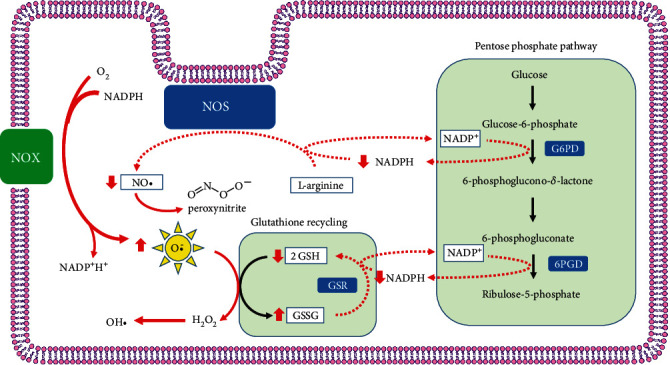
Figure 1
Figure 1
Pentose phosphate pathway (PPP) and glucose 6-phosphate dehydrogenase (G6PD) in nucleated cells. The NADPH provides reducing equivalents for antioxidant defense and reductive biosynthesis and NADPH oxidase for generation of superoxide anions. The G6PD is required to maintain a normal NADPH/NADP ratio which in turn regulates the glutathione (γ-L-glutamyl-L-cysteinylglycine, GSH) biosynthesis. The GSH is a sulfhydryl-containing compound present in all mammalian cells. The redox-active thiol group in GSH is essential in the regulation of disulfide bonds of proteins and to detoxify oxidant compounds. The function of GSH as an antioxidant is efficient when the free thiol is maintained. This is accomplished by the reaction catalyzed by the NADPH-dependent glutathione-disulfide reductase (GSR) that reduces glutathione disulfide (GSSG) into the form with a free thiol (GSH). In G6PD deficiency, the decreased supply of NADPH limits the GSH regeneration and in turn the disposal of oxidants. The NADPH produced in the PPP is also a substrate for nitric oxide synthase (NOS) for the release of nitric oxide (NO) and for NADPH oxidase for the release of superoxide anion. In G6PD deficiency, NO depletion leads to the decreased neutralization of superoxide anion and other free radicals.
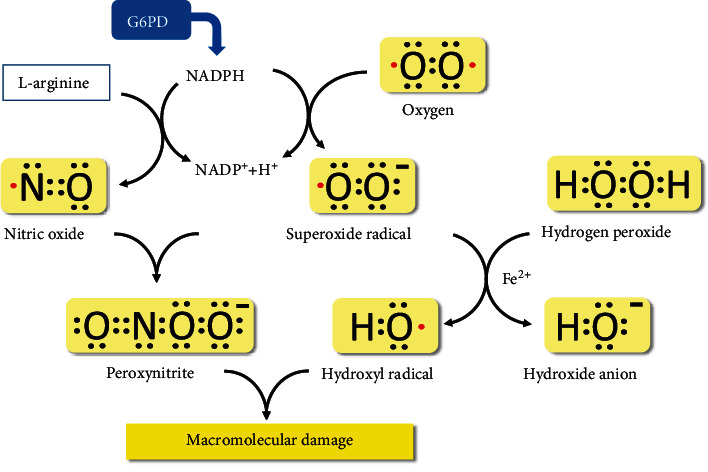
Figure 2
Figure 2
Indirect production of prooxidant and antioxidant molecules by the pathway catalyzed by G6PD. The NADPH produced in the reaction catalyzed by G6PD contributes to the formation of both free radicals and antioxidant molecules; hence, the net effect on the cellular redox balance depends on its concentration in vivo. Under normal conditions, and in the presence of oxygen, NADPH generates the anion radical superoxide, which in turn reacts with hydrogen peroxide to form the hydroxyl radical. At the same time, NADPH feeds the NOS reaction to form NO which at low concentrations has an antioxidant action and contributes to the scavenging of the superoxide radical. It can be hypothesized that in the case of G6PD deficiency, the superoxide scavenging by NO is significantly abated which results in increased oxidative stress and damage to a variety of macromolecules.
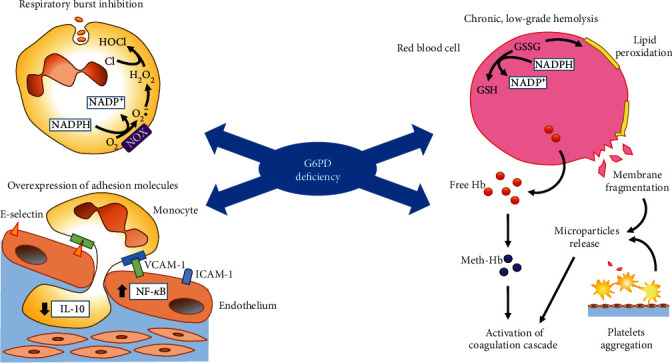
Figure 3
Figure 3
Main mechanisms underlying vascular damage in G6PD deficiency. G6PD deficiency may act as a cardiovascular risk factor by activating a number of mechanisms that involve numerous cell types and tissues, such as triggering an inflammatory response in monocytes/macrophages and endothelial cells, causing hemolysis in red blood cells with the release of membrane fragments and free hemoglobin that activate the coagulation cascade and platelets aggregation.

References

    1. Ross R. Atherosclerosis — An inflammatory disease. The New England Journal of Medicine. 1999;340(2):115–126. doi: 10.1056/NEJM199901143400207. - DOI - PubMed
    1. GBD 2013 Mortality and Causes of Death Collaborators. Global, regional, and national age-sex specific all-cause and cause-specific mortality for 240 causes of death, 1990-2013: a systematic analysis for the Global Burden of Disease Study 2013. The Lancet. 2015;385:117–171. doi: 10.1016/S0140-6736(14)61682-2. - DOI - PMC - PubMed
    1. Benjamin E. J., Muntner P., Alonso A., et al. Heart disease and stroke statistics-2019 update: a report from the American Heart Association. Circulation. 2019;139(10):e56–e528. doi: 10.1161/CIR.0000000000000659. - DOI - PubMed
    1. Bentzon J. F., Otsuka F., Virmani R., Falk E. Mechanisms of plaque formation and rupture. Circulation Research. 2014;114(12):1852–1866. doi: 10.1161/CIRCRESAHA.114.302721. - DOI - PubMed
    1. Emini Veseli B., Perrotta P., de Meyer G. R. A., et al. Animal models of atherosclerosis. European Journal of Pharmacology. 2017;816:3–13. doi: 10.1016/j.ejphar.2017.05.010. - DOI - PubMed

MeSH terms