. 2021 Aug 1;6(8):880-888.
doi: 10.1001/jamacardio.2021.0487.

Association of Socioeconomic Disadvantage With Long-term Mortality After Myocardial Infarction: The Mass General Brigham YOUNG-MI Registry

Affiliations

Association of Socioeconomic Disadvantage With Long-term Mortality After Myocardial Infarction: The Mass General Brigham YOUNG-MI Registry

Adam N Berman et al. JAMA Cardiol. .

Abstract

Importance: Socioeconomic disadvantage is associated with poor health outcomes. However, whether socioeconomic factors are associated with post-myocardial infarction (MI) outcomes in younger patient populations is unknown.

Objective: To evaluate the association of neighborhood-level socioeconomic disadvantage with long-term outcomes among patients who experienced an MI at a young age.

Design, setting, and participants: This cohort study analyzed patients in the Mass General Brigham YOUNG-MI Registry (at Brigham and Women's Hospital and Massachusetts General Hospital in Boston, Massachusetts) who experienced an MI at or before 50 years of age between January 1, 2000, and April 30, 2016. Each patient's home address was mapped to the Area Deprivation Index (ADI) to capture higher rates of socioeconomic disadvantage. The median follow-up duration was 11.3 years. The dates of analysis were May 1, 2020, to June 30, 2020.

Exposures: Patients were assigned an ADI ranking according to their home address and then stratified into 3 groups (least disadvantaged group, middle group, and most disadvantaged group).

Main outcomes and measures: The outcomes of interest were all-cause and cardiovascular mortality. Cause of death was adjudicated from national registries and electronic medical records. Cox proportional hazards regression modeling was used to evaluate the association of ADI with all-cause and cardiovascular mortality.

Results: The cohort consisted of 2097 patients, of whom 2002 (95.5%) with an ADI ranking were included (median [interquartile range] age, 45 [42-48] years; 1607 male individuals [80.3%]). Patients in the most disadvantaged neighborhoods were more likely to be Black or Hispanic, have public insurance or no insurance, and have higher rates of traditional cardiovascular risk factors such as hypertension and diabetes. Among the 1964 patients who survived to hospital discharge, 74 (13.6%) in the most disadvantaged group compared with 88 (12.6%) in the middle group and 41 (5.7%) in the least disadvantaged group died. Even after adjusting for a comprehensive set of clinical covariates, higher neighborhood disadvantage was associated with a 32% higher all-cause mortality (hazard ratio, 1.32; 95% CI, 1.10-1.60; P = .004) and a 57% higher cardiovascular mortality (hazard ratio, 1.57; 95% CI, 1.17-2.10; P = .003).

Conclusions and relevance: This study found that, among patients who experienced an MI at or before age 50 years, socioeconomic disadvantage was associated with higher all-cause and cardiovascular mortality even after adjusting for clinical comorbidities. These findings suggest that neighborhood and socioeconomic factors have an important role in long-term post-MI survival.


Conflict of interest statement

Conflict of Interest Disclosures: Dr Berman reported receiving a grant from the National Heart, Lung, and Blood Institute (NHLBI) during the conduct of the study. Dr Wadhera reported receiving a grant from the NHLBI outside the submitted work. Dr Divakaran reported receiving a KL2/Catalyst Medical Research Investigator Training award from Harvard Catalyst and a grant from the Boston Claude D. Pepper Older Americans Independence Center outside the submitted work. Dr Plutzky reported receiving grants from Boehringer Ingelheim and personal fees from Alnylam, Amgen, Esperion, Genfit, Novo Nordisk, Sanofi, and Vivus outside the submitted work. Dr Nasir reported serving on the advisory boards of Amgen, Novartis, and The Medicines Company and receiving partial support for his research from the Jerold B. Katz Academy of Translational Research. Dr Di Carli reported receiving grants from Gilead Sciences and Spectrum Dynamics as well as personal fees from Bayer and Janssen outside the submitted work. Dr Bhatt discloses the following relationships: advisory board: Cardax, CellProthera, Cereno Scientific, Elsevier Practice Update Cardiology, Level Ex, Medscape Cardiology, PhaseBio, PLx Pharma, Regado Biosciences; board of directors: Boston VA Research Institute, Society of Cardiovascular Patient Care, TobeSoft; chair: American Heart Association Quality Oversight Committee, NCDR-ACTION Registry Steering Committee, VA CART Research and Publications Committee; data monitoring committees: Baim Institute for Clinical Research, Cleveland Clinic, Contego Medical, Duke Clinical Research Institute, Mayo Clinic, Mount Sinai School of Medicine, Population Health Research Institute; honoraria: American College of Cardiology, Baim Institute for Clinical Research, Belvoir Publications, Duke Clinical Research Institute, HMP Global, Journal of the American College of Cardiology, K2P, Level Ex, Medtelligence/ReachMD, MJH Life Sciences, Population Health Research Institute, Slack Publications, Society of Cardiovascular Patient Care, WebMD; deputy editorship: Clinical Cardiology; research funding: Abbott, Afimmune, Amarin, Amgen, AstraZeneca, Bayer, Boehringer Ingelheim, Bristol Myers Squibb, Cardax, Chiesi, CSL Behring, Eisai, Ethicon, Ferring Pharmaceuticals, Forest Laboratories, Fractyl, Idorsia, Ironwood, Ischemix, Lexicon, Lilly, Medtronic, Pfizer, PhaseBio, PLx Pharma, Regeneron, Roche, Sanofi Aventis, Synaptic, The Medicines Company; royalties: Elsevier; site coinvestigator: Biotronik, Boston Scientific, CSI, St Jude Medical, Svelte; trustee: American College of Cardiology; unfunded research: FlowCo, Merck, Novo Nordisk, Takeda. No other disclosures were reported.

Figures

Figure 1.
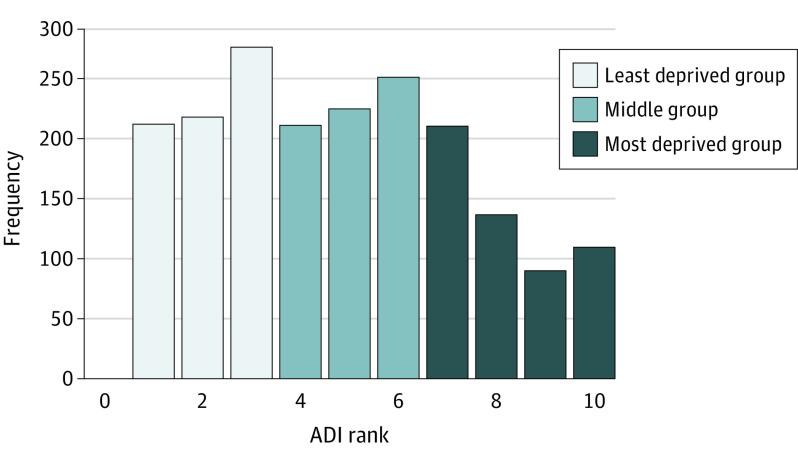
Figure 1.. Distribution of the Cohort’s Neighborhood Deprivation by Rank of Area Deprivation Index (ADI)
ADI ranks 1 to 3 were grouped into the least disadvantaged group, 4 to 6 into the middle group, and 7 to 10 into the most disadvantaged group.
Figure 2.
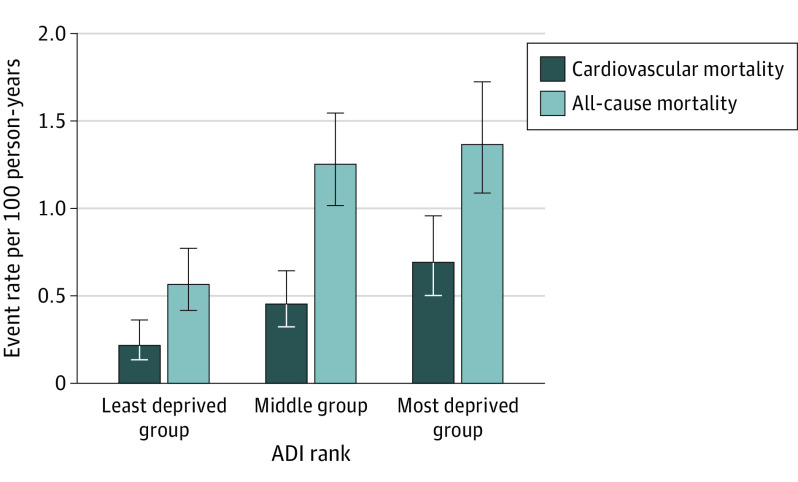
Figure 2.. All-Cause and Cardiovascular Mortality Rates per 100 Person-Years by Grouping of Neighborhood Disadvantage After Myocardial Infarction
The all-cause mortality rate was 1.37 deaths per 100 person-years in the most disadvantaged group, 1.26 deaths per 100 person-years in the middle group, and 0.57 deaths per 100 person-years in the least disadvantaged group. The cardiovascular mortality rate was 0.70 deaths per 100 person-years in the most disadvantaged group, 0.46 deaths per 100 person-years in the middle group, and 0.22 deaths per 100 person-years in the least disadvantaged group. ADI indicates area deprivation index.
Figure 3.
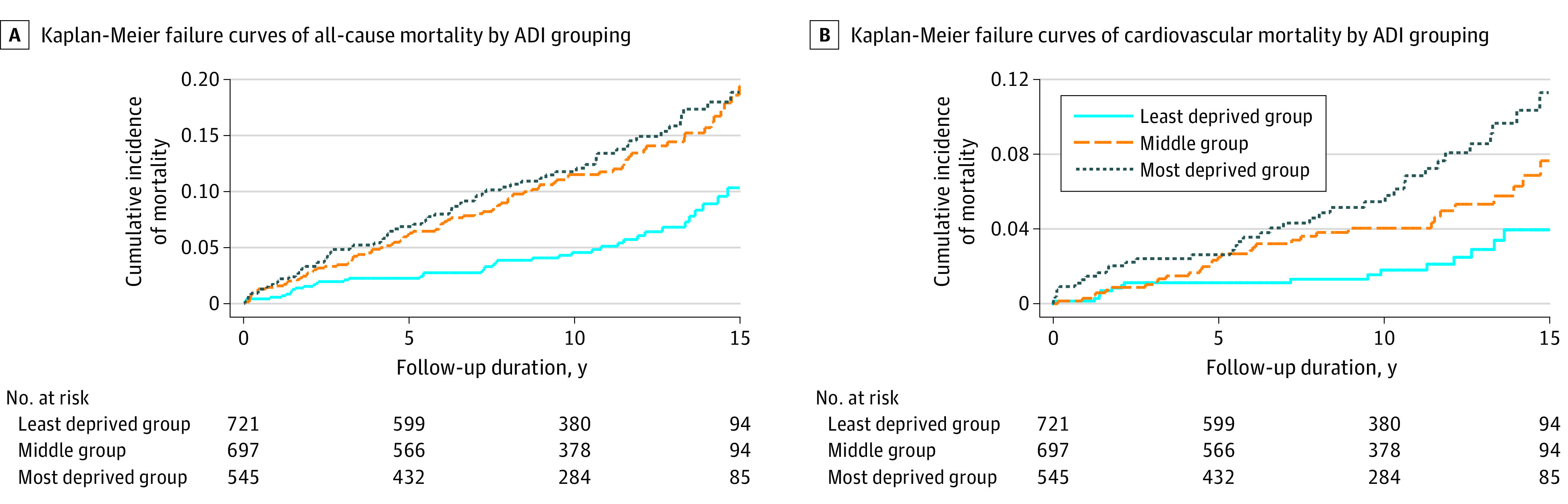
Figure 3.. Kaplan-Meier Failure Curves of All-Cause and Cardiovascular Mortality Rates by Grouping of Neighborhood Disadvantage After Myocardial Infarction
Multivariable models were adjusted for the following covariates: age, sex, race, medical insurance, creatinine level, risk factors (diabetes, hypertension, and dyslipidemia status; tobacco smoking; and marijuana, cocaine, and alcohol use), cardiac catheterization, statin at discharge, and aspirin at discharge. ADI indicates area deprivation index.

Comment in

References

    1. Shah NS, Lloyd-Jones DM, O’Flaherty M, et al. Trends in cardiometabolic mortality in the United States, 1999-2017. JAMA. 2019;322(8):780-782. doi: 10.1001/jama.2019.9161 - DOI - PMC - PubMed
    1. Sidney S, Quesenberry CP Jr, Jaffe MG, et al. Recent trends in cardiovascular mortality in the United States and public health goals. JAMA Cardiol. 2016;1(5):594-599. doi: 10.1001/jamacardio.2016.1326 - DOI - PubMed
    1. Pahigiannis K, Thompson-Paul AM, Barfield W, et al. Progress toward improved cardiovascular health in the United States. Circulation. 2019;139(16):1957-1973. doi: 10.1161/CIRCULATIONAHA.118.035408 - DOI - PMC - PubMed
    1. Diez Roux AV, Merkin SS, Arnett D, et al. Neighborhood of residence and incidence of coronary heart disease. N Engl J Med. 2001;345(2):99-106. doi: 10.1056/NEJM200107123450205 - DOI - PubMed
    1. Ludwig J, Sanbonmatsu L, Gennetian L, et al. Neighborhoods, obesity, and diabetes—a randomized social experiment. N Engl J Med. 2011;365(16):1509-1519. doi: 10.1056/NEJMsa1103216 - DOI - PMC - PubMed

MeSH terms