Review
. 2022 Apr;37(4):735-744.
doi: 10.1007/s00467-021-05113-9. Epub 2021 May 19.

Hyaluronan, a double-edged sword in kidney diseases

Affiliations
Review

Hyaluronan, a double-edged sword in kidney diseases

Aditya Kaul et al. Pediatr Nephrol. 2022 Apr.

Abstract

Over the years, hyaluronic acid (HA) has emerged as an important molecule in nephrological and urological studies involving extracellular matrix (ECM) organization, inflammation, tissue regeneration, and viral sensing. During this time, many have noted the perplexing double-edged nature of the molecule, at times promoting pro-fibrotic events and at other times promoting anti-fibrotic events. Different molecular weights of HA can be attributed to these disparities, though most studies have yet to focus on this subtlety. With regard to the kidney, HA is induced in the initial response phase of injury and is subsequently decreased during disease progression of AKI, CKD, and diabetic nephropathy. These and other kidney diseases force patients, particularly pediatric patients, to face dialysis, surgical procedures, and ultimately, transplant. To summarize the current literature for researchers and pediatric nephrologists, this review aims to expound HA and elucidate its paradoxical effects in multiple kidney diseases using studies that emphasize HA molecular weight when available.

Keywords: Acute kidney injury (AKI); Chronic kidney disease (CKD); Diabetic nephropathy; Hyaluronic acid (HA); IgA nephropathy; Kidney cancer; Kidney fibrosis; Obstructive uropathy; Vesicoureteral reflux (VUR).


Conflict of interest statement

The authors declare no competing interests.

Figures
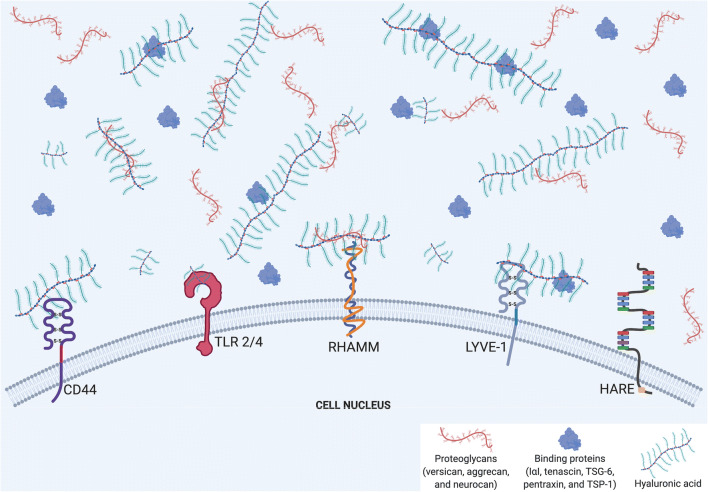
Fig. 1
Fig. 1
Schematic illustration of the interactions of extracellular hyaluronan (HA) and its receptors and binding proteins. This figure illustrates the common binding mechanisms for extracellular HA. The major HA receptors include CD44 and its homolog, LYVE-1, in addition to TLR 2/4, RHAMM, and HARE. These receptors are present at the cell surface, with extracellular HA binding with or without binding proteins (specified in the legend). The fact that HA and its binding proteins are located outside the cell indicates that HA is a major component of pericellular coats. The interaction between HA and its receptors can be preferential, as LMW-HA tends to bind TLRs 2/4, although some, like CD44, bind both LMW- and HMW-HA. The depiction of different sizes of HA corresponds to LMW and HMW variants, which are responsible for the dichotomous pro-inflammatory/pro-fibrotic effects to anti-inflammatory/anti-fibrotic effects, respectively. In addition, crosslinks between HA and various binding proteins, including proteoglycans and other hyaladherins, modifies HA’s effects. This schematic is a broad illustration and is not drawn to scale. Moreover, that five receptors are shown on one cell surface is for illustrative purposes only. Created with BioRender.com
Fig. 2
Fig. 2
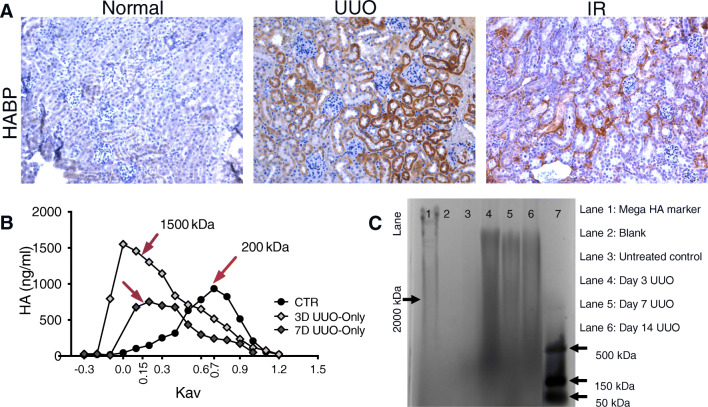
HA expression and molecular weight changes in normal and diseased mouse kidneys. A. Images of HA binding protein (HABP) staining of the cortex from control, 7-day UUO kidney and 7-day IR kidney show increased HA accumulation after UUO injury. Scale bars 50 μm. B. Plots of total incorporated [3H] in labeled HA samples were used to determine the relative MW of HA synthesized by control and 3D UUO kidneys (n ≥ 3 per condition) using Sephacryl S-1000 chromatography. Data were plotted as HA concentration versus the partition coefficient (Kav), showing an increase in HA size distribution in samples with UUO injury. C. The extracted HA from control and 3-, 7-, and 14-day untreated and treated UUO kidneys is shown on a 0.5% agarose gel electrophoresis, supporting the chromatography results
Fig. 3
Fig. 3
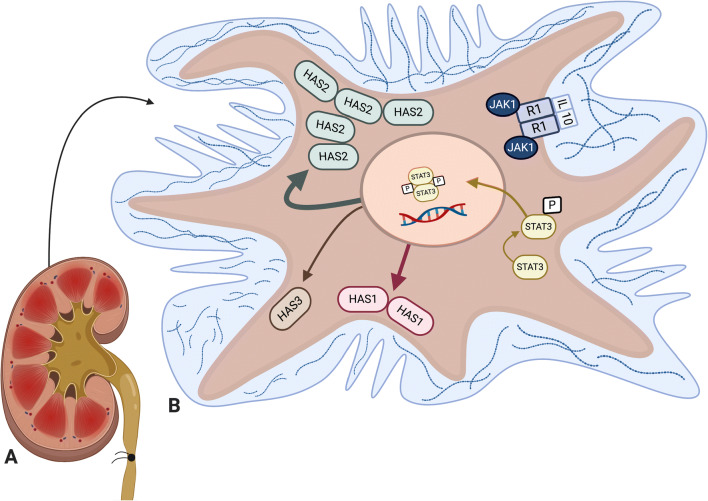
IL-10 stimulation of renal fibroblasts induces HMW-HA production via STAT3 pathway. This figure is adapted from our recent publication [22]. It illustrates how IL-10 stimulates renal fibroblasts, activates the STAT3 pathway, and upregulates HA synthesis, especially HMW-HA synthesized by HAS2 which ultimately results in cytoprotection and less fibrosis. Our data demonstrate reduced fibrosis and better-preserved tubules. A. Kidney with UUO treated with IL-10. B. Fibroblast from renal cortex with HA MW variants in ECM. This schematic is a broad illustration and is not drawn to scale. Created with BioRender.com

References

    1. Tecklenborg J, Clayton D, Siebert S, Coley SM. The role of the immune system in kidney disease. Clin Exp Immunol. 2018;192:142–150. - PMC - PubMed
    1. (2013) Introduction to Volume One: 2012 USRDS Annual Data Report Atlas of Chronic Kidney Disease in the United States. Am J Kidney Dis 61(Suppl 1):e1-e22 - PubMed
    1. Inokoshi Y, Tanino Y, Wang X, Sato S, Fukuhara N, Nikaido T, Fukuhara A, Saito J, Frevert CW, Munakata M. Clinical significance of serum hyaluronan in chronic fibrotic interstitial pneumonia. Respirology. 2013;18:1236–1243. - PubMed
    1. Litwiniuk M, Krejner A, Speyrer MS, Gauto AR, Grzela T. Hyaluronic acid in inflammation and tissue regeneration. Wounds. 2016;28:78–88. - PubMed
    1. Wang CT, Lin YT, Chiang BL, Lin YH, Hou SM. High molecular weight hyaluronic acid down-regulates the gene expression of osteoarthritis-associated cytokines and enzymes in fibroblast-like synoviocytes from patients with early osteoarthritis. Osteoarthr Cartil. 2006;14:1237–1247. - PubMed

Publication types

Substances