


Occupational Hearing Loss Associated With Non-Gaussian Noise: A Systematic Review and Meta-analysis
- PMID: 34010248
- PMCID: PMC8542072
- DOI: 10.1097/AUD.0000000000001060
Occupational Hearing Loss Associated With Non-Gaussian Noise: A Systematic Review and Meta-analysis
Abstract
Objectives: Epidemiological characteristics of occupational noise-induced hearing loss (NIHL) associated with non-Gaussian noise are still unclear and have been rarely reported in the literature.
Methods: The relationships between non-Gaussian noise exposure and occupational NIHL were analyzed based on the published papers. Systematic review and meta-analysis of epidemiological studies were performed.
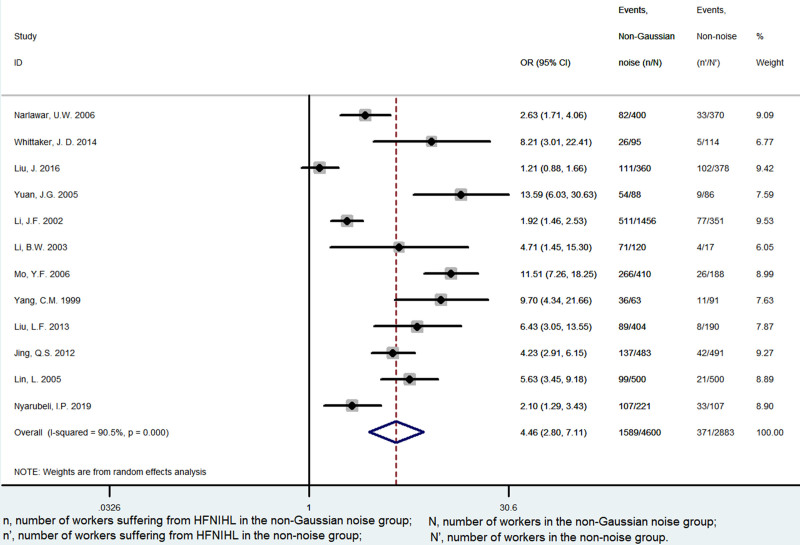
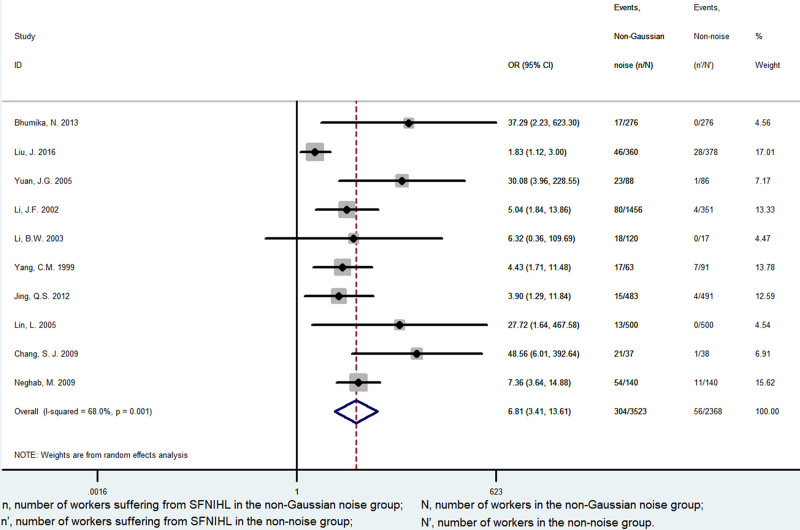
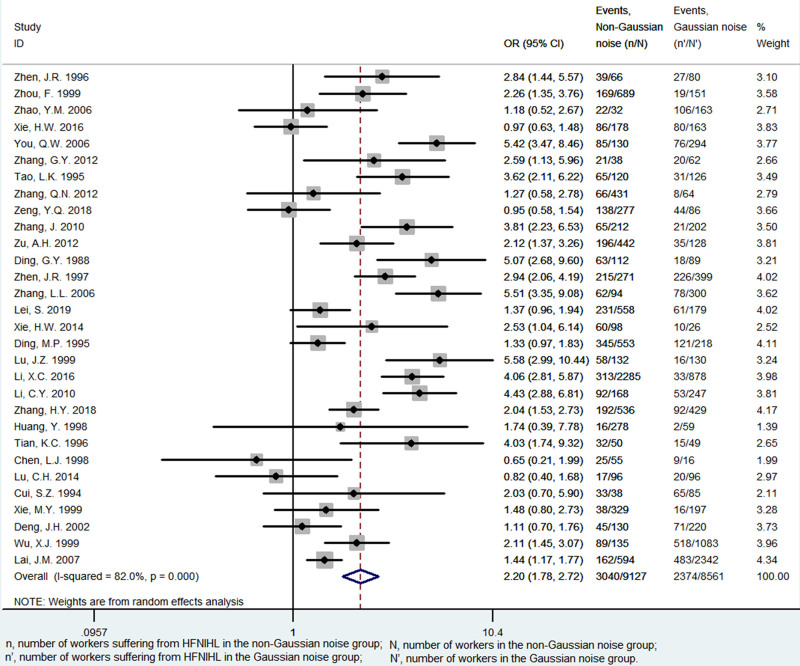
Results: Of 78 epidemiological studies (47,814 workers) selected, there were seven cohort studies and 71 cross-sectional studies. The incidence of high-frequency NIHL (HFNIHL) and speech-frequency NIHL (SFNIHL) in the seven cohort studies was 10.9 and 2.9%, respectively. In 71 cross-sectional studies, the prevalence of HFNIHL and SFNIHL was 34.2 and 18.9%, respectively. The average hearing threshold level at the high frequencies was 42.1 ± 17.4 dB HL. Workers exposed to non-Gaussian noise had a higher risk of developing HFNIHL than those not exposed to noise (overall-weighted odds ratio [OR] = 4.46) or those exposed to Gaussian noise (overall-weighted OR = 2.20). The Chi-square trend test demonstrated that the prevalence of HFNIHL was positively correlated with age, cumulative noise exposure, and exposure duration (p < 0.001).
Conclusions: Workers exposed to non-Gaussian noise suffered from greater NIHL than those exposed to Gaussian noise or not exposed to noise. Age, exposure duration, noise level, and noise temporal structure were the main risk factors for occupational NIHL. The A-weighted equivalent continuous sound pressure level (LAeq) is not a sufficient measurement metric for quantifying non-Gaussian noise exposure, and a combination of kurtosis and noise energy metrics (e.g., LAeq) should be used. It is necessary to reduce the exposure of non-Gaussian noise to protect the hearing health of workers.
Copyright © 2021 The Authors. Ear & Hearing is published on behalf of the American Auditory Society, by Wolters Kluwer Health, Inc.
Conflict of interest statement
This research was funded by the Zhejiang Provincial Key Research and Development Project (2015C03039); the Zhejiang Provincial Program for the Cultivation of High-Level Innovative Health Talents, Zhejiang Province, China; and the Health Commission of Zhejiang Province (2019KY057). There are no conflicts of interest, financial, or otherwise.
Figures
References
-
- Ahroon W. A., Hamernik R. P., Davis R. I. (Complex noise exposures: An energy analysis. J Acoust Soc Am, 1993). 93, 997–1006. - PubMed
-
- Bauer P., Körpert K., Neuberger M., Raber A., Schwetz F. (Risk factors for hearing loss at different frequencies in a population of 47,388 noise-exposed workers. J Acoust Soc Am, 1991). 90, 3086–3098. - PubMed
-
- Chang S. J., Chang C. K. (Prevalence and risk factors of noise-induced hearing loss among liquefied petroleum gas (LPG) cylinder infusion workers in Taiwan. Ind Health, 2009). 47, 603–610. - PubMed
-
- Chen J. C., Lin A. H. (Analysis of the continuous inspection result of industrial noise on hearing loss rate of electronics worker. China Medical Herald, 2010). 7, 113–114.
Publication types
MeSH terms
LinkOut - more resources
Full Text Sources
Other Literature Sources
Medical
Miscellaneous
