. 2021 May 21;100(20):e25952.
doi: 10.1097/MD.0000000000025952.

m6A regulators are associated with osteosarcoma metastasis and have prognostic significance: A study based on public databases

Affiliations

m6A regulators are associated with osteosarcoma metastasis and have prognostic significance: A study based on public databases

Wenpeng Zhang et al. Medicine (Baltimore). .

Abstract

Background: Osteosarcoma represents the most common malignant bone tumor with high metastatic potential and inferior prognosis. RNA methylation (N6-methyladenosine [m6A]) is a prevalent RNA modification that epigenetically influences numerous biological processes including tumorigenesis. This study aims to determine that m6A regulators are significant biomarkers for osteosarcoma, and establish a prognostic model to predict the survival of patients.

Methods: In this study, we comprehensively analyzed the underlying associations between m6A regulators' mRNA expressions and metastasis as well as prognosis of osteosarcoma patients in the Cancer Genome Atlas. Multivariate Cox-regression analysis was used to screen regulators that were significantly associated with overall survival of osteosarcoma patients. Least absolute shrinkage and selection operator (LASSO) Cox-regression analysis was used for constructing m6A regulator-based osteosarcoma prognostic signature.

Results: Some of the regulators exhibited aberrant mRNA levels between osteosarcoma samples with and without metastasis. Multivariate Cox-regression analysis identified several regulators with potential prognostic significance. A risk score formula consisted of methyltransferase-like 3, YTH domains of Homo sapiens, and fat mass and obesity-associated protein was obtained through which patients could be prognostically stratified independently of potential confounding factors. The signature was also significantly associated with the metastatic potential of osteosarcoma. All the analyses could be well reproduced in another independent osteosarcoma cohort from the Gene Expression Omnibus.

Conclusions: In conclusion, this study first revealed potential roles of m6A regulators in osteosarcoma metastasis and prognosis, which should be helpful for its clinical decision-making.


Conflict of interest statement

The authors have no conflicts of interest to disclose.

Figures
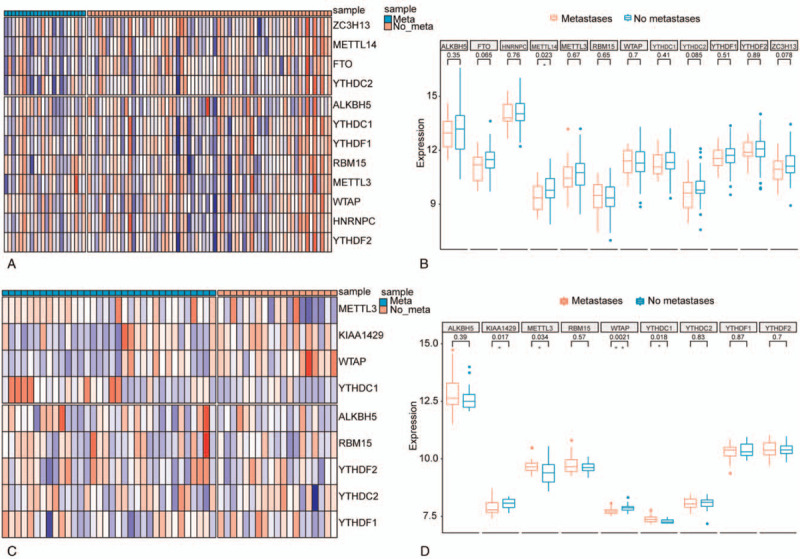
Figure 1
Figure 1
Expression landscape of the 12 m6A regulators in osteosarcoma samples. (A) Heatmap illustrating mRNA expression values of the 12 m6A regulators across the 88 osteosarcoma samples from TCGA (training set). (B) Boxplots illustrating comparison of each m6A regulator's mRNA expression values between osteosarcoma samples with and without metastasis from TCGA (training set). Wilcoxon P values were provided above the boxplots. (C) Heatmap illustrating mRNA expression values of the 9 m6A regulators that were profiled by Illumina expression microarray across the 53 osteosarcoma samples from GSE21257 dataset (testing set). (D) Boxplots illustrating the comparison of each m6A regulator's mRNA expression values between osteosarcoma samples with and without metastasis from GSE21257 dataset (testing set). Wilcoxon P values were provided above the boxplots. “Meta” represents osteosarcoma samples with metastasis, while “no meta” represents osteosarcoma samples without metastasis; and ∗∗ represents P-value < .05 and .01, respectively. TCGA = the Cancer Genome Atlas.
Figure 2
Figure 2
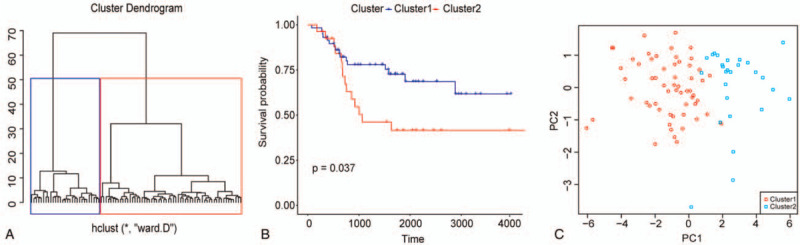
m6A regulators could stratify osteosarcoma patients that were prognostically different. (A) Clustering of osteosarcoma samples from TCGA based on their mRNA expression values of the 12 m6A regulators via K-means method. (B) Kaplan–Meier survival curves of osteosarcoma patients from TCGA stratified by cluster. (C) PCA scatter plot of osteosarcoma samples from TCGA along first 2 principal components. Scatter shapes and colors are used to distinguish samples within different K-means clusters. PCA = principle component analysis, TCGA = the Cancer Genome Atlas.
Figure 3
Figure 3
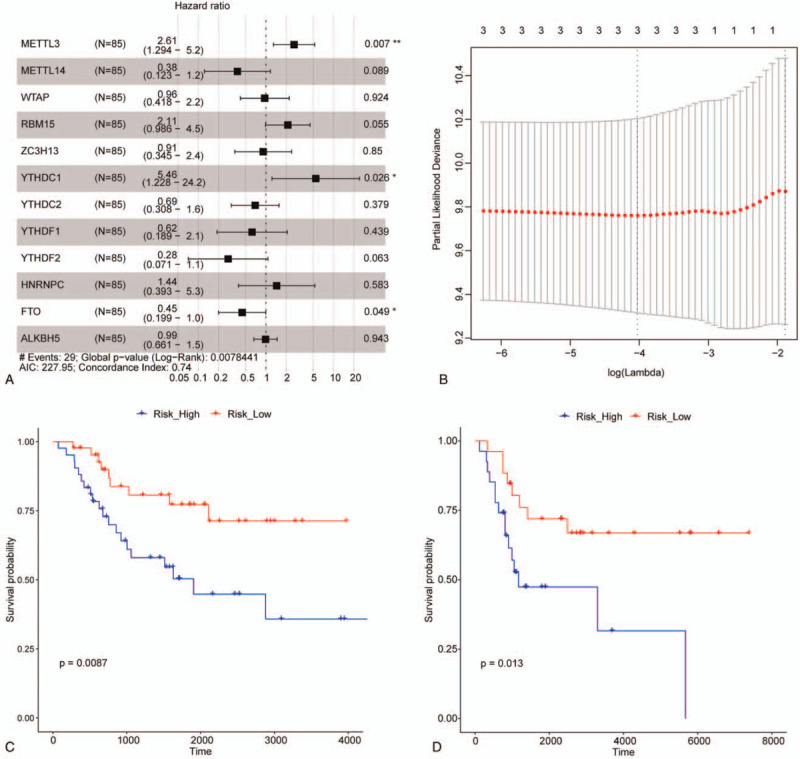
Construction of m6A regulator-based prognostic signature for osteosarcoma. (A) Forest plot of multivariate Cox-regression analysis illustrates associations between each m6A regulator and overall survival of osteosarcoma patients from TCGA. Square data indicates hazard ratio and error bar is 95% confidence interval. and ∗∗ represents P-value < .05 and .01, respectively. (B) Risk score distribution of osteosarcoma samples in training set. (C) and (D) are the Kaplan–Meier survival curves of osteosarcoma patients from TCGA (training set) and GSE21257 (testing set), respectively. Samples are stratified by the median risk score. TCGA = the Cancer Genome Atlas.
Figure 4
Figure 4
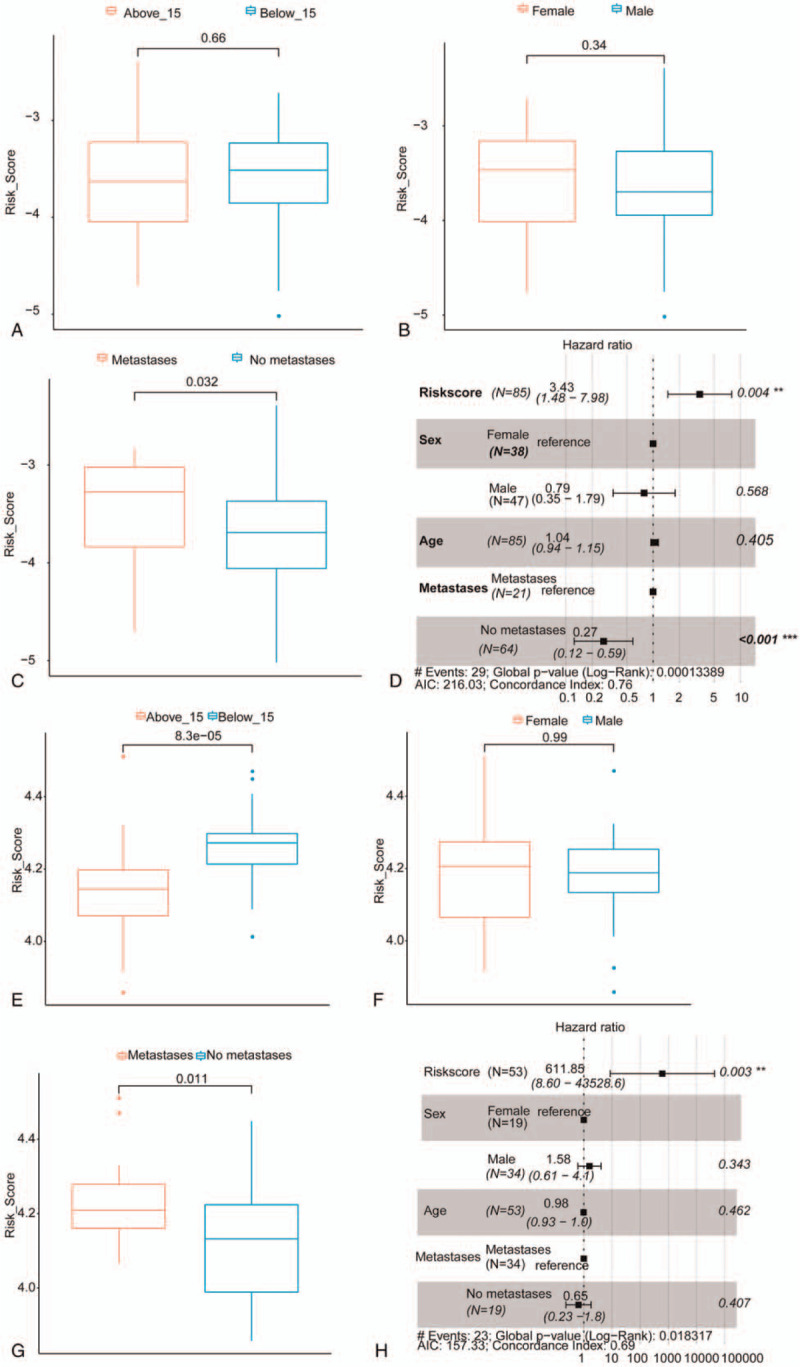
Clinical relevance of risk score. (A–C) Boxplots illustrating comparison of risk score for osteosarcoma samples from TCGA (training set) stratified by their age, gender, and metastatic status. Wilcoxon P values are provided above the boxplots. (D) Forest plot of multivariate Cox-regression analysis indicates risk score as an independent prognostic signature for osteosarcoma patients from TCGA (training set) after adjusting for confounding factors including age, gender, and metastatic status. (E–G) Boxplots illustrating comparison of risk score for osteosarcoma samples from GSE21257 dataset (testing set) stratified by their age, gender, and metastatic status. Wilcoxon P values are provided above the boxplots. (H) Forest plot of multivariate Cox-regression analysis indicates risk score as an independent prognostic signature for osteosarcoma patients from GSE21257 dataset (testing set) after adjusting for confounding factors including age, gender, and metastatic status. TCGA = the Cancer Genome Atlas.

References

    1. Durfee RA, Mohammed M, Luu HH. Review of osteosarcoma and current management. Rheumatol Ther 2016;3:221–43. - PMC - PubMed
    1. Anderson ME. Update on survival in osteosarcoma. Orthop Clin North Am 2016;47:283–92. - PubMed
    1. Ferrari S, Serra M. An update on chemotherapy for osteosarcoma. Expert Opin Pharmacother 2015;16:2727–36. - PubMed
    1. Suehara Y, Alex D, Bowman A, et al. Clinical genomic sequencing of pediatric and adult osteosarcoma reveals distinct molecular subsets with potentially targetable alterations. Clin Cancer Res 2019;25:6346–56. - PMC - PubMed
    1. Evola FR, Costarella L, Pavone V, et al. Biomarkers of osteosarcoma, chondrosarcoma, and ewing sarcoma. Front Pharmacol 2017;8:150. - PMC - PubMed

MeSH terms