


Factors Associated with the Type of Cesarean Section in Greece and Their Correlation with International Guidelines
- PMID: 34012212
- PMCID: PMC8116101
- DOI: 10.5455/aim.2021.29.38-44
Factors Associated with the Type of Cesarean Section in Greece and Their Correlation with International Guidelines
Abstract
Background: Cesarean section (CS) rates have been increasing worldwide with different effects on maternal and neonatal health. Factors responsible for the growing trend of CSs, include maternal characteristics, medical insurance and convenient scheduling or financial incentives. Effective interventions and guidelines are required to reduce CS rates.
Objective: The aim of this research was to investigate the factors contributing to CS rate increase and their correlation with international guidelines.
Methods: The performed analysis included the available socio-demographic and medical information retrieved from the medical records and a related questionnaire in both emergency and elective CSs.
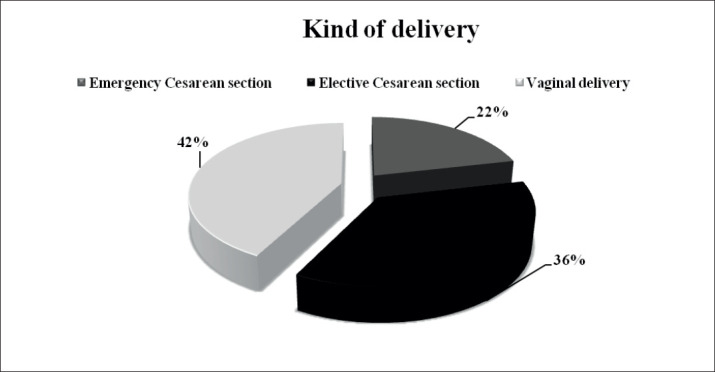
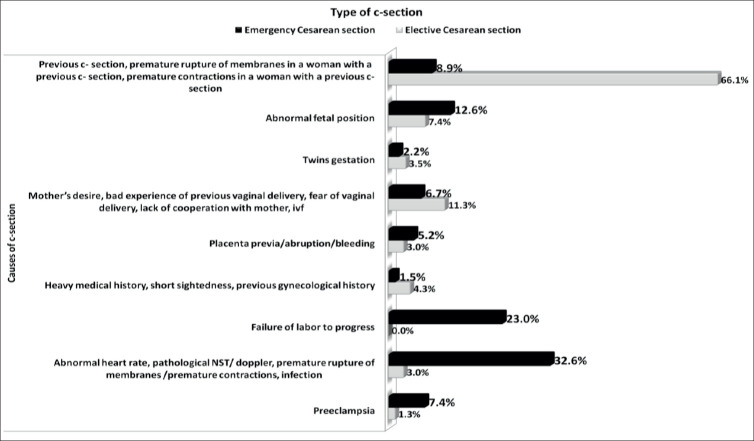
Results: Out of the included 633 births, the cesarean delivery rate was 58%. Women with a previous CS showed higher percentages for Elective CS (66.1%) compared to Emergency CSs for the same reasons (8.9%). Furthermore, 23% of the patients underwent an Emergency CS because of failure of labor to progress while 18% of CSs were due to maternal desire.
Conclusion: The high rates of CS in Greece demonstrate the lack of use of international obstetric protocols, national strategies, Cesarean Section audits and a significant shortage of midwives. A decrease in iatrogenic and non-iatrogenic factors leading to the primary CS will decrease CS rates.
Keywords: Cesarean Section; cesarean section and international guidelines; elective cesarean section; emergency cesarean section; risk factors for cesarean sections.
© 2021 Evangelia Antoniou Eirini Orovou, Maria Iliadou, Angeliki Sarella, Ermioni Palaska, Antigoni Sarantaki, Georgios Iatrakis, Maria Dagla.
Conflict of interest statement
There are no conflicts of interest.
Figures
References
-
- Ayres-De-Campos D, Cruz J, Medeiros-Borges C, Costa-Santos C, Vicente L. Lowered national cesarean section rates after a concerted action. [2020 Apr 6];Acta Obstet Gynecol Scand (Internet) 2015 94(4):391–398. Available from: https://obgyn.onlinelibrary.wiley.com/doi/abs/10.1111/aogs.12582. - DOI - PubMed
-
- Field A, Haloob R. Complications of caesarean section. [2020 Apr 7];Obstet Gynaecol (Internet) 2016 18(4):265–272. Available from: https://obgyn.onlinelibrary.wiley.com/doi/abs/10.1111/tog.12280. - DOI
-
- Cardwell CR, Stene LC, Joner G, Cinek O, Svensson J, Goldacre MJ, et al. Caesarean section is associated with an increased risk of childhood-onset type 1 diabetes mellitus: a meta-analysis of observational studies. Diabetologia. 2008 May;51(5):726–735. - PubMed
-
- Getahun D, Oyelese Y, Salihu HM, Ananth CV. Previous cesarean delivery and risks of placenta previa and placental abruption. Obstet Gynecol. 2006 Apr;107(4):771–778. - PubMed
LinkOut - more resources
Full Text Sources
Other Literature Sources