Interventional pulmonology during COVID-19 pandemic: current evidence and future perspectives
- PMID: 34012596
- PMCID: PMC8107537
- DOI: 10.21037/jtd-20-2192
Interventional pulmonology during COVID-19 pandemic: current evidence and future perspectives
Abstract
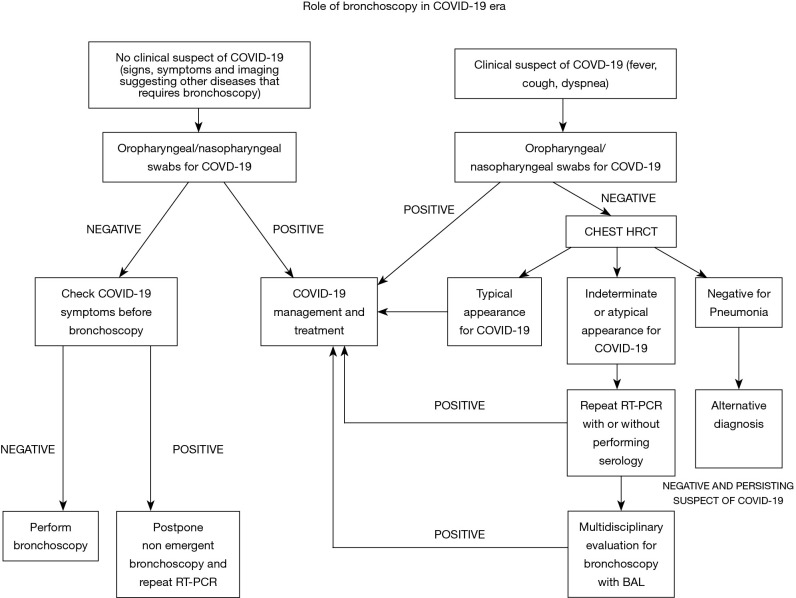
COVID-19, caused by SARS-CoV-2 infection, has become increasingly prevalent worldwide, reaching a pandemic stage in March 2020. The organization of health care services had to change because of this new disease, with the need to reallocate staff and materials, besides changing management protocols. A very important challenge is not to expose patients and health care workers to the risk of infection and not to waste personal protective equipment (PPE). In the field of interventional pulmonology, various aspects related to COVID-19 must be taken into great consideration. Although bronchoscopy is not a first-line test for patients with suspected SARS-CoV-2 infection, it has a role in selected cases and it can be useful for differential diagnosis. However, bronchoscopy is an aerosol-generating procedure, that's why its unjustified use could contribute to propagate the virus. For this reason, the utility of each procedure must be carefully evaluated, the patient has to be properly investigated before the procedure, which has to be performed with specific precautions, including adequate PPE. In this review, we summarize the knowledge and the principal statements about endoscopic activity in COVID-19 period, in both diagnosis of COVID-19 and management of patients. How to safely perform both bronchoscopic and pleural-related procedures (thoracoscopy, pleural biopsy and drainage of pleural effusions) is described with the aim to help the staff to decide when and how performing a procedure. We also highlight how interventional pulmonology could help in matter of complications related to COVID-19.
Keywords: COVID-19; SARS-CoV-2; Thoracoscopy; bronchoscopy; interventional pulmonology.
2021 Journal of Thoracic Disease. All rights reserved.
Conflict of interest statement
Conflicts of Interest: All authors have completed the ICMJE uniform disclosure form (available at http://dx.doi.org/10.21037/jtd-20-2192). The authors have no conflicts of interest to declare.
Figures
References
-
- WHO. Coronavirus disease (COVID-19) Situation Report – 115 Data as received by WHO from national authorities by 10:00 CEST, 14 May 2020.
Publication types
LinkOut - more resources
Full Text Sources
Other Literature Sources
Miscellaneous