. 2021 Apr;10(4):1608-1622.
doi: 10.21037/tlcr-20-1231.

Transbronchial microwave ablation of lung nodules with electromagnetic navigation bronchoscopy guidance-a novel technique and initial experience with 30 cases

Affiliations

Transbronchial microwave ablation of lung nodules with electromagnetic navigation bronchoscopy guidance-a novel technique and initial experience with 30 cases

Joyce W Y Chan et al. Transl Lung Cancer Res. 2021 Apr.

Abstract

Background: Microwave ablation of lung nodules may provide a faster, larger and more predictable ablation zone than other energy sources, while bronchoscopic transbronchial ablation has theoretical advantage of fewer pleural-based complications than percutaneous approach. Our study aims to determine whether the novel combination of bronchoscopic approach and microwave ablation in management of lung nodules is technically feasible, safe and effective.

Methods: This is a retrospective analysis of a single center experience in electromagnetic navigation bronchoscopy microwave ablation in hybrid operating room. Patients had high surgical risks while lung nodules were either proven malignant or radiologically suspicious. Primary endpoints include technical feasibility and safety.

Results: Total of 30 lung nodules from 25 patients were treated. Mean nodule size was 15.1 mm, and bronchus directly leads to the nodules (bronchus sign positive) in only half of them. Technical success rate was 100%, although some nodules required double ablation for adequate coverage. Mean minimal ablation margin was 5.51 mm. The mean actual ablation zone volume was -21.4% compared to predicted, likely due to significant tissue contraction ranging from 0-43%. There was no significant heat sink effect. Mean hospital stay was 1.73 days, and only 1 patient stayed for more than 3 days. Complications included pain (13.3%), pneumothorax requiring drainage (6.67%), post-ablation reaction (6.67%), pleural effusion (3.33%) and hemoptysis (3.33%). After median follow up of 12 months, none of the nodules had evidence of progression.

Conclusions: Bronchoscopic transbronchial microwave ablation is safe and feasible for treatment of malignant lung nodules. Prospective study on clinical application of this novel technique is warranted.

Keywords: Microwave ablation; electromagnetic navigation bronchoscopy; hybrid operating room; lung cancer; transbronchial ablation.


Conflict of interest statement

Conflicts of Interest: All authors have completed the ICMJE uniform disclosure form (available at Available at http://dx.doi.org/10.21037/tlcr-20-1231). CSHN is a consultant for Johnson and Johnson; Medtronic, USA; and Siemens Healthineer. RWHL is a consultant for Medtronic, USA; and Siemens Healthineer. TSKM has no potential conflicts of interest that exist with companies/organizations whose products or services are discussed in this article. The other authors have no conflicts of interest to declare.

Figures
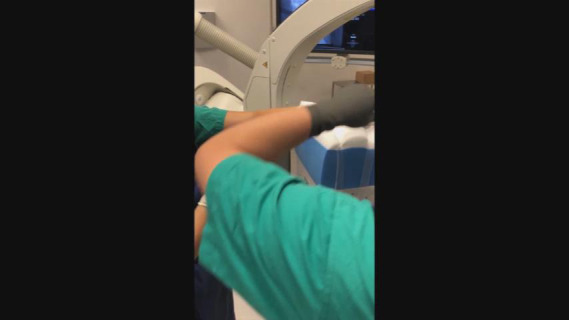
Video 1
Video 1
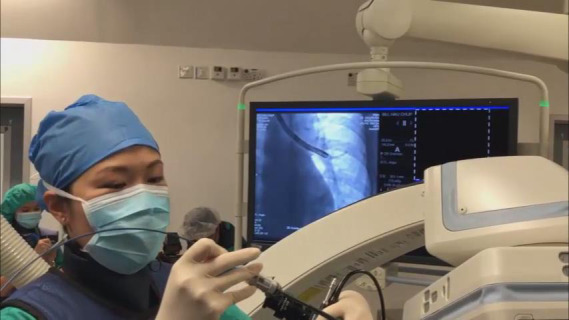
The video demonstrates transbronchial access using CrossCountryTM tool. After ENB navigation to the proximity of a lung nodule which requires transbronchial access, the locatable guide is removed and replaced with the CrossCountryTM needle. The nodule is marked by yellow tracings, and accurate placement of needle is guided by real-time fluoroscopy.
Video 2
Video 2
After transbronchial access by CrossCountryTM needle, the extended working channel (EWC) can then be advanced over the needle to reach the lung nodule, also under fluoroscopy guidance. The operator’s left hand holds the needle steady in position, while the operator’s right hand advances the EWC over needle in careful wiggling motion.
Video 3
Video 3
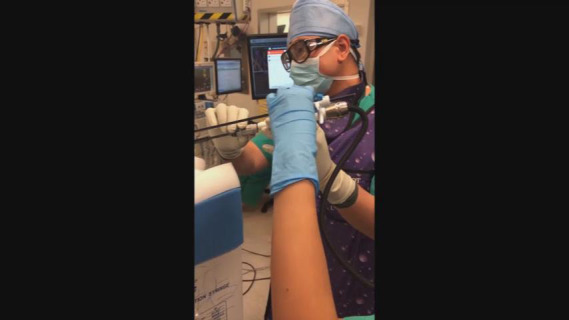
The microwave ablation catheter is inserted into the extended working channel (EWC) (first “click”), and locked to the bronchoscope system using a long rod (second “click”). Afterwards, the ablation catheter is unsheathed by pulling the EWC backwards, with the operator’s left hand holding the ablation catheter steady and right hand pulling the EWC backwards in a slow and controlled fashion. The third “click” signifies complete unsheathing of the ablation catheter.
Video 4
Video 4
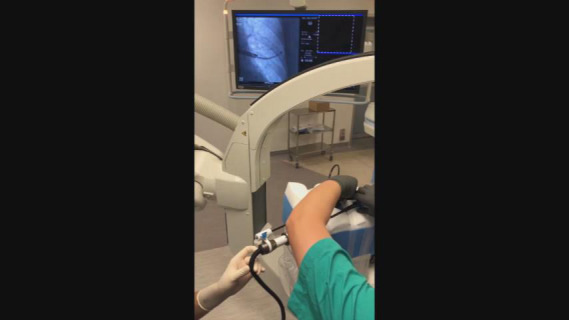
Same procedure as Video 3 but real-time fluoroscopy screening is also shown. During unsheathing of ablation catheter, the operator avoids any unintentional forward or backward shifting of the whole system.
Figure 1
Figure 1
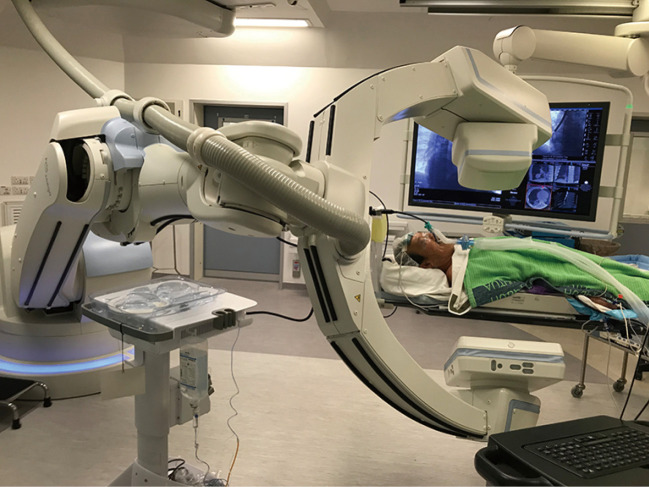
Set-up in the hybrid theatre is shown. The microwave catheter is connected to the microwave ablation console at the lower left in a particular direction such the C-arm was still able to rotate around the table to perform CBCT.
Figure 2
Figure 2
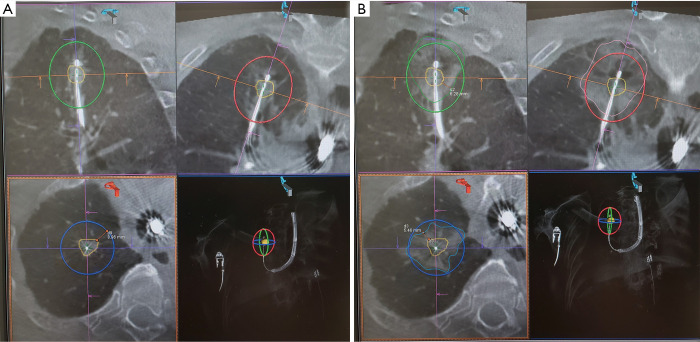
(A) This shows the target lung lesion (yellow tracing) in 3 axes before ablation. With ablation energy of 100 W × 10 minutes, the predicted ablation zone (red, green and blue ovals) is a spheroid measuring 42×35×35 mm, and the minimal predicted margin is 8.96 mm. (B) Figure is the 10-minute post-ablation scan, showing a minimal actual margin of 5.46 mm due to irregular shape of resultant ablation zone (red, green and blue irregular contour tracings), although the total ablation zone volume is similar to prediction.
Figure 3
Figure 3
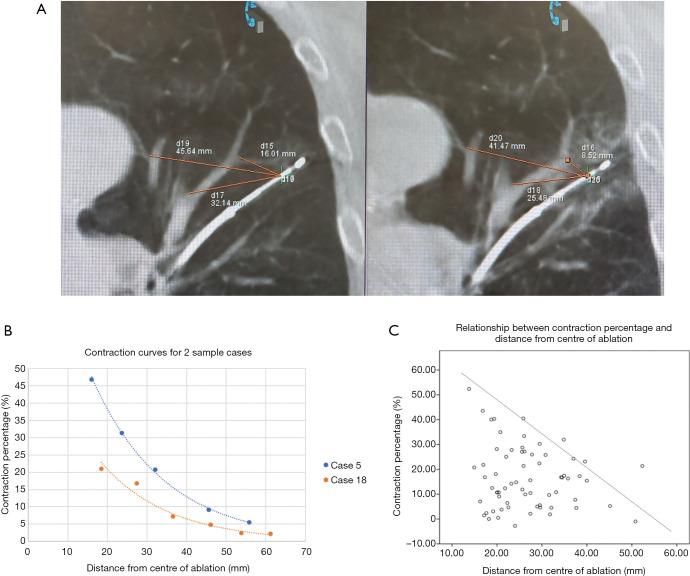
(A) shows the pre-ablation (left) and post-ablation (right) CBCT appearances. The centre of ablation (green cross) is 1cm from the tip of the microwave catheter as defined by the manufacturer. The distance between the centre of ablation and reference points (usually the bifurcation of recognizable neighbouring blood vessels) are measured pre- and post-ablation respectively. The contraction percentage for a particular distance from centre is calculated by (Pre-ablation distance – Post-ablation distance)/Pre-ablation distance ×100%. For example, contraction percentage is (32.14–25.48)/32.14×100% =20.7% for the point d17. (B) shows the contraction percentages measured at 5−6 reference points for two cases. References points are usually recognizable bifurcations of adjacent blood vessels which can be identified in both pre- and post-ablation CTs. The contraction percentage and distance from centre of ablation demonstrates an inverse relationship. Each patient has a different contraction curve due to differences in lung and lesion properties and amount of ablation energy used, although the shape of curve should be similar. (C) shows a scatter plot of contraction percentage against distance from centre of ablation when data from all patients are pooled together. It is not a linear relationship, but there is a maximum possible contraction percentage for each distance. For instance, for reference points 20 mm from centre of ablation, a maximum of 40% contraction is observed. Likewise, for a reference point at 40 mm, a maximum of roughly 20% contraction is expected.
Figure 4
Figure 4
A box-plot showing percentage change in ablation zone from day 0 to 1 year after ablation. The rate of decrease in ablation zone volumes is initially fast and flattens out after 6 to 9 months, reaching a maximum of −79.8% at 9 months with our current data.

References

    1. Aberle DR, Adams AM, Berg CD, et al. Reduced Lung-Cancer Mortality with Low-Dose Computed Tomographic Screening. N Engl J Med 2011;365:395-409. 10.1056/NEJMoa1102873 - DOI - PMC - PubMed
    1. Bryant AK, Mundt RC, Sandhu AP, et al. Stereotactic Body Radiation Therapy Versus Surgery for Early Lung Cancer Among US Veterans. Ann Thorac Surg 2018;105:425-31. 10.1016/j.athoracsur.2017.07.048 - DOI - PubMed
    1. Puri V, Crabtree TD, Bell JM, et al. Treatment Outcomes in Stage I Lung Cancer: A Comparison of Surgery and Stereotactic Body Radiation Therapy. J Thorac Oncol 2015;10:1776-84. 10.1097/JTO.0000000000000680 - DOI - PMC - PubMed
    1. Lee K, Kim HO, Choi HK, et al. Real-world treatment patterns for patients 80 years and older with early lung cancer: A nationwide claims study. BMC Pulm Med 2018;18:127. 10.1186/s12890-018-0699-0 - DOI - PMC - PubMed
    1. Senthi S, Lagerwaard FJ, Haasbeek CJA, et al. Patterns of disease recurrence after stereotactic ablative radiotherapy for early stage non-small-cell lung cancer: A retrospective analysis. Lancet Oncol 2012;13:802-9. 10.1016/S1470-2045(12)70242-5 - DOI - PubMed

LinkOut - more resources