


Treatment of mild Class II malocclusion in growing patients with clear aligners versus fixed multibracket therapy: A retrospective study
- PMID: 34013659
- PMCID: PMC9290977
- DOI: 10.1111/ocr.12500
Treatment of mild Class II malocclusion in growing patients with clear aligners versus fixed multibracket therapy: A retrospective study
Abstract
Objective: To compare the dental and skeletal effects of intermaxillary elastics on the correction of mild Angle's Class II division 1 malocclusion with clear aligner treatment (CA) versus fixed multibracket (FMB) in growing patients.
Settings and sample population: The study sample consisted of 49 consecutively patients (mean age ± SD 12.9 ± 1.7 years), 32 females and 17 males referred from the School of Orthodontics of the University of Bratislava Comenius (Slovakia). All patients were treated with a non-extraction orthodontic treatment, 25 with FMB and 24 with CA.
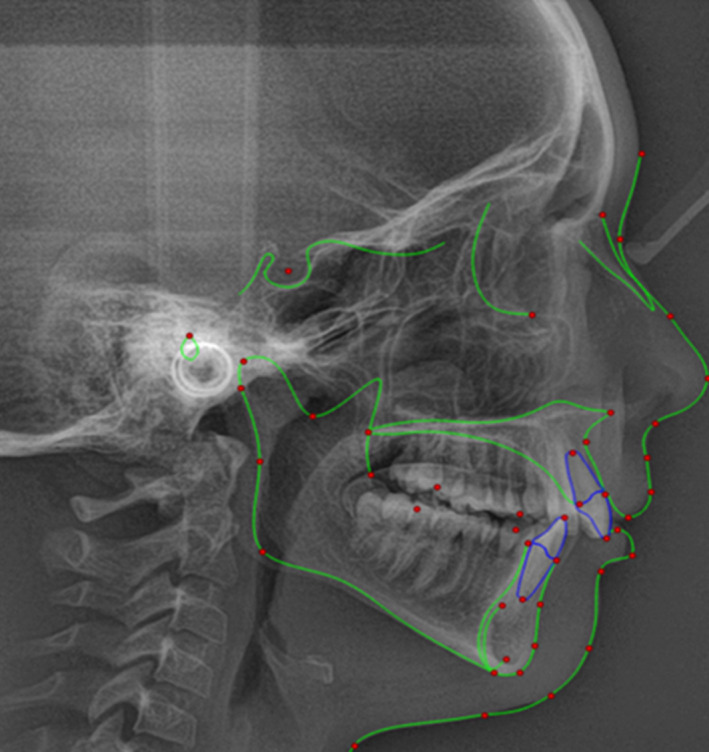
Methods: The cephalometric analysis was performed at the beginning (T0) and the end of the treatment (T1). The t test for unpaired data was carried out to compare cephalometric values at T0 and changes at T1-T0 between the two groups. The level of significance was set as P < .0035.
Results: The two groups showed no statistically significant differences (ANPg = -0.1°; P = .762) in the correction of the sagittal intermaxillary relation. The analysis of vertical skeletal changes showed no statistically significant effects on mandibular inclination (SN/MP = 0.1°; P = .840). The two treatments had a statistically significant and clinically relevant difference in controlling the inclination of the lower incisors (L1/GoGn = 4.8°, CAG = -0.5°± 3.9°; FMB = 4.3°± 5.8°; P < .001).
Conclusions: Class II elastics combined with CA and FMB produce a similar correction on sagittal discrepancies in growing patients. CA presented a better control in the proclination of the lower incisors. CA and elastics might be a good alternative in the correction of mild Class II malocclusion in cases where a proclination of lower incisors is unwanted.
Keywords: Class II elastics; Class II malocclusion; adolescents; clear aligners.
© 2021 The Authors. Orthodontics & Craniofacial Research published by John Wiley & Sons Ltd.
Conflict of interest statement
The authors declare no conflict of interest.
Figures
References
-
- Shalish M, Cooper‐Kazaz R, Ivgi I, et al. Adult patients’ adjustability to orthodontic appliances. Part I: a comparison between Labial, Lingual, and InvisalignTM . Eur J Orthod. 2012;34:724‐730. - PubMed
-
- Rosvall MD, Fields HW, Ziuchkovski J, Rosenstiel SF, Johnston WM. Attractiveness, acceptability, and value of orthodontic appliances. Am J Orthod Dentofacial Orthop. 2009;135(3):276.e1‐276.e12. - PubMed
-
- Walton DK, Fields HW, Johnston WM, Rosenstiel SF, Firestone AR, Christensen JC. Orthodontic appliance preferences of children and adolescents. Am J Orthod Dentofacial Orthop. 2010;138(6):698.e1‐698.e12. - PubMed
-
- Zhang B, Huang X, Huo S, et al. Effect of clear aligners on oral health‐related quality of life: a systematic review. Orthod Craniofac Res. 2020;23(4):363‐370. - PubMed
MeSH terms
Grants and funding
LinkOut - more resources
Full Text Sources
Other Literature Sources
Medical
