Proposal for Human Respiratory Syncytial Virus Nomenclature below the Species Level

Vahid Salimi et al. Emerg Infect Dis. 2021 Jun.

Abstract

Human respiratory syncytial virus (HRSV) is the leading viral cause of serious pediatric respiratory disease, and lifelong reinfections are common. Its 2 major subgroups, A and B, exhibit some antigenic variability, enabling HRSV to circulate annually. Globally, research has increased the number of HRSV genomic sequences available. To ensure accurate molecular epidemiology analyses, we propose a uniform nomenclature for HRSV-positive samples and isolates, and HRSV sequences, namely: HRSV/subgroup identifier/geographic identifier/unique sequence identifier/year of sampling. We also propose a template for submitting associated metadata. Universal nomenclature would help researchers retrieve and analyze sequence data to better understand the evolution of this virus.

Keywords: HRSV; Human orthopneumovirus; human respiratory syncytial virus; isolates; nomenclature; respiratory infections; specimens; strains; subspecies nomenclature; viruses.


Figures
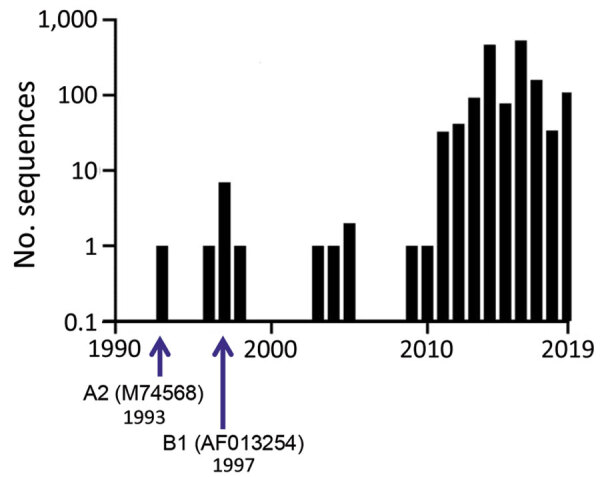
Figure 1
Figure 1
Annual numbers of HRSV whole-genome sequences released in GenBank since publication of the whole-genome sequence of HRSV A2, M74568, in 1993. HRSV, human respiratory syncytial virus.
Figure 2
Figure 2
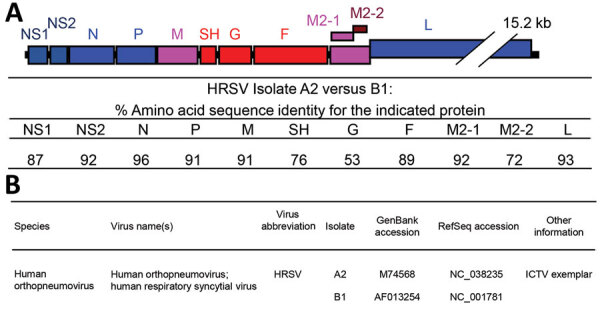
A) Schematic overview of the HRSV gene order and comparison of the amino acid identities of the reference strains of subgroups A (HRSV A2, GenBank accession no. M74568/NC_038235) and B (HRSV B1, GenBank accession no. AF013254/NC_001781). B) ICTV-proposed species designation, virus name, and associated GenBank reference sequences. HRSV, human respiratory syncytial virus; ICTV, International Committee on Virus Taxonomy; RefSeq, reference sequence.
Figure 3
Figure 3
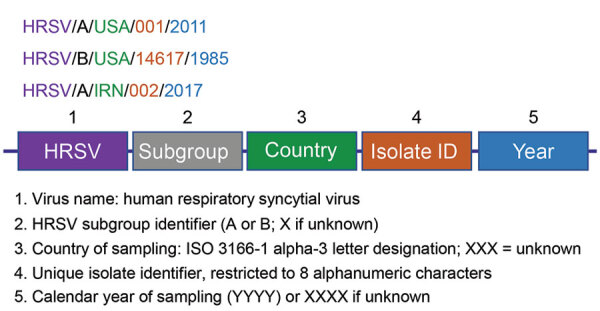
Schematic representation of the 5 consensus nomenclature elements of HRSV strains and isolates, with examples (top) and an explanation of each element (bottom). HRSV, human respiratory syncytial virus; ID, identification number; ISO, International Organization for Standardization.
Figure 4
Figure 4
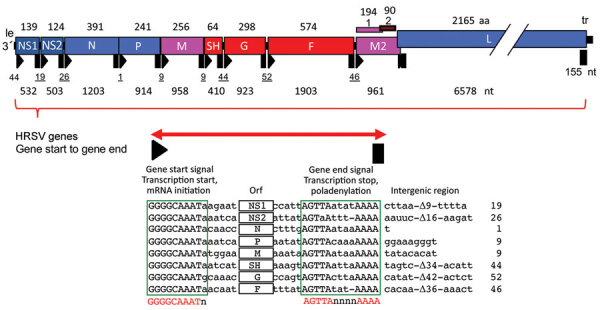
Schematic aid to gene annotations of HRSV whole-genome sequences. An HRSV gene comprises the sequence from the first nucleotide of the conserved HRSV gene start signal (GGGGCAAATa) to the last adenosine residue of the HRSV gene end signal (AGTTAnnnnAAAA) (25,41). Gene start signals are represented by black triangles, and gene end signals are shown as black rectangles, separated by intergenic regions (underlined). Note the M2/L gene overlap (annotations derived from HRSV A2; GenBank accession no. M74568/NC_038235). le, leader region; HRSV, human respiratory syncytial virus; tr, trailer region.

References

    1. Shi T, McAllister DA, O’Brien KL, Simoes EAF, Madhi SA, Gessner BD, et al. ; RSV Global Epidemiology Network. Global, regional, and national disease burden estimates of acute lower respiratory infections due to respiratory syncytial virus in young children in 2015: a systematic review and modelling study. Lancet. 2017;390:946–58. 10.1016/S0140-6736(17)30938-8 - DOI - PMC - PubMed
    1. Nair H, Nokes DJ, Gessner BD, Dherani M, Madhi SA, Singleton RJ, et al. Global burden of acute lower respiratory infections due to respiratory syncytial virus in young children: a systematic review and meta-analysis. Lancet. 2010;375:1545–55. 10.1016/S0140-6736(10)60206-1 - DOI - PMC - PubMed
    1. Salimi V, Tavakoli-Yaraki M, Yavarian J, Bont L, Mokhtari-Azad T. Prevalence of human respiratory syncytial virus circulating in Iran. J Infect Public Health. 2016;9:125–35. 10.1016/j.jiph.2015.05.005 - DOI - PubMed
    1. Stein RT, Bont LJ, Zar H, Polack FP, Park C, Claxton A, et al. Respiratory syncytial virus hospitalization and mortality: Systematic review and meta-analysis. Pediatr Pulmonol. 2017;52:556–69. 10.1002/ppul.23570 - DOI - PMC - PubMed
    1. O’Brien KL, Baggett HC, Brooks WA, Feikin DR, Hammitt LL, Higdon MM, et al. ; Pneumonia Etiology Research for Child Health (PERCH) Study Group. Causes of severe pneumonia requiring hospital admission in children without HIV infection from Africa and Asia: the PERCH multi-country case-control study. Lancet. 2019;394:757–79. 10.1016/S0140-6736(19)30721-4 - DOI - PMC - PubMed

Publication types

LinkOut - more resources