


A Clinical Prediction Model to Predict Heparin Treatment Outcomes and Provide Dosage Recommendations: Development and Validation Study
- PMID: 34014171
- PMCID: PMC8176336
- DOI: 10.2196/27118
A Clinical Prediction Model to Predict Heparin Treatment Outcomes and Provide Dosage Recommendations: Development and Validation Study
Abstract
Background: Unfractionated heparin is widely used in the intensive care unit as an anticoagulant. However, weight-based heparin dosing has been shown to be suboptimal and may place patients at unnecessary risk during their intensive care unit stay.
Objective: In this study, we intended to develop and validate a machine learning-based model to predict heparin treatment outcomes and to provide dosage recommendations to clinicians.
Methods: A shallow neural network model was adopted in a retrospective cohort of patients from the Multiparameter Intelligent Monitoring in Intensive Care III (MIMIC III) database and patients admitted to the Peking Union Medical College Hospital (PUMCH). We modeled the subtherapeutic, normal, and supratherapeutic activated partial thromboplastin time (aPTT) as the outcomes of heparin treatment and used a group of clinical features for modeling. Our model classifies patients into 3 different therapeutic states. We tested the prediction ability of our model and evaluated its performance by using accuracy, the kappa coefficient, precision, recall, and the F1 score. Furthermore, a dosage recommendation module was designed and evaluated for clinical decision support.
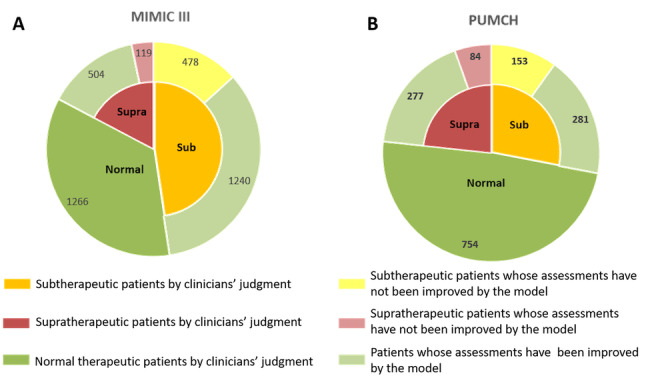
Results: A total of 3607 patients selected from MIMIC III and 1549 patients admitted to the PUMCH who met our criteria were included in this study. The shallow neural network model showed results of F1 scores 0.887 (MIMIC III) and 0.925 (PUMCH). When compared with the actual dosage prescribed, our model recommended increasing the dosage for 72.2% (MIMIC III, 1240/1718) and 64.7% (PUMCH, 281/434) of the subtherapeutic patients and decreasing the dosage for 80.9% (MIMIC III, 504/623) and 76.7% (PUMCH, 277/361) of the supratherapeutic patients, suggesting that the recommendations can contribute to clinical improvements and that they may effectively reduce the time to optimal dosage in the clinical setting.
Conclusions: The evaluation of our model for predicting heparin treatment outcomes demonstrated that the developed model is potentially applicable for reducing the misdosage of heparin and for providing appropriate decision recommendations to clinicians.
Keywords: clinical decision support; dosage recommendation; intensive care unit; machine learning; outcome prediction.
©Dongkai Li, Jianwei Gao, Na Hong, Hao Wang, Longxiang Su, Chun Liu, Jie He, Huizhen Jiang, Qiang Wang, Yun Long, Weiguo Zhu. Originally published in the Journal of Medical Internet Research (https://www.jmir.org), 20.05.2021.
Conflict of interest statement
Conflicts of Interest: None declared.
Figures
References
-
- Hannes K, Leys M, Vermeire E, Aertgeerts B, Buntinx F, Depoorter A. Implementing evidence-based medicine in general practice: a focus group based study. BMC Fam Pract. 2005 Sep 09;6:37. doi: 10.1186/1471-2296-6-37. https://bmcfampract.biomedcentral.com/articles/10.1186/1471-2296-6-37 - DOI - PMC - PubMed
-
- Moffatt Robin. Book Review: Making Use of Guidelines in Clinical Practice. SAGE Publications Sage UK: London, England; 2001.
-
- Pirracchio R, Cohen MJ, Malenica I, Cohen J, Chambaz A, Cannesson M, Lee C, Resche-Rigon M, Hubbard A, ACTERREA Research Group Big data and targeted machine learning in action to assist medical decision in the ICU. Anaesth Crit Care Pain Med. 2019 Aug;38(4):377–384. doi: 10.1016/j.accpm.2018.09.008. - DOI - PubMed
Publication types
MeSH terms
Substances
LinkOut - more resources
Full Text Sources
Medical
Miscellaneous
