


Hand hygiene intervention to optimise soil-transmitted helminth infection control among primary school children: the Mikono Safi cluster randomised controlled trial in northwestern Tanzania
- PMID: 34016091
- PMCID: PMC8139108
- DOI: 10.1186/s12916-021-01987-6
Hand hygiene intervention to optimise soil-transmitted helminth infection control among primary school children: the Mikono Safi cluster randomised controlled trial in northwestern Tanzania
Abstract
Background: Soil-transmitted helminth (STH) infections are highly prevalent in resource-limited countries. We assessed the effect of a combination intervention aiming to enhance handwashing with soap on STH reinfection following mass drug administration among primary school children in Kagera region, Northwestern Tanzania.
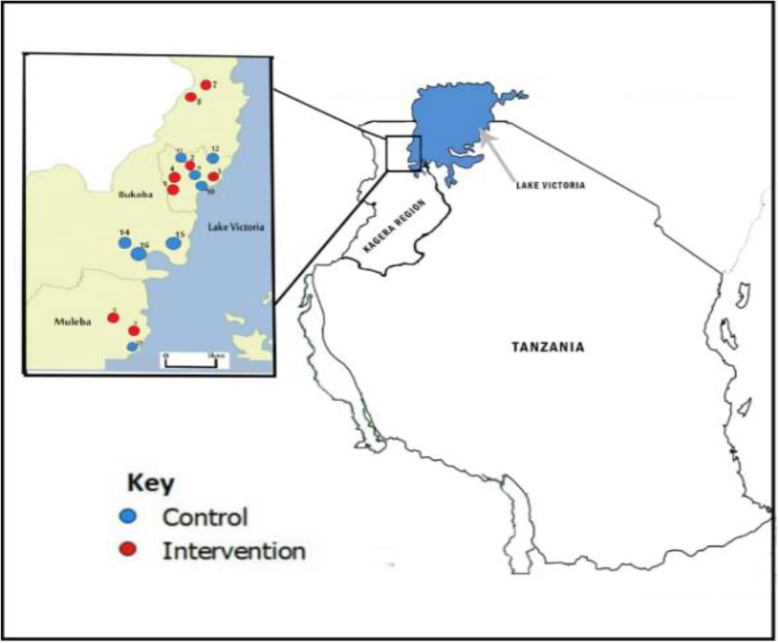
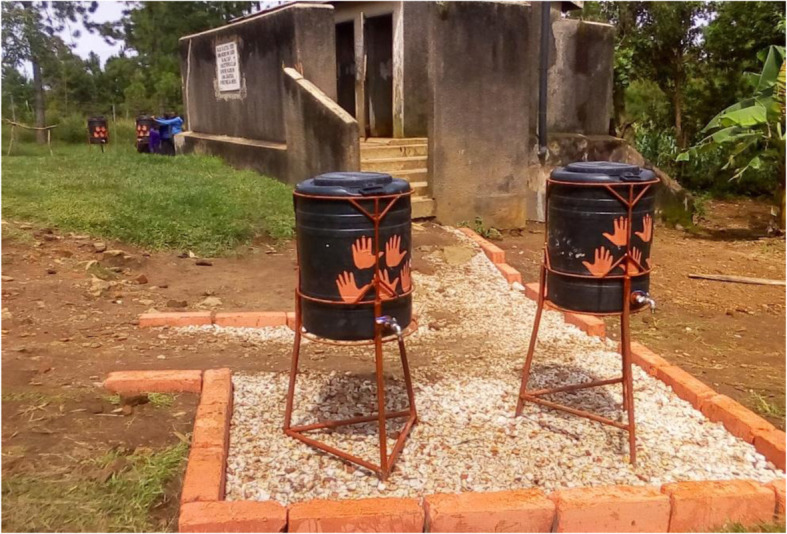
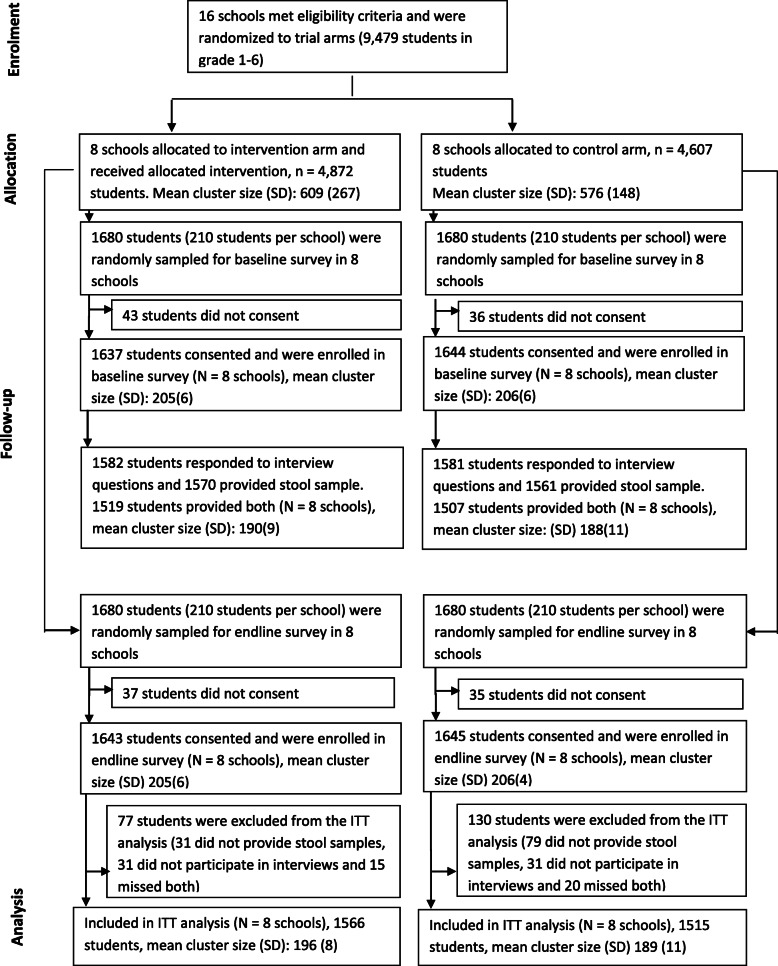
Methods: We conducted a cluster randomised trial in sixteen primary schools with known high STH prevalence. Schools were randomly assigned in a 1:1 ratio to either receive the intervention or continue with routine health education. The intervention included teacher-led classroom teaching, parental engagement sessions, environmental modifications and improved handwashing stations. The evaluation involved two cross-sectional surveys in a representative sample of students, with the end-line survey conducted 12 months after the baseline survey. The primary outcome was the combined prevalence of Ascaris lumbricoides and Trichuris trichiura infections at the end-line survey. Secondary outcomes included reported handwashing behaviour, the prevalence and intensity of individual STHs, and hand contamination with STH ova and coliform bacteria. End-line STH prevalence and intensity were adjusted for baseline differences of potential confounders.
Results: At the end-line survey, 3081 school children (1566 from intervention schools and 1515 from control schools) provided interview data and stool specimens. More school children in the intervention group reported the use of water and soap during handwashing compared to school children in the control group (58% vs. 35%; aOR=1.76, 95%CI 1.28-2.43, p=0.001). The combined prevalence of A. lumbricoides and T. trichiura infections was 39% in both trial arms (aOR = 1.19; 95%CI 0.74-1.91). The prevalence of A. lumbricoides was 15% in the intervention and 17% in the control arm (aOR =1.24, 95%CI 0.59-2.59) and that of T. trichiura was 31% in both arms (aOR=1.17, 95%CI 0.73-1.88). No significant differences were found for STH infection intensity in both the main study and the hand contamination sub-study.
Conclusions: The intervention was effective in increasing reported handwashing behaviour at school, but failed to show a similar effect in the home. The intervention had no effect on STH infection, possibly due to infection in the home environment, other transmission routes such as contaminated water or food or limited changes in school children's handwashing behaviour.
Trial registration: The trial was registered on June 21, 2017, by the International Standard Randomised Controlled Trial Number ( ISRCTN45013173) .
Keywords: Ascaris lumbricoides; Cluster randomised trial; Deworming; Hand hygiene; Handwashing; Mass drug administration; School children; Soil-transmitted helminth; Tanzania; Trichuris trichiura.
Conflict of interest statement
The authors declare that they have no competing interests.
Figures
References
-
- World Health Organization . Soil-transmitted halminthiases: STH: eliminating soil-transmitted helminthiases as a public health problem in children: progress report 2001-2010 and strategic plan 2011-2020. Geneva: World Health Organization; 2012.
-
- Koukounari A, Estambale BBA, KiamboNjagi J, Cundill B, Ajanga A, Crudder C, et al. Relationships between anaemia and parasitic infections in Kenyan schoolchildren: a Bayesian hierarchical modelling approach. Int J Parasitol. 2008;38(14):1663–1671. doi: 10.1016/j.ijpara.2008.05.013. - DOI - PMC - PubMed
-
- United Republic of Tanzania M of E and VT . National Strategic Plan for School Water, Sanitation and Hygiene (SWASH) 2012 - 2017. 2011.
-
- Brooker S, Kabatereine NB, Smith JL, Mupfasoni D, Mwanje MT, Ndayishimiye O, Lwambo NJS, Mbotha D, Karanja P, Mwandawiro C, Muchiri E, Clements ACA, Bundy DAP, Snow RW. An updated atlas of human helminth infections: the example of East Africa. Int J Health Geogr. 2009;8(1):42. doi: 10.1186/1476-072X-8-42. - DOI - PMC - PubMed
Publication types
MeSH terms
Substances
Grants and funding
LinkOut - more resources
Full Text Sources
Other Literature Sources
Medical
