


Review
doi: 10.1016/j.beem.2021.101547.
Epub 2021 May 1.
Preclinical models for investigating how bone marrow adipocytes influence bone and hematopoietic cellularity
Affiliations
- PMID: 34016532
- PMCID: PMC8458229
- DOI: 10.1016/j.beem.2021.101547
Item in Clipboard
Review
Preclinical models for investigating how bone marrow adipocytes influence bone and hematopoietic cellularity
Best Pract Res Clin Endocrinol Metab.
2021 Jul.
Abstract
Laboratory mice are a crucial preclinical model system for investigating bone marrow adipocyte (BMAd)-bone and BMAd-hematopoiesis interactions. In this review, we evaluate the suitability of mice to model common human diseases related to osteopenia or hematopoietic disorders, point out consistencies and discrepancies among different studies, and provide insights into model selection. Species, age, sex, skeletal site, and treatment protocol should all be considered when designing future studies.
Keywords: bone; bone marrow adipocyte; bone marrow adipose tissue; hematopoiesis; preclinical models.
Copyright © 2021 Elsevier Ltd. All rights reserved.
Figures
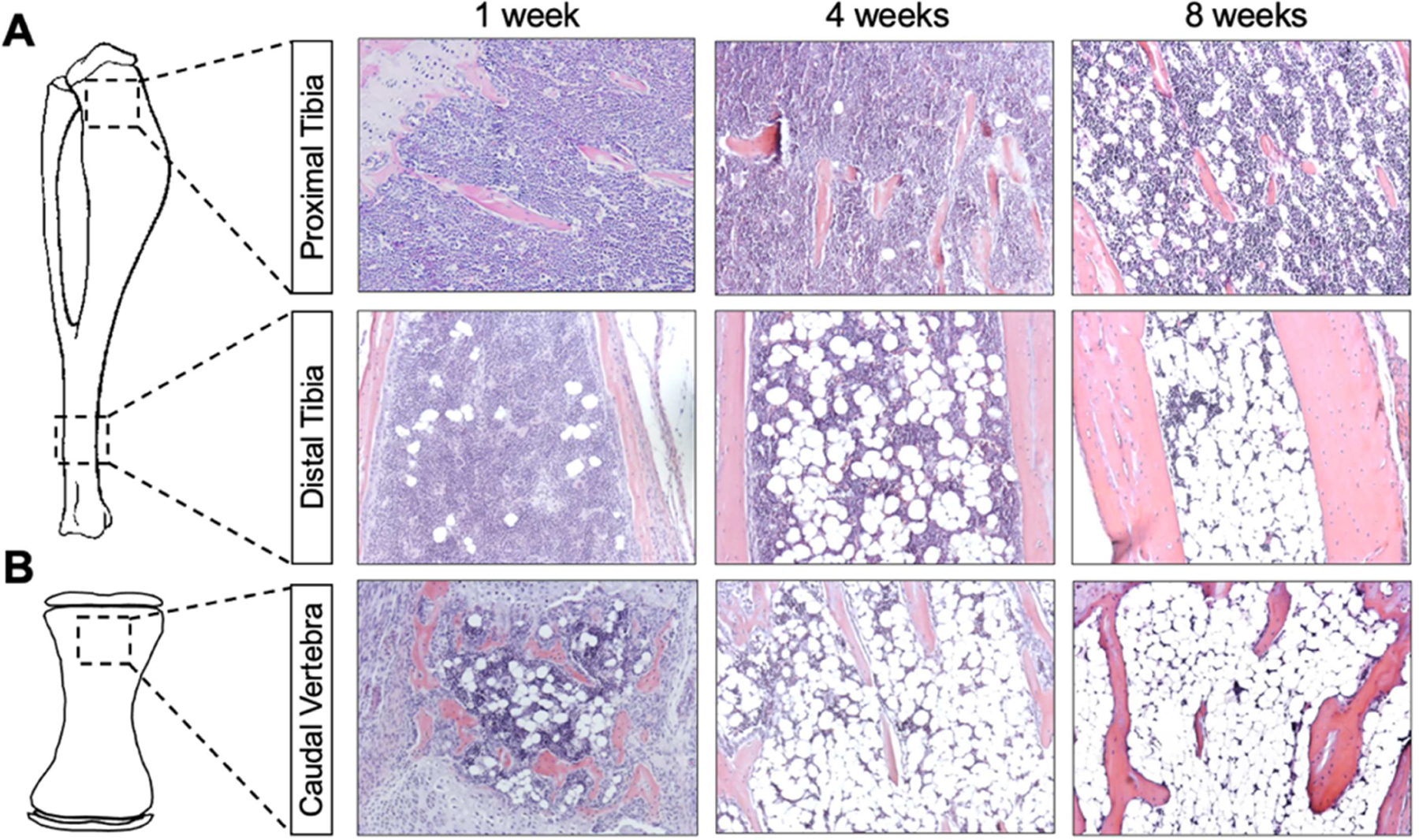
Mouse long bones (A) and 3rd caudal vertebrae (B) were collected at 1, 4 and 8 weeks after birth. Bones were decalcified with 14% EDTA for 3 weeks and used for paraffin sectioning. Slides were stained with hematoxylin (nuclei) and eosin (cytoplasm). Photomicrographs were taken under 200x magnification.

Bone marrow adipocytes (BMAds) may serve as energy source or secrete adipokines/cytokines to influence bone resorption, bone formation, hematopoietic stem cell (HSC) maintenance and hematopoiesis. Many preclinical models have been used to investigate the relationship between BMAds and bone/hematopoiesis. However, each one has their own pros and cons. We reviewed the literature and ranked these models based on their consistencies with human studies and repeatability between different studies. + indicates less-recommended and ++++ indicates well-recommended.
References
-
- Goodsitt MM, Johnson RH, and Chesnut CH 3rd, A new set of calibration standards for estimating the fat and mineral content of vertebrae via dual energy QCT. Bone Miner, 1991. 13(3): p. 217–33. - PubMed
Publication types
MeSH terms
Grants and funding
LinkOut - more resources
Full Text Sources
Other Literature Sources
