


Law and Policy as Tools in Healthy People 2030
- PMID: 34016909
- PMCID: PMC8478297
- DOI: 10.1097/PHH.0000000000001358
Law and Policy as Tools in Healthy People 2030
Abstract
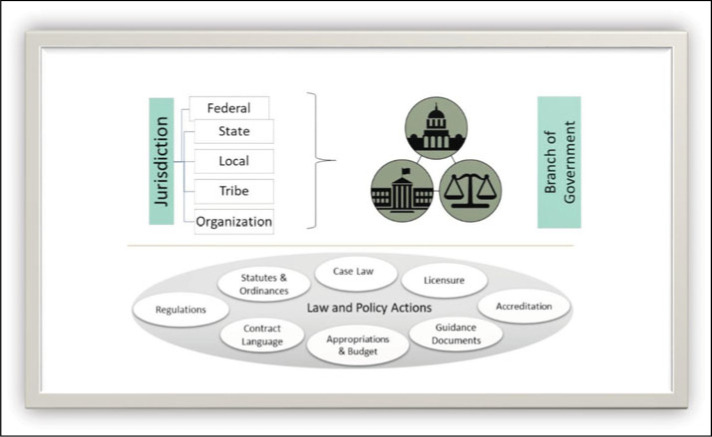
Laws and policies are critical determinants of health and well-being. They can encourage positive behaviors and discourage harmful behaviors, and they can enhance or worsen health, health equity, health disparities, and health literacy. Recognizing their contribution to conditions in the environments in which people are born, live, learn, work, play, worship, and age, and people's experiences of these conditions, the US Department of Health and Human Services considered the roles of law and policy throughout its development of Healthy People 2030. Laws and policies often interrelate, but they have different purposes. A law is an established procedure, standard, or system of rules that members of a society must follow. A policy is a decision or set of decisions meant to address a long-term purpose or problem. Healthy People 2030 offers an opportunity for users in diverse sectors and at all levels to use laws and policies to support or inform the initiative's implementation, address health disparities and health inequities, and improve health and well-being in this decade. Introducing new laws and policies or rescinding existing ones to achieve Healthy People 2030 goals offers a chance to rigorously assess outcomes and weigh the balance of good outcomes against unintended consequences.
Copyright © 2021 The Authors. Published by Wolters Kluwer Health, Inc.
Conflict of interest statement
The authors declare no conflicts of interest.
Figures
References
-
- Wiley LF. Health law as social justice. Cornell J Law Public Policy. 2014;24(1):47–105. https://scholarship.law.cornell.edu/cjlpp/vol24/iss1/2. Accessed August 26, 2020. - PubMed
-
- Benfer EA. Health justice: a framework (and call to action) for the elimination of health inequity and social injustice. Am Univ Law Rev. 2015;65(2):275–351. http://www.aulawreview.org/health-justice-a-framework-and-call-to-action.... Accessed August 26, 2020. - PubMed
-
- Committee on Public Health Strategies to Improve Health, Institute of Medicine. For the Public's Health: Investing in a Healthier Future. Washington, DC: National Academies Press; 2012. https://www.ncbi.nlm.nih.gov/books/NBK201011. Accessed January 30, 2021. - PubMed
-
- US Department of Health, Education, and Welfare. Healthy People: The Surgeon General's Report on Health Promotion and Disease Prevention. Washington, DC: US Government Printing Office; 1979.
-
- US Department of Health and Human Services. The 1990 Health Objectives for the Nation: A Midcourse Review. Washington, DC: US Government Printing Office; 1986.
MeSH terms
LinkOut - more resources
Full Text Sources
Other Literature Sources
Medical
