Editorial
. 2021 May 10:27:e933015.
doi: 10.12659/MSM.933015.

Editorial: The Pathogenesis of Long-Term Neuropsychiatric COVID-19 and the Role of Microglia, Mitochondria, and Persistent Neuroinflammation: A Hypothesis

Affiliations
Editorial

Editorial: The Pathogenesis of Long-Term Neuropsychiatric COVID-19 and the Role of Microglia, Mitochondria, and Persistent Neuroinflammation: A Hypothesis

George B Stefano et al. Med Sci Monit. .

Abstract

Persistent comorbidities occur in patients who initially recover from acute coronavirus disease 2019 (COVID-19) due to infection with severe acute respiratory syndrome coronavirus 2 (SARS-CoV-2). 'Long COVID' involves the central nervous system (CNS), resulting in neuropsychiatric symptoms and signs, including cognitive impairment or 'brain fog' and chronic fatigue syndrome. There are similarities in these persistent complications between SARS-CoV-2 and the Ebola, Zika, and influenza A viruses. Normal CNS neuronal mitochondrial function requires high oxygen levels for oxidative phosphorylation and ATP production. Recent studies have shown that the SARS-CoV-2 virus can hijack mitochondrial function. Persistent changes in cognitive functioning have also been reported with other viral infections. SARS-CoV-2 infection may result in long-term effects on immune processes within the CNS by causing microglial dysfunction. This short opinion aims to discuss the hypothesis that the pathogenesis of long-term neuropsychiatric COVID-19 involves microglia, mitochondria, and persistent neuroinflammation.


Figures
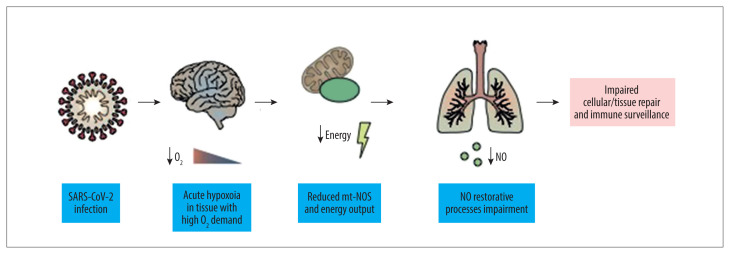
Figure 1
Figure 1. Following SARS-CoV-2 infection, blood-borne competent mitochondria provide a novel source of restorative ATP and constitutive nitric oxide synthase (cNOS) to stimulate the release of nitric oxide (NO), which is anti-inflammatory
During acute stress from viral infection, proinflammatory responses partially mediate autoregulatory homeostatic mechanisms and maintain immune surveillance against infection [18]. Changes in the production of proinflammatory mediators commonly occur in autoimmune diseases and comorbid syndromes [18]. Cell-free mitochondria with significant bioenergetics capacity are present in the peripheral circulation [1]. Blood-borne competent mitochondria may represent a novel source of restorative ATP. Also, cNOS activation results in enhanced production, release, and intra-mitochondrial recycling of NO, which promote anti-inflammatory processes, to effectively modulate cell damage following viral infection [19].
Figure 2
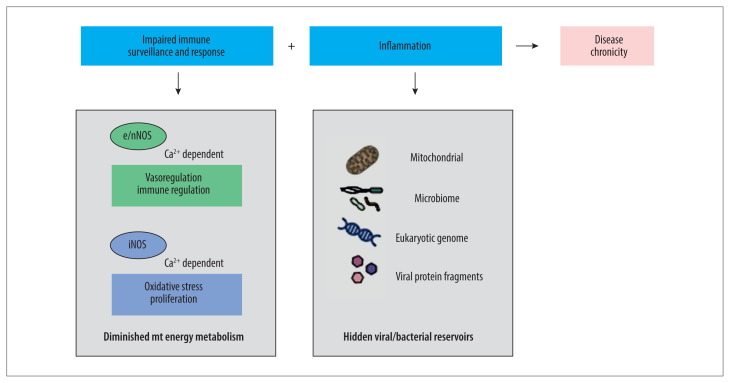
Figure 2. The persistent presence and magnitude of chronic symptoms linked to viral infections, including ‘long COVID’ may occur by altering the normal healing process
There are empirically determined normal regulatory equilibria between the sympathetic and parasympathetic branches of the autonomic nervous system. A model of behaviorally-mediated regulatory effects on whole-body metabolic processes is intrinsically broad-based and multifaceted with the integration of the peripheral nervous system (PNS) and the central nervous system (CNS) [18]. Regulatory molecules, including nitric oxide (NO) are multifaceted and stereoselective, and associated with conformational matching. Acute proinflammatory events have the potential to lead to chronic disruption of regulatory molecules. The morbidity that is associated with viral and bacterial infection highlights the role of high-efficiency mitochondrial bioenergetics. Complex behavioral, cognitive, and motor activities may be functionally linked to the fine-tuned cellular metabolic processes, which, when altered following widespread infection [17,19]. Therefore, whole-body bioenergetics is reciprocally and synergistically dependent on the mitochondrial genomic health of the host. Also, the microenvironment in areas of tissue damage may serve as reservoirs for persistent viral and bacterial by products, resulting in chronic inflammation [19]. NO signaling is evolutionarily conserved and complex, highlighting its importance in disease chronicity, including persistent neuroinflammation following SARS-CoV-2 infection [19].

References

    1. Esch T, Stefano GB, Ptacek R, Kream RM. Emerging roles of blood-borne intact and respiring mitochondria as bidirectional mediators of pro- and anti-inflammatory processes. Med Sci Monit. 2020;26:e924337. - PMC - PubMed
    1. Wang F, Kream RM, Stefano GB. Long-term respiratory and neurological sequelae of COVID-19. Med Sci Monit. 2020;26:e928996. - PMC - PubMed
    1. Stefano GB, Ptacek R, Ptackova H, et al. Selective neuronal mitochondrial targeting in SARS-CoV-2 infection affects cognitive processes to induce ‘brain fog’ and results in behavioral changes that favor viral survival. Med Sci Monit. 2021;27:e930886. - PMC - PubMed
    1. Dutta S, Das N, Mukherjee P. Picking up a fight: Fine tuning mitochondrial innate immune defenses against RNA viruses. Front Microbiol. 2020;11:1990. - PMC - PubMed
    1. Salmond GP, Fineran PC. A century of the phage: Past, present and future. Nat Rev Microbiol. 2015;13:777–86. - PubMed

Publication types