Review
. 2021 May 20;4(1):601.
doi: 10.1038/s42003-021-02118-w.

Wnt signaling in lung development, regeneration, and disease progression

Affiliations
Review

Wnt signaling in lung development, regeneration, and disease progression

Cody J Aros et al. Commun Biol. .

Abstract

The respiratory tract is a vital, intricate system for several important biological processes including mucociliary clearance, airway conductance, and gas exchange. The Wnt signaling pathway plays several crucial and indispensable roles across lung biology in multiple contexts. This review highlights the progress made in characterizing the role of Wnt signaling across several disciplines in lung biology, including development, homeostasis, regeneration following injury, in vitro directed differentiation efforts, and disease progression. We further note uncharted directions in the field that may illuminate important biology. The discoveries made collectively advance our understanding of Wnt signaling in lung biology and have the potential to inform therapeutic advancements for lung diseases.


Conflict of interest statement

The authors declare no competing interests.

Figures
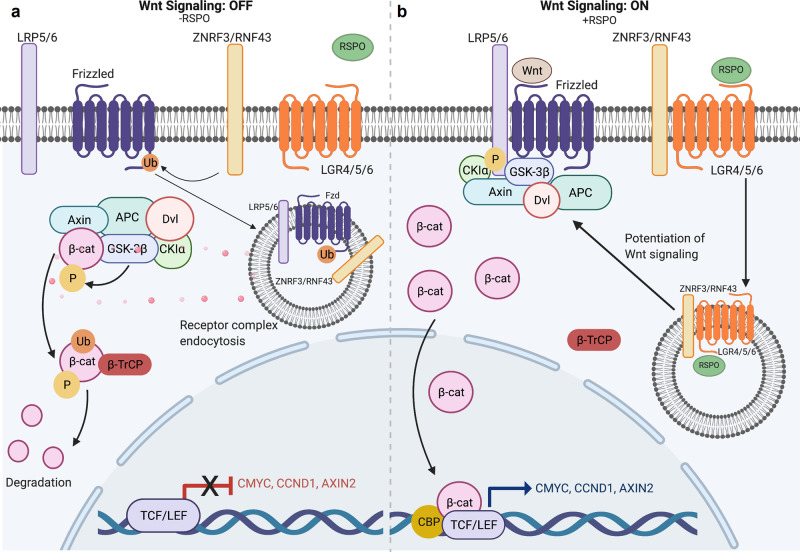
Fig. 1
Fig. 1. Overview of canonical Wnt signaling.
a In the absence of RSPO binding to LGR4/5/6, ubiquitin ligase ZNRF43/RNF43 ubiquitinates the Frizzled receptor which leads to receptor complex endocytosis, β-catenin degradation and subsequent inhibition of Wnt-driven transcriptional activity. b The binding of RSPO to LGR4/5/6 potentiates Wnt signaling by removing ZNR43/RNF43 ubiquitin ligase from the cell membrane, which would otherwise mark Frizzled receptor for ubiquitination. Frizzled receptors are then able to interact with both Wnt ligand and LRP5/6 co-receptor to drive Wnt signaling cascade. β-catenin then escapes cytoplasmic proteasomal degradation, resulting in its nuclear translocation, interactions with transcription factors. TCF/LEF, and subsequent transactivation of Wnt target genes like c-MYC, CyclinD1, and Axin2.
Fig. 2
Fig. 2. Wnt signals mediate epithelial–mesenchymal interactions during lung development.
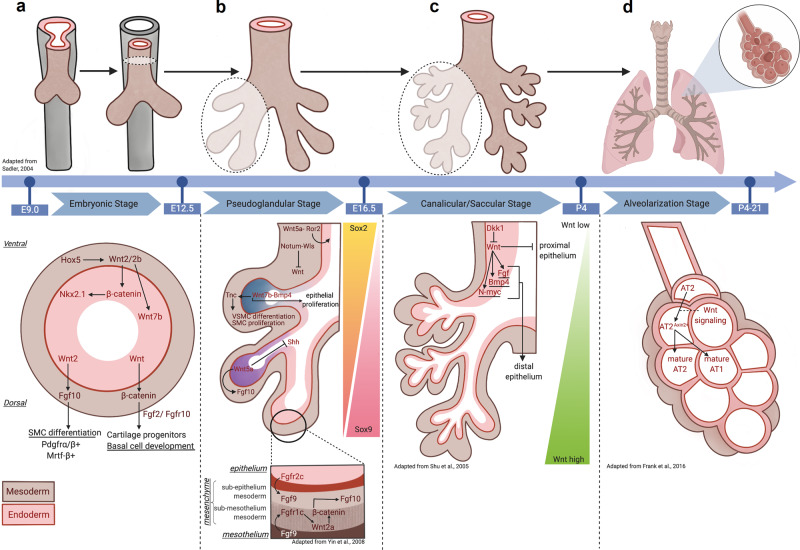
a During the embryonic stage (E9.0–12.5) of development, lung bud emerges from tracheal-esophageal septation occurs. Mesenchymal (brown) HOX5 spatiotemporally regulates endodermal (pink) Wnt2/2b to establish NKX2.1 lung progenitor via downstream β-catenin signaling. Endodermal Wnt ligands also promote mesenchymal FGF10 and β-catenin, which then allow for SMC differentiation and cartilage and basal cell development. b During the pseudoglandular stage (E12.5–E16.5), lung buds undergo branching morphogenesis to develop terminal bronchioles. Mesenchymal Wnt5a promotes tracheal and cartilage formation via ROR2-dependent mechanisms. Wntless (Wls)-regulated Notum suppresses mesenchymal Wnt and is necessary for tracheal development and branching morphogenesis,. A Wnt7b-BMP4 signaling axis also promotes epithelial proliferation and mesenchymal vascular SMC (VSMC) differentiation and SMC proliferation. Further, epithelial Wnt5a expression is highest in distal tips, and works to promote branching morphogenesis via suppression and activation of SHH and Fgf10 signaling, respectively. A closer examination of the mesenchyme reveals FGF9 signaling from both the epithelium and mesothelium converge to promote submesothelial Wnt2a and facilitate mesenchymal cell proliferation. c During the canalicular/saccular stages of development (E16.5-P4), terminal bronchioles become more defined and form epithelial sacs. Negative regulation of Wnt by DKK1 results in proximalization of lung epithelium. High levels of Wnt signaling drive a distal airway phenotype, mediated in part by N-MYC-BMP4-FGF signaling. d The alveolarization stage (P4–21) concludes with the maturation of alveolar structures. Wnt-responsive (AXIN2+) ATII cells regulate lung alveologenesis by skewing toward a mature ATII lineage and in lieu of an ATI lineage.
Fig. 3
Fig. 3. Wnt signaling plays pivotal roles in submucosal gland, proximal airway, bronchiolar, and distal lung regeneration.
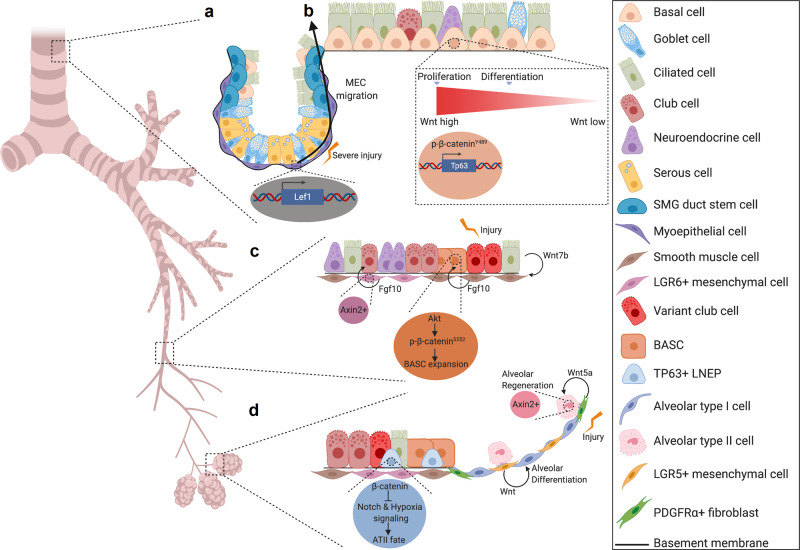
a Following severe injury, Lef1 transcription within MECs of the SMGs promotes their migration to the surface airway epithelium and their subsequent ability to give rise to the differentiated cell types of the proximal airway,. b In the proximal airway ABSCs employ high levels of Wnt signaling to facilitate proliferation and medium levels of Wnt signaling to promote differentiation to the ciliated cell fate. At the molecular level, this appears to be accomplished by nuclear localization of p-β-cateninY489 . Further, Tp63 is regulated by upstream Wnt signaling to promote basal cell stemness, thereby inhibiting differentiation to ciliated cells. c In the bronchioles after injury, ciliated cells produce Wnt7b ligand that signals to airway smooth muscle cells (SMCs). SMCs then secrete Fgf10 ligand to promote an Akt/p-β-cateninS552 signaling cascade. These events then, in turn, promote BASC expansion,. Another study identified that Wnt-responsive (Axin2+) Lgr6+ mesenchymal cells are a key source of Fgf10 ligand to promote bronchiolar repair. d At the bronchioalveolar duct junction, LNEPs employ β-catenin signaling to inhibit Notch and hypoxia signaling that is permissive for formation of an ATII-like cell fate. Further, Lgr5+ mesenchymal cells secrete Wnt ligands that promote alveolar differentiation. In the alveolus, Pdgfrα+ fibroblasts are also a key source of Wnt5a to signal to Axin2+ ATII cells to drive alveolar regeneration.
Fig. 4
Fig. 4. Directed differentiation of iPSCs to lung lineages utilizes perturbations in Wnt signaling at various stages.
a Primary report to lung-directed differentiation utilized Activin to induce definitive endoderm specification. Use of Noggin and SB431542, a bone morphogenetic protein (BMP) and transforming growth factor beta (TGFβ) family signaling inhibitor, respectively, in Activin A-induced definitive endoderm drives anterior foregut endoderm (AFE) specification. Further differentiation of the AFE would utilize a WKFBE factor cocktail (WNT3a, keratinocyte growth factor (KGF), fibroblast growth factor (FGF) 10, BMP4, epidermal growth factor (EGF)) alongside retinoic acid (RA) to attain lung endoderm progenitors (NKX2.1+). Consistent with idea that activated Wnt signaling promotes distal lung phenotype, treatment of lung endoderm progenitors with Wnt3a, FGF10, and KGF promotes a distal phenotype. b Subsequent studies introduced Wnt3a, alongside Activin, to generate definitive endoderm. GSK3β inhibitor CHIR, alongside FGFs and BMPs, facilitates generation of NKX2.1+ lung endoderm from anterior foregut endoderm. Tankyrase inhibition via treatment with IWR-1 skewed cells toward a more proximal fate,. New additions to differentiation protocols are indicated in blue while Wnt-specific biology is highlighted in green. c Subsequent efforts utilized among other factors in a “ventralization” cocktail that allowed for more efficient derivation of NKX2.1+ lung endoderm from anterior foregut endoderm. New additions to differentiation protocols are indicated in blue while Wnt-specific biology is highlighted in green. d Between 2014–2017, refined strategies emerged that indicate the importance of the level of Wnt modulation by the absence or addition of CHIR to skew cell fates toward a more proximal or distal fate from NKX2.1+ lung endoderm,,. New additions to differentiation protocols are indicated in blue while Wnt-specific biology is highlighted in green. e Most recently, using mouse PSCs, Wnt3a was removed from the generative of definitive endoderm and instead utilized in a “distalization media” to skew Nkx2.1+ lung endodermal progenitors to a more distal lung epithelial fate. New additions to differentiation protocols are indicated in blue while Wnt-specific biology is highlighted in green.

References

    1. Cardoso WV, Whitsett JA. Resident cellular components of the lung: developmental aspects. Proc. Am. Thorac. Soc. 2008;5:767–771. doi: 10.1513/pats.200803-026HR. - DOI - PMC - PubMed
    1. Bustamante-Marin, X. M. & Ostrowski, L. E. Cilia and mucociliary clearance. Cold Spring Harb. Perspect. Biol.9, a028241 (2017). - PMC - PubMed
    1. Nusse R, Clevers H. Wnt/beta-catenin signaling, disease, and emerging therapeutic modalities. Cell. 2017;169:985–999. doi: 10.1016/j.cell.2017.05.016. - DOI - PubMed
    1. Szenker-Ravi E, et al. RSPO2 inhibition of RNF43 and ZNRF3 governs limb development independently of LGR4/5/6. Nature. 2018;557:564–569. doi: 10.1038/s41586-018-0118-y. - DOI - PubMed
    1. Clevers H, Loh KM, Nusse R. Stem cell signaling. An integral program for tissue renewal and regeneration: Wnt signaling and stem cell control. Science. 2014;346:1248012. doi: 10.1126/science.1248012. - DOI - PubMed