Review
. 2021 May 4:12:656452.
doi: 10.3389/fimmu.2021.656452. eCollection 2021.

Targeting Immune Cell Trafficking - Insights From Research Models and Implications for Future IBD Therapy

Affiliations
Review

Targeting Immune Cell Trafficking - Insights From Research Models and Implications for Future IBD Therapy

Maximilian Wiendl et al. Front Immunol. .

Abstract

Inflammatory bowel diseases (IBDs), including Crohn's disease (CD) and ulcerative colitis (UC) are multifactorial diseases with still unknown aetiology and an increasing prevalence and incidence worldwide. Despite plentiful therapeutic options for IBDs, the lack or loss of response in certain patients demands the development of further treatments to tackle this unmet medical need. In recent years, the success of the anti-α4β7 antibody vedolizumab highlighted the potential of targeting the homing of immune cells, which is now an important pillar of IBD therapy. Due to its complexity, leukocyte trafficking and the involved molecules offer a largely untapped resource for a plethora of potential therapeutic interventions. In this review, we aim to summarise current and future directions of specifically interfering with immune cell trafficking. We will comment on concepts of homing, retention and recirculation and particularly focus on the role of tissue-derived chemokines. Moreover, we will give an overview of the mode of action of drugs currently in use or still in the pipeline, highlighting their mechanisms and potential to reduce disease burden.

Keywords: IBD; T cell; homing; retention; therapy; trafficking.


Conflict of interest statement

The authors declare that the research was conducted in the absence of any commercial or financial relationships that could be construed as a potential conflict of interest.

Figures
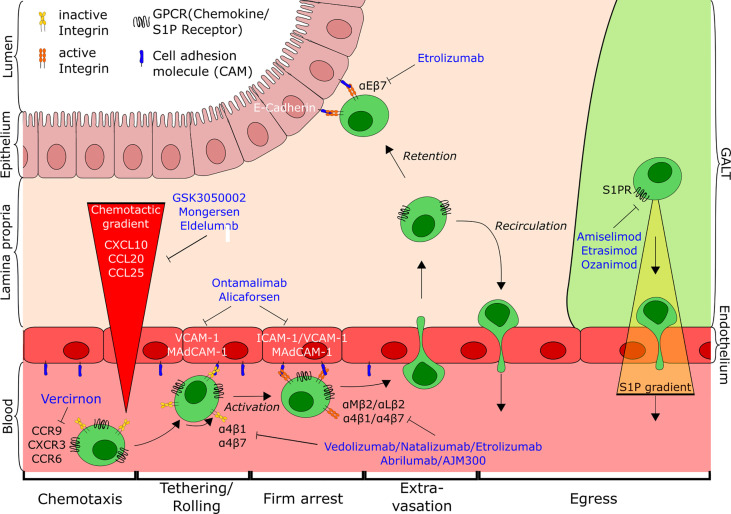
Figure 1
Figure 1
Overview of T cell trafficking in the intestine indicating the points of action of current and potential future anti-trafficking agents for the treatment of IBD. Tethering and rolling of cells on the endothelial wall mediated by interaction of low-affinity integrins with their respective ligands (e.g. α4β7-MAdCAM-1) leads to the exposure to a chemokine gradient (CCL25, CXCL10, CCL20). Subsequent activation of cells causes conformational changes of the integrins, followed by firm arrest and extravasation of T cells to the gut. There, cells are either retained in the tissue through interaction with the epithelium (αEβ7-E-cadherin) or antagonism of egress, or recirculate into the blood from gut and GALT along the S1P-gradient. CD, cluster of differentiation; CCR, Chemokine receptor; CXCR, CXC-motif chemokine receptor; GPCR, G-protein coupled receptor; S1P, Sphingosine-1-phospate; S1PR, Sphingosine-1-phosphate receptor; ICAM-1, Intercellular adhesion molecule 1; VCAM-1, Vascular cell adhesion molecule 1; MAdCAM-1, Mucosal addressin cell adhesion molecule-1; GALT, Gut-associated lymphoid tissue.

References

    1. von Andrian UH, Mackay CR. T-Cell Function and Migration — Two Sides of the Same Coin. N Engl J Med (2000) 343:1020–34. 10.1056/nejm200010053431407 - DOI - PubMed
    1. Ley K, Laudanna C, Cybulsky MI, Nourshargh S. Getting to the Site of Inflammation: The Leukocyte Adhesion Cascade Updated. Nat Rev Immunol (2007) 7:678–89. 10.1038/nri2156 - DOI - PubMed
    1. Butcher EC, Scollay RG, Weissman IL. Organ Specificity of Lymphocyte Migration: Mediation by Highly Selective Lymphocyte Interaction With Organ-Specific Determinants on High Endothelial Venules. Eur J Immunol (1980) 10:556–61. 10.1002/eji.1830100713 - DOI - PubMed
    1. Girard JP, Springer TA. High Endothelial Venules (Hevs): Specialized Endothelium for Lymphocyte Migration. Immunol Today (1995) 16:449–57. 10.1016/0167-5699(95)80023-9 - DOI - PubMed
    1. Habtezion A, Nguyen LP, Hadeiba H, Butcher EC. Leukocyte Trafficking to the Small Intestine and Colon. Gastroenterology (2016) 150:340–54. 10.1053/j.gastro.2015.10.046 - DOI - PMC - PubMed

Publication types

MeSH terms

LinkOut - more resources
