. 2021 May 4:8:592336.
doi: 10.3389/fmed.2021.592336. eCollection 2021.

Prediction of COVID-19 Hospital Length of Stay and Risk of Death Using Artificial Intelligence-Based Modeling

Affiliations

Prediction of COVID-19 Hospital Length of Stay and Risk of Death Using Artificial Intelligence-Based Modeling

Bassam Mahboub et al. Front Med (Lausanne). .

Abstract

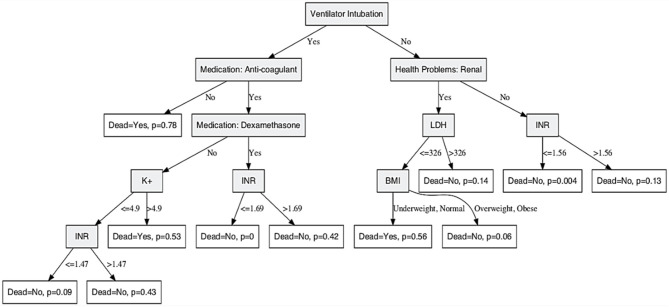
Severe acute respiratory syndrome coronavirus 2 (SARS-CoV-2) is a highly infectious virus with overwhelming demand on healthcare systems, which require advanced predictive analytics to strategize COVID-19 management in a more effective and efficient manner. We analyzed clinical data of 2017 COVID-19 cases reported in the Dubai health authority and developed predictive models to predict the patient's length of hospital stay and risk of death. A decision tree (DT) model to predict COVID-19 length of stay was developed based on patient clinical information. The model showed very good performance with a coefficient of determination R 2 of 49.8% and a median absolute deviation of 2.85 days. Furthermore, another DT-based model was constructed to predict COVID-19 risk of death. The model showed excellent performance with sensitivity and specificity of 96.5 and 87.8%, respectively, and overall prediction accuracy of 96%. Further validation using unsupervised learning methods showed similar separation patterns, and a receiver operator characteristic approach suggested stable and robust DT model performance. The results show that a high risk of death of 78.2% is indicated for intubated COVID-19 patients who have not used anticoagulant medications. Fortunately, intubated patients who are using anticoagulant and dexamethasone medications with an international normalized ratio of <1.69 have zero risk of death from COVID-19. In conclusion, we constructed artificial intelligence-based models to accurately predict the length of hospital stay and risk of death in COVID-19 cases. These smart models will arm physicians on the front line to enhance management strategies to save lives.

Keywords: COVID-19; artificial intelligence; length of stay; predictive analytics; risk of death.


Conflict of interest statement

The authors declare that the research was conducted in the absence of any commercial or financial relationships that could be construed as a potential conflict of interest.

Figures
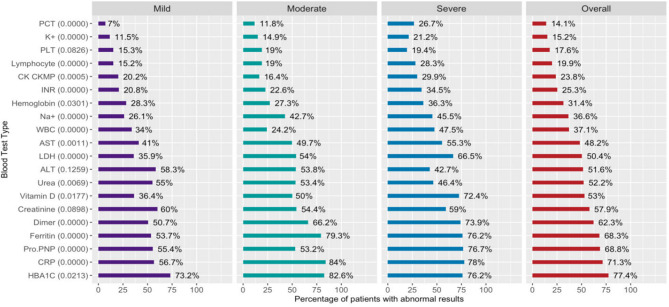
Figure 1
Figure 1
Percentage of patients with abnormal laboratory test results. Percentage of patients with abnormal blood test results was calculated as the proportion of patients with blood test results outside the normal range at each disease severity level. Numbers in parentheses are the Chi-squared p-values for testing for significant differences among severity levels.
Figure 2
Figure 2
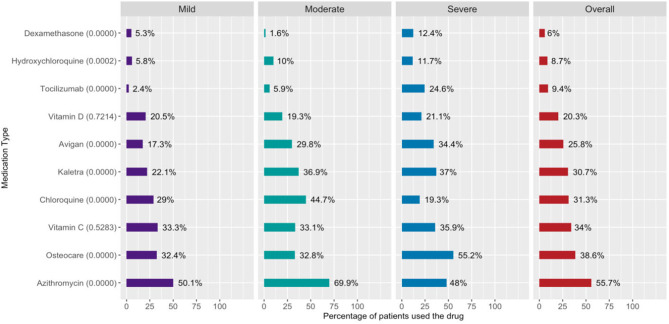
Percentage of patients prescribed COVID-19 treatment drugs. Percentage of patients prescribed COVID-19 medications shown in the y-axis of the figure. Proportions were calculated as the proportion of patients prescribed the medication of all patients at that severity level. Numbers in parentheses are the Chi-squared p-values for testing for significant differences among severity levels.
Figure 3
Figure 3
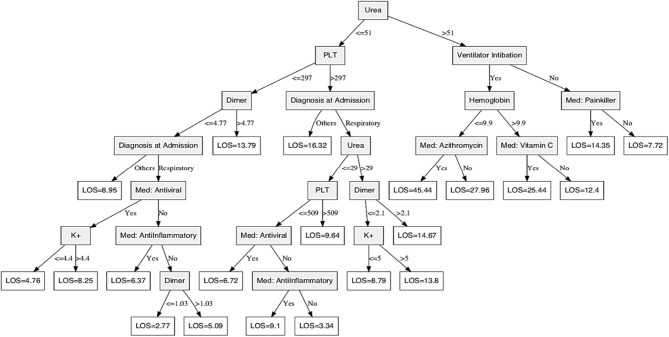
Decision Tree model for predicting COVID-19 patients' hospital length of stay. A secision tree prediction model was constructed to predict patient's hospital length of stay given demographic and clinical attributes at initial evaluation. Shaded nodes are the parent/split nodes, and the non-shaded nodes are the leaf nodes of the DT model. The conditional recursive partitioning tree algorithm (ctree) was used for model building.
Figure 4
Figure 4
Decision tree model for predicting COVID-19 risk of death. A decision tree prediction model was constructed to predict patient's risk of death given demographic and clinical attributes at initial evaluation. Shaded nodes are the parent/split nodes, and the non-shaded nodes are the leaf nodes of the DT model. The conditional recursive partitioning tree algorithm (ctree) was used for model building. The parameter p shown at the leaf nodes is the risk of death for patients satisfying the conditions of that tree branch.
Figure 5
Figure 5
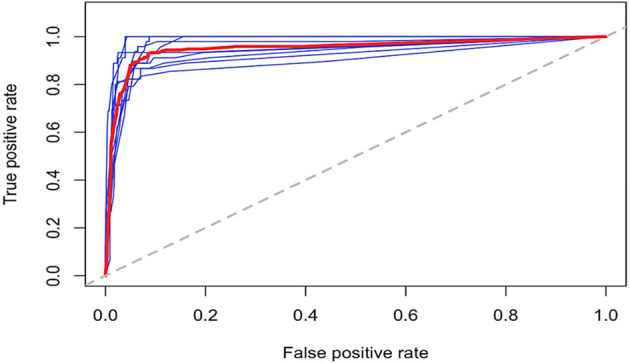
Risk of death ROC curves for the tenfold cross-validation subsets. ROC curves for the tenfold training data used at the model-building step. Blue lines represent the ROC curves at each cross-validation fold, and the red bold line represent the average across all cross-validation folds.

References

    1. Huang C, Wang Y, Li X, Ren L, Zhao J, Hu Y, et al. Clinical features of patients infected with 2019 novel coronavirus in Wuhan, China. Lancet. (2020) 395:497–506. 10.1016/S0140-6736(20)30183-5 - DOI - PMC - PubMed
    1. Lai Y, Yeung W, Celi LA. Urban intelligence for pandemic response: viewpoint. JMIR Public Health Surveill. (2020) 6:e18873. 10.2196/18873 - DOI - PMC - PubMed
    1. Silver D, Schrittwieser J, Simonyan K, Antonoglou I, Huang A, Guez A, et al. Mastering the game of Go without human knowledge. Nature. (2017) 550:354–9. 10.1038/nature24270 - DOI - PubMed
    1. Pickering BW, Dong Y, Ahmed A, Giri J, Kilickaya O, Gupta A, et al. The implementation of clinician designed, human-centered electronic medical record viewer in the intensive care unit: a pilot step-wedge cluster randomized trial. Int J Med Inform. (2015) 84:299–307. 10.1016/j.ijmedinf.2015.01.017 - DOI - PubMed
    1. Steele AJ, Denaxas SC, Shah AD, Hemingway H, Luscombe NM. Machine learning models in electronic health records can outperform conventional survival models for predicting patient mortality in coronary artery disease. PLoS ONE. (2018) 13:e0202344. 10.1371/journal.pone.0202344 - DOI - PMC - PubMed