Review
. 2021 Nov 29;144(10):2915-2932.
doi: 10.1093/brain/awab201.

Karyopherin abnormalities in neurodegenerative proteinopathies

Affiliations
Review

Karyopherin abnormalities in neurodegenerative proteinopathies

Terouz Pasha et al. Brain. .

Abstract

Neurodegenerative proteinopathies are characterized by progressive cell loss that is preceded by the mislocalization and aberrant accumulation of proteins prone to aggregation. Despite their different physiological functions, disease-related proteins like tau, α-synuclein, TAR DNA binding protein-43, fused in sarcoma and mutant huntingtin, all share low complexity regions that can mediate their liquid-liquid phase transitions. The proteins' phase transitions can range from native monomers to soluble oligomers, liquid droplets and further to irreversible, often-mislocalized aggregates that characterize the stages and severity of neurodegenerative diseases. Recent advances into the underlying pathogenic mechanisms have associated mislocalization and aberrant accumulation of disease-related proteins with defective nucleocytoplasmic transport and its mediators called karyopherins. These studies identify karyopherin abnormalities in amyotrophic lateral sclerosis, frontotemporal dementia, Alzheimer's disease, and synucleinopathies including Parkinson's disease and dementia with Lewy bodies, that range from altered expression levels to the subcellular mislocalization and aggregation of karyopherin α and β proteins. The reported findings reveal that in addition to their classical function in nuclear import and export, karyopherins can also act as chaperones by shielding aggregation-prone proteins against misfolding, accumulation and irreversible phase-transition into insoluble aggregates. Karyopherin abnormalities can, therefore, be both the cause and consequence of protein mislocalization and aggregate formation in degenerative proteinopathies. The resulting vicious feedback cycle of karyopherin pathology and proteinopathy identifies karyopherin abnormalities as a common denominator of onset and progression of neurodegenerative disease. Pharmacological targeting of karyopherins, already in clinical trials as therapeutic intervention targeting cancers such as glioblastoma and viral infections like COVID-19, may therefore represent a promising new avenue for disease-modifying treatments in neurodegenerative proteinopathies.

Keywords: karyopherin; neurodegeneration; nucleocytoplasmic transport; phase transition; protein aggregation.


Figures

Figure 1
Figure 1
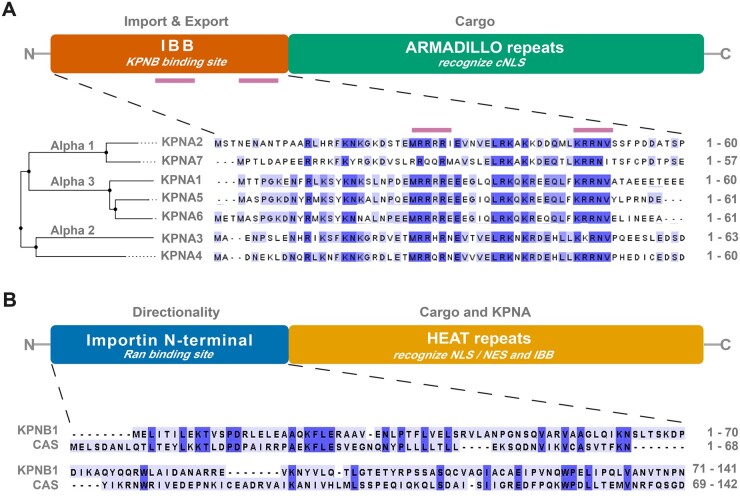
Functional architecture of karyopherins. (A) KPNA family proteins consist of two main functional domains: an importin beta (KPNB) binding (IBB) domain for nuclear import and export and armadillo repeats for the recognition of canonical NLS (cNLS) of cargo proteins. The IBB consists of cNLS binding boxes (bars in purple), major (‘KRR’) and minor (‘RRRR’ or ‘RRQR’ or ‘RRHR’) binding sites, which in the absence of KPNB occupy the canonical NLS-binding surface of armadillo repeats. This prevents import of ‘unloaded’ karyopherin complexes in the nucleus. KPNA family proteins are subdivided into three subfamilies, α1, α2 and α3, based on differences in amino acid sequence in their IBB domain and cNLS binding sites. See Table 1 for details on all KPNA family members. (B) KPNB family proteins comprise an N-terminal (20–120 amino acids) importin domain responsible for binding with Ran and for directed protein translocation across the nuclear envelope, and HEAT repeats that are distinguishable by their flexibility and recognition/binding of cargo-proteins via the NLS or the nuclear export signal and binding to KPNA. Shown are two functionally important representatives of the KPNB family, KPNB1 and CAS (see Table 2 for details on all KPNB family members). Protein sequences were obtained from UniProt (see Tables 1 and 2 for ID numbers); Clustal Omega was used for sequence alignment. CAS = cellular apoptosis susceptibility protein; NES = nuclear export signal.
Figure 2
Figure 2
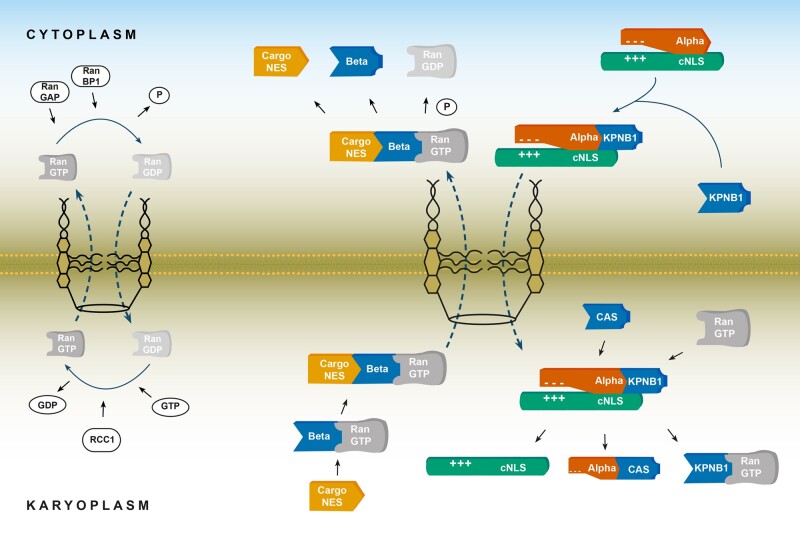
Nucleocytoplasmic transport and chaperone function of karyopherins.Left: Schematic diagram showing the RanGTP/GDP cycle through the nuclear pore complex. In the cytoplasm, RanGAP1, together with RanBP, hydrolyses RanGTP to maintain high cytoplasmic concentrations of RanGDP. In the nucleus, RCC1 (nuclear RanGEF) facilitates GTP-GDP exchange, causing high concentrations of RanGTP. These regulators maintain higher concentrations of RanGDP in the cytoplasm whilst preserving high levels of RanGTP in the karyoplasm, leading to a gradient required for energy-dependent nucleocytoplasmic transport. Right: Schematic diagram of the classical nuclear import and export pathway. During nuclear import, KPNB1 binds to KPNA, which itself is bound to the classical NLS (cNLS) of cargo, forming a trimeric complex. KPNA also exerts chaperone function to cargo-cNLS by shielding basic residues from hydrophobic/ionic interactions, which maintains a cargo protein in its native soluble state. KPNB1 carries the complex through the nuclear pore complex, where RanGTP binds, causing a conformational change in the bound importin (note, some KPNBs shown as beta bind directly to cargo forming a dimeric complex which directly translocates to the nucleus). This results in a trimeric complex of KPNA, nuclear export factor CAS, and RanGTP, and a dimeric complex consisting of KPNB1 and RanGTP. Both complexes then translocate back to the cytoplasm where their respective RanGTPs are hydrolysed to bind to the next cargo. During export, Exportin/KPNB (beta) bound to RanGTP binds to the cargo-NES of the cargo in the nucleoplasm. This complex is exported through the nuclear pore complex into the cytoplasm where RanGTP is hydrolysed, which triggers cargo release. CAS = cellular apoptosis susceptibility protein; RAN = Ras-related nuclear; RCC1 = regulator of chromosome condensation 1; Ran-GAP = Ran GTPase activating protein; RanBP1 = Ran binding protein 1; RanGEF = Ran guanine exchange factor.
Figure 3
Figure 3
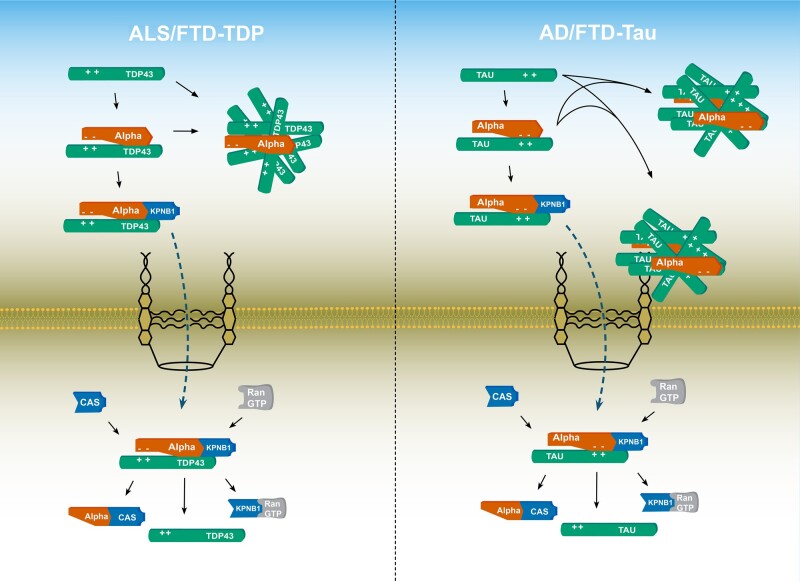
Karyopherins abnormalities in neurodegenerative proteinopathies.Left: In ALS/FTD-TDP, cytoplasmic accumulation of TDP-43 and its aggregates not associated with stress granules have been shown to sequester KPNAs. Right: In Alzheimer’s disease and FTD-Tau, pathological tau has been shown to sequester KPNAs (Table 3). AD = Alzheimer’s disease; CAS = cellular apoptosis susceptibility.

References

    1. World Health Organization. Global action plan on the public health response to dementia 2017–2025. World Health Organization; 2017. Accessed 30 September 2021. https://www.who.int/publications/i/item/global-action-plan-on-the-public...
    1. Moreno-Gonzalez I, Soto C.. Misfolded protein aggregates: Mechanisms, structures and potential for disease transmission. Semin Cell Dev Biol. 2011;22(5):482–487. - PMC - PubMed
    1. Braak H, Tredici K, Del, Rüb U, de Vos RA, Jansen Steur EN, Braak E.. Staging of brain pathology related to sporadic Parkinson’s disease. Neurobiol Aging. 2003;24(2):197–211. - PubMed
    1. Jucker M, Walker LC.. Self-propagation of pathogenic protein aggregates in neurodegenerative diseases. Nature. 2013;501(7465):45–51. - PMC - PubMed
    1. Alberti S, Halfmann R, King O, Kapila A, Lindquist S.. A systematic survey identifies prions and illuminates sequence features of prionogenic proteins. Cell. 2009;137(1):146–158. - PMC - PubMed

Publication types

MeSH terms