


Decline in Rehab Transfers Among Rehab-Eligible Stroke Patients During the COVID-19 Pandemic
- PMID: 34022581
- PMCID: PMC8769561
- DOI: 10.1016/j.jstrokecerebrovasdis.2021.105857
Decline in Rehab Transfers Among Rehab-Eligible Stroke Patients During the COVID-19 Pandemic
Abstract
Objective: To characterize differences in disposition arrangement among rehab-eligible stroke patients at a Comprehensive Stroke Center before and during the COVID-19 pandemic.
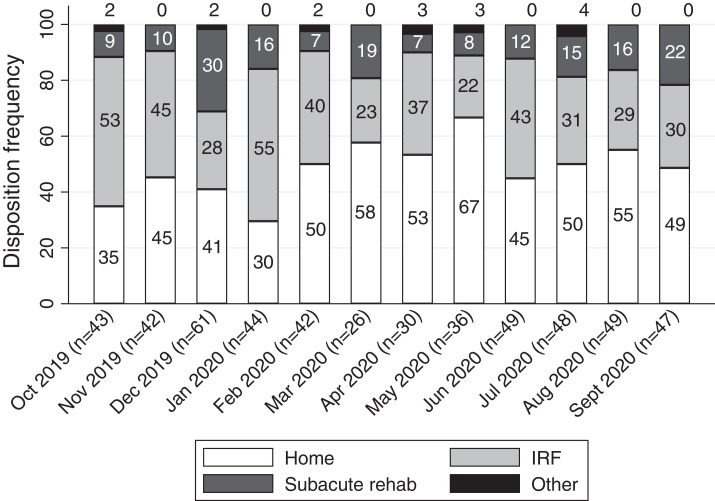
Materials and methods: We retrospectively analyzed a prospective registry for demographics, hospital course, and discharge dispositions of rehab-eligible acute stroke survivors admitted 6 months prior to (10/2019-03/2020) and during (04/2020-09/2020) the COVID-19 pandemic. The primary outcome was discharge to an inpatient rehabilitation facility (IRF) as opposed to other facilities using descriptive statistics, and IRF versus home using unadjusted and adjusted backward stepwise logistic regression.
Results: Of the 507 rehab-eligible stroke survivors, there was no difference in age, premorbid disability, or stroke severity between study periods (p>0.05). There was a 9% absolute decrease in discharges to an IRF during the pandemic (32.1% vs. 41.1%, p=0.04), which translated to 38% lower odds of being discharged to IRF versus home in unadjusted regression (OR 0.62, 95%CI 0.42-0.92, p=0.016). The lower odds of discharge to IRF persisted in the multivariable model (aOR 0.16, 95%CI 0.09-0.31, p<0.001) despite a significant increase in discharge disability (median discharge mRS 4 [IQR 2-4] vs. 2 [IQR 1-3], p<0.001) during the pandemic.
Conclusions: Admission for stroke during the COVID-19 pandemic was associated with a significantly lower probability of being discharged to an IRF. This effect persisted despite adjustment for predictors of IRF disposition, including functional disability at discharge. Potential reasons for this disparity are explored.
Keywords: COVID-19; Ischemic stroke; Recovery of function; Rehabilitation.
Copyright © 2021 Elsevier Inc. All rights reserved.
Figures
References
Publication types
MeSH terms
LinkOut - more resources
Full Text Sources
Other Literature Sources
Medical
