The contribution of employer characteristics to continued employment of employees with residual work capacity: evidence from register data in The Netherlands
- PMID: 34023910
- PMCID: PMC8504544
- DOI: 10.5271/sjweh.3961
The contribution of employer characteristics to continued employment of employees with residual work capacity: evidence from register data in The Netherlands
Abstract
Objectives: This study aimed to examine the contribution of employer characteristics to continued employment of employees with residual work capacity. Moreover, we examined whether the contribution of employer characteristics differs across types of employers and employees' types of diseases.
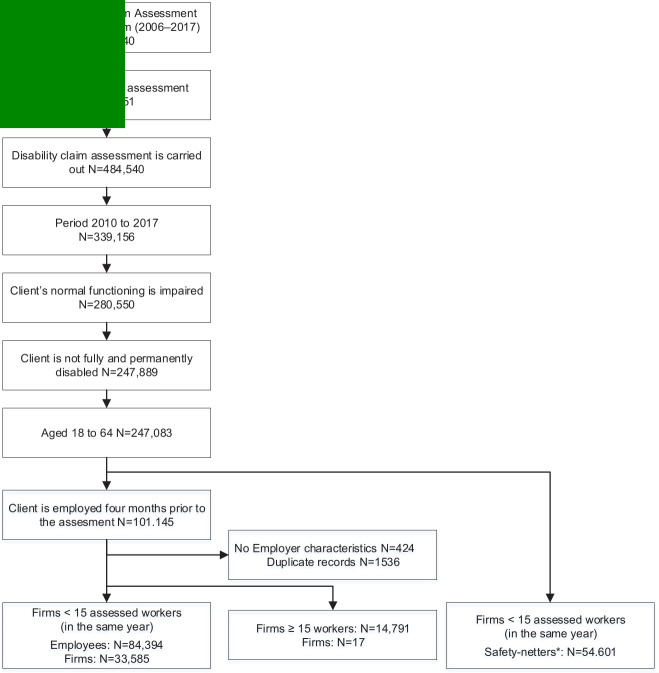
Methods: Register data on disability assessments and employment status of N=84 394 long-term sick-listed employees with residual work capacity were obtained from the Dutch Employee Insurance Agency between 2010 and 2017. The dependent variable was continued employment four months after the assessment. We linked employees to their (former) employer to measure sector, firm size, and workforce composition. The average employment outcome of all employees assessed in the same firm and year served as a proxy measure for the extent of implemented disability-related policies and practices. Using multilevel multiple regression analysis, we compared the relative contribution of employer characteristics with employees' characteristics.
Results: Employer characteristics accounted for 10% of the variability in employment outcomes. In comparison, employees' socio-demographic and disease characteristics accounted for 13% of the variability. The prevalence of continued employment was lowest in smaller firms and construction and low-wage service-orientated sectors. Furthermore, there were sizeable differences in employment outcomes between similar employers in terms of size, sector and workforce-composition, particularly between larger firms and among employees with mental or musculoskeletal disorders compared to other diseases.
Conclusions: This study shows substantial differences between employers in facilitating continued employment of employees with residual work capacity. Encouraging firms to invest more in disability-related policies and practices may result in better employment opportunities for these employees.
Conflict of interest statement
The authors declare no conflicts of interest.
Figures
References
-
- Anema JR, Prinz C, Prins R. Sickness and Disability Policy Interventions. In: Loisel P, Anema JR, editors. Handbook of Work Disability:Prevention and Management. New York, NY: Springer New York; 2013. pp. 357–71.
-
- Burkhauser RV, Daly MC, Ziebarth NR. Protecting working-age people with disabilities:experiences of four industrialized nations. J Labour Market Res. 2016;49(4):367–86. https://doi.org/10.1007/s12651-016-0215-z.
-
- Koning P, Lindeboom M. The Rise and Fall of Disability Insurance Enrollment in the Netherlands. J Econ Perspect. 2015;29(2):151–72. https://doi.org/10.1257/jep.29.2.151. - PubMed
-
- OECD, editor. Sickness, disability and work:breaking the barriers;a synthesis of findings across OECD countries. Paris:OECD. 2010
-
- Burkhauser RV, Butler JS, Kim YW, Weathers RR. The Importance of Accommodation on the Timing of Disability Insurance Applications:Results from the Survey of Disability and Work and the Health and Retirement Study. J Hum Resour. 1999;34(3):589–611. https://doi.org/10.2307/146381.
Publication types
MeSH terms
LinkOut - more resources
Full Text Sources
Other Literature Sources
Medical