


Conducting Event-Related Potential (ERP) Research with Young Children: A Review of Components, Special Considerations and Recommendations for Research on Cognition and Emotion
- PMID: 34024985
- PMCID: PMC8136588
- DOI: 10.1027/0269-8803/a000243
Conducting Event-Related Potential (ERP) Research with Young Children: A Review of Components, Special Considerations and Recommendations for Research on Cognition and Emotion
Abstract
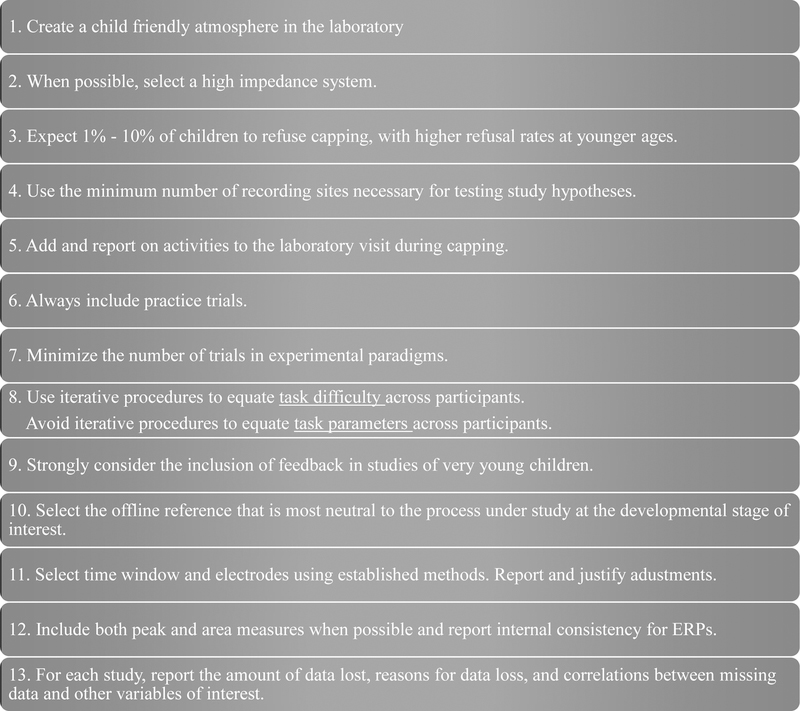
There has been an unprecedented increase in the number of research studies employing event-related potential (ERP) techniques to examine dynamic and rapidly-occurring neural processes with children during the preschool and early childhood years. Despite this, there has been little discussion of the methodological and procedural differences that exist for studies of young children versus older children and adults. That is, reviewers, editors, and consumers of this work often expect developmental studies to simply apply adult techniques and procedures to younger samples. Procedurally, this creates unrealistic expectations for research paradigms, data collection, and data reduction and analyses. Scientifically, this leads to inappropriate measures and methods that hinder drawing conclusions and advancing theory. Based on ERP work with preschoolers and young children from 10 laboratories across North America, we present a summary of the most common ERP components under study in the area of emotion and cognition in young children along with 13 realistic expectations for data collection and loss, laboratory procedures and paradigms, data processing, ERP averaging, and typical challenges for conducting this type of work. This work is intended to supplement previous guidelines for work with adults and offer insights to aid researchers, reviewers, and editors in the design and evaluation of developmental research using ERPs. Here we make recommendations for researchers who plan to conduct or who are conducting ERP studies in children between ages 2 and 12, focusing on studies of toddlers and preschoolers. Recommendations are based on both data and our cumulative experience and include guidelines for laboratory setup, equipment and recording settings, task design, and data processing.
Figures

References
-
- Belden AC, Irvin K, Hajcak G, Kappenman ES, Kelly D, Karlow S, … Barch DM (2016). Neural correlates of reward processing in depressed and healthy preschool-age children. Journal of the American Academy of Child & Adolescent Psychiatry, 55(12), 1081–1089. doi:10.1016/j.jaac.2016.09.503 - DOI - PMC - PubMed
-
- Bell MA, & Wolfe CD (2008). The use of the electroencephalogram in research on cognitive development. In Schmidt LA & Segalowitz SJ (Eds.), Developmental Psychophysiology (pp. 150–170). New York, New York: Cambridge University Press.
Grants and funding
LinkOut - more resources
Full Text Sources