


Lower Number of Teeth Is Related to Higher Risks for ACVD and Death-Systematic Review and Meta-Analyses of Survival Data
- PMID: 34026863
- PMCID: PMC8138430
- DOI: 10.3389/fcvm.2021.621626
Lower Number of Teeth Is Related to Higher Risks for ACVD and Death-Systematic Review and Meta-Analyses of Survival Data
Abstract
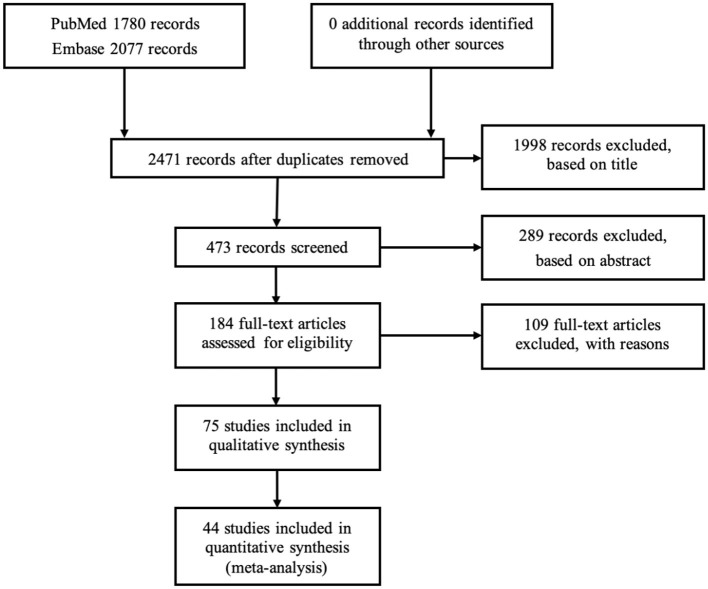
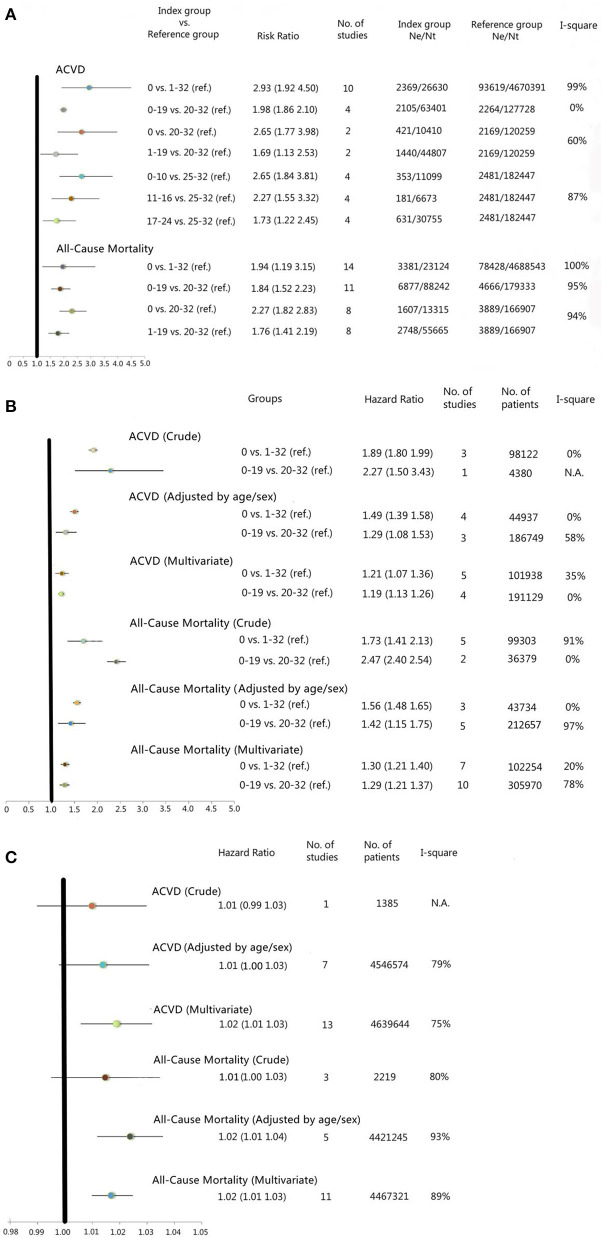
Tooth loss reflects the endpoint of two major dental diseases: dental caries and periodontitis. These comprise 2% of the global burden of human diseases. A lower number of teeth has been associated with various systemic diseases, in particular, atherosclerotic cardiovascular diseases (ACVD). The aim was to summarize the evidence of tooth loss related to the risk for ACVD or death. Cohort studies with prospective follow-up data were retrieved from Medline-PubMed and EMBASE. Following the PRISMA guidelines, two reviewers independently selected articles, assessed the risk of bias, and extracted data on the number of teeth (tooth loss; exposure) and ACVD-related events and all-cause mortality (ACM) (outcome). A total of 75 articles were included of which 44 were qualified for meta-analysis. A lower number of teeth was related to a higher outcome risk; the pooled risk ratio (RR) for the cumulative incidence of ACVD ranged from 1.69 to 2.93, and for the cumulative incidence of ACM, the RR ranged from 1.76 to 2.27. The pooled multiple adjusted hazard ratio (HR) for the incidence density of ACVD ranged from 1.02 to 1.21, and for the incidence density of ACM, the HR ranged from 1.02 to 1.30. This systematic review and meta-analyses of survival data show that a lower number of teeth is a risk factor for both ACVD and death. Health care professionals should use this information to inform their patients and increase awareness on the importance of good dental health and increase efforts to prevent tooth loss.
Keywords: atherosclerosis; cardiovascular disease; meta-analysis; mortality; number of teeth; risk; systematic review; tooth loss.
Copyright © 2021 Beukers, Su, Loos and van der Heijden.
Conflict of interest statement
The authors declare that the research was conducted in the absence of any commercial or financial relationships that could be construed as a potential conflict of interest.
Figures
References
-
- Chapple IL, Bouchard P, Cagetti MG, Campus G, Carra MC, Cocco F, et al. Interaction of lifestyle, behaviour or systemic diseases with dental caries and periodontal diseases: consensus report of group 2 of the joint EFP/ORCA workshop on the boundaries between caries and periodontal diseases. J Clin Periodontol. (2017) 44(Suppl.18):S39–51. 10.1111/jcpe.12685 - DOI - PubMed
-
- Tonetti MS, Bottenberg P, Conrads G, Eickholz P, Heasman P, Huysmans MC, et al. Dental caries and periodontal diseases in the ageing population: call to action to protect and enhance oral health and well-being as an essential component of healthy ageing - Consensus report of group 4 of the joint EFP/ORCA workshop on the boundaries between caries and periodontal diseases. J Clin Periodontol. (2017) 44(Suppl.18):S135–44. 10.1111/jcpe.12681 - DOI - PubMed
Publication types
LinkOut - more resources
Full Text Sources
Other Literature Sources
