


"I'm a Survivor": Perceptions of Chronic Disease and Survivorship Among Individuals in Long-Term Remission from Opioid Use Disorder
- PMID: 34027611
- PMCID: PMC8141362
- DOI: 10.1007/s11606-021-06925-z
"I'm a Survivor": Perceptions of Chronic Disease and Survivorship Among Individuals in Long-Term Remission from Opioid Use Disorder
Abstract
Background: While opioid use disorder (OUD) is prevalent, little is known about what patients with OUD in sustained remission think about the chronic disease model of OUD and their perspectives of the cause, course, and ongoing treatment needs of their OUD.
Objective: To (1) examine patient perceptions of the chronic disease model of addiction and disease identity and (2) use an explanatory model framework to explore how these perceptions inform ongoing treatment needs and help maintain abstinence.
Design: Qualitative study of a cross-sectional cohort of patients with OUD in long-term sustained remission currently receiving methadone or buprenorphine. Participants completed a single in-depth, semi-structured individual interview.
Participants: Twenty adults were recruited from two opioid treatment programs and two office-based opioid treatment programs in Baltimore, MD. Half of the participants were Black, had a median (IQR) age of 46.5 (43-52) years and the median (IQR) time since the last non-prescribed opioid was 12 (8-15) years.
Approach: Hybrid deductive-inductive thematic analysis of the transcribed interviews.
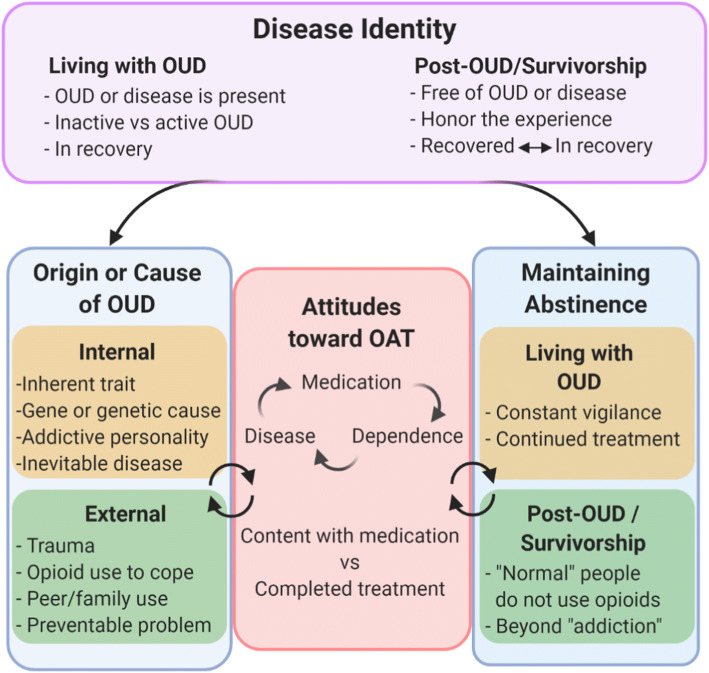
Key results: Some participants described a chronic OUD disease identity where they continue to live with OUD. Participants who maintain an OUD identity describe inherent traits or predetermination of developing OUD. Maintaining a disease identity helps them remain vigilant against returning to drug use. Others described a post-OUD/survivor identity where they no longer felt they had OUD, but the experience remains. Each perspective informed attitudes about continued treatment with methadone or buprenorphine and strategies to remain in remission.
Conclusions: The identity that people with OUD in sustained remission maintain was the lens through which they viewed other aspects of their OUD including cause and ongoing treatment needs. An alternative, post-OUD/survivorship model emerged or was accepted by participants who did not identify as currently having OUD. Understanding patient perspectives of OUD identity might improve patient-centered care and improve outcomes.
Keywords: buprenorphine; chronic disease; methadone; opioid use disorder; survivorship.
© 2021. Society of General Internal Medicine.
Conflict of interest statement
The authors declare that they do not have a conflict of interest.
Figures
References
-
- Substance Abuse and Mental Health Services Administration. Key Substance Use and Mental Health Indicators in the United States: Results from the 2018 National Survey on Drug Use and Health. Center for Behavioral Health Statistics and Quality, Substance Abuse and Mental Health Services Administration; 2019. Accessed July 30, 2020. https://www.samhsa.gov/data/
-
- American Psychiatric Association. Diagnostic and Statistical Manual of Mental Disorders. Fifth Edition. American Psychiatric Association; 2013. doi:10.1176/appi.books.9780890425596
-
- Martins SS, Sarvet A, Santaella-Tenorio J, Saha T, Grant BF, Hasin DS. Changes in US Lifetime Heroin Use and Heroin Use Disorder: Prevalence From the 2001-2002 to 2012-2013 National Epidemiologic Survey on Alcohol and Related Conditions. JAMA Psychiatr. 2017;74(5):445–455. doi: 10.1001/jamapsychiatry.2017.0113. - DOI - PMC - PubMed
Publication types
MeSH terms
Substances
Grants and funding
LinkOut - more resources
Full Text Sources
Other Literature Sources
Medical
