Site-Selective C-H alkylation of Complex Arenes by a Two-Step Aryl Thianthrenation-Reductive Alkylation Sequence
- PMID: 34028272
- PMCID: PMC8297726
- DOI: 10.1021/jacs.1c03459
Site-Selective C-H alkylation of Complex Arenes by a Two-Step Aryl Thianthrenation-Reductive Alkylation Sequence
Erratum in
-
Correction to "Site-Selective C-H Alkylation of Complex Arenes by a Two-Step Aryl Thianthrenation-Reductive Alkylation Sequence".J Am Chem Soc. 2021 Jul 14;143(27):10477-10478. doi: 10.1021/jacs.1c06057. Epub 2021 Jul 1. J Am Chem Soc. 2021. PMID: 34197095 Free PMC article. No abstract available.
Abstract
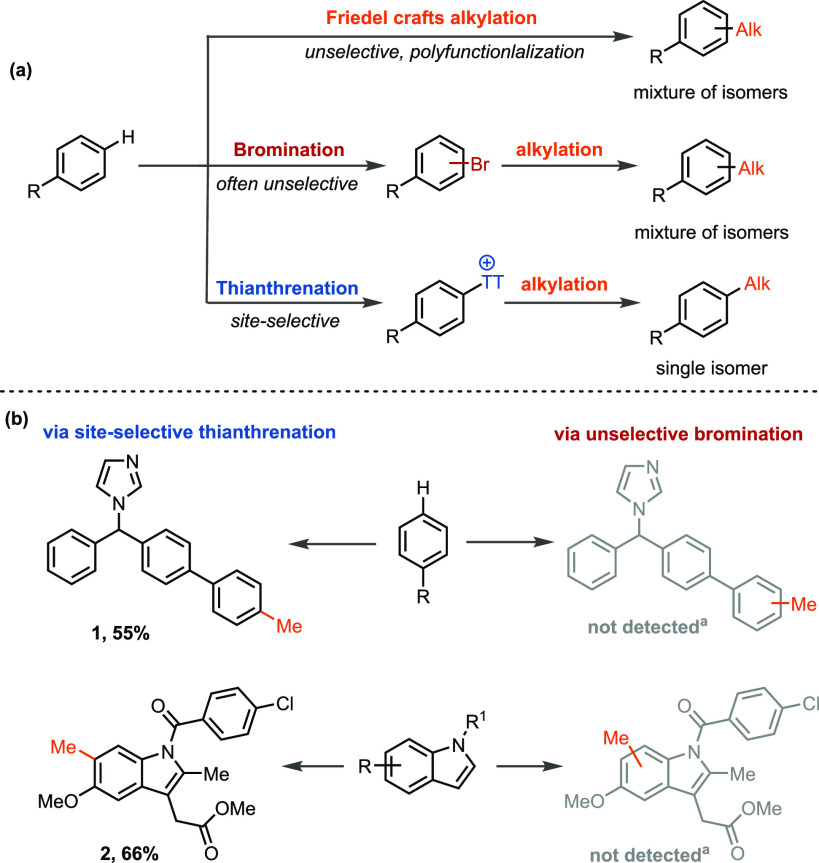
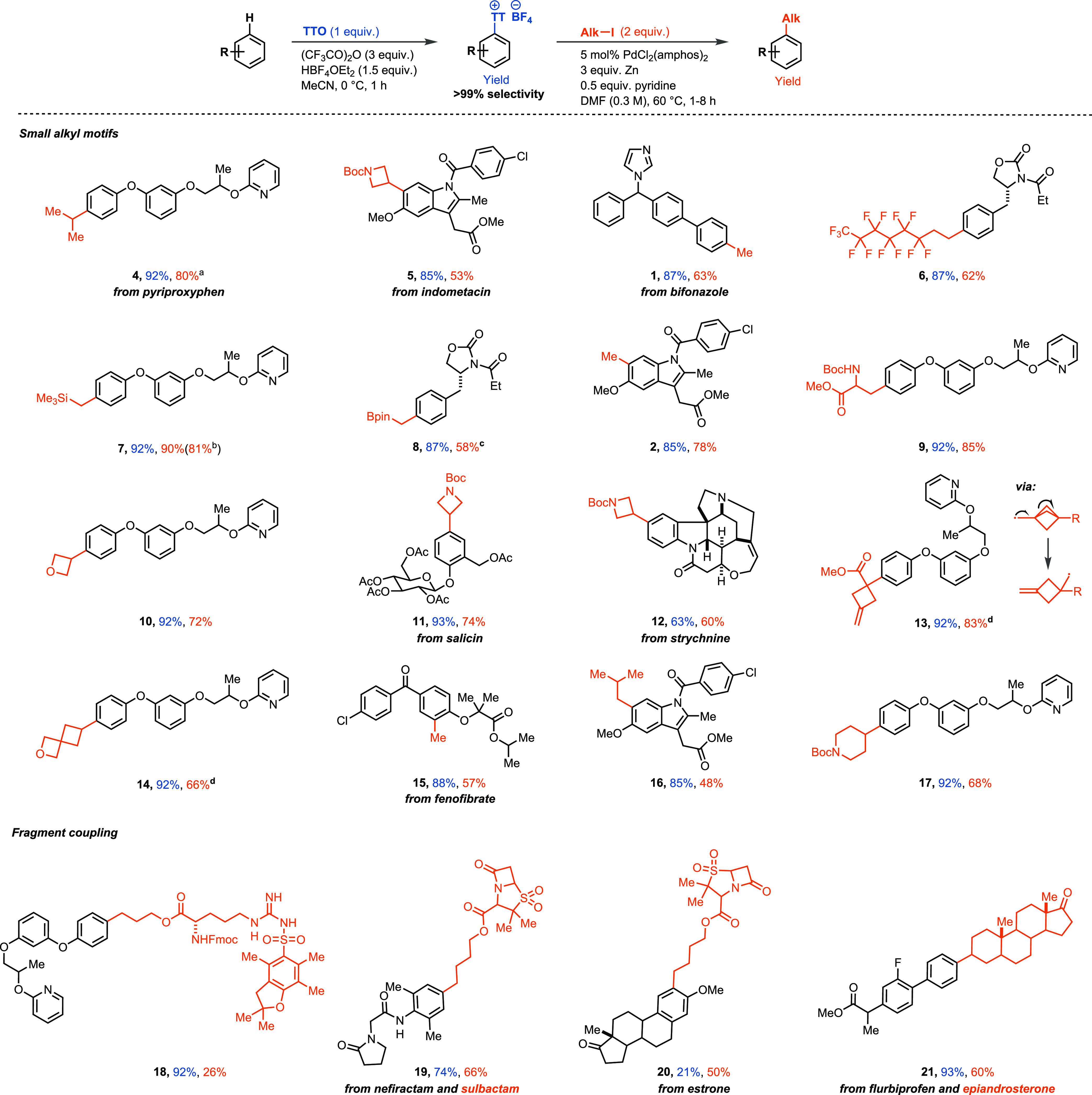
Herein, we present an undirected para-selective two-step C-H alkylation of complex arenes useful for late-stage functionalization. The combination of a site-selective C-H thianthrenation with palladium-catalyzed reductive electrophile cross-coupling grants access to a diverse range of synthetically useful alkylated arenes which cannot be accessed otherwise with comparable selectivity, diversity, and practicality. The robustness of this transformation is further demonstrated by thianthrenium-based reductive coupling of two complex fragments.
Conflict of interest statement
The authors declare the following competing financial interest(s): A patent application (number EP18204755.5, Germany) dealing with the use of thianthrene and its derivatives for C-H functionalization has been filed and F.B. and T.R. may benefit from royalty payments.
Figures
References
-
- Walters W. P.; Green J.; Weiss J. R.; Murcko M. A. What do medicinal chemists actually make? A 50-year retrospective. J. Med. Chem. 2011, 54, 6405–6416. 10.1021/jm200504p. - DOI - PubMed
- Ritchie T. J.; Macdonald S. J.; Peace S.; Pickett S. D.; Luscombe C. N. Increasing small molecule drug developability in sub-optimal chemical space. MedChemComm 2013, 4, 673–680. 10.1039/c3md00003f. - DOI
- Lovering F.; Bikker J.; Humblet C. Escape from flatland: increasing saturation as an approach to improving clinical success. J. Med. Chem. 2009, 52, 6752–6756. 10.1021/jm901241e. - DOI - PubMed
- Lovering F. Escape from Flatland 2: complexity and promiscuity. MedChemComm 2013, 4, 515–519. 10.1039/c2md20347b. - DOI
-
- Dong Z.; Ren Z.; Thompson S. J.; Xu Y.; Dong G. Transition-metal-catalyzed C–H alkylation using alkenes. Chem. Rev. 2017, 117, 9333–9403. 10.1021/acs.chemrev.6b00574. - DOI - PubMed
- Evano G.; Theunissen C. Beyond Friedel and Crafts: directed alkylation of C–H bonds in arenes. Angew. Chem., Int. Ed. 2019, 58, 7202–7236. 10.1002/anie.201806629. - DOI - PubMed
-
- Jana R.; Pathak T. P.; Sigman M. S. Advances in transition metal (Pd, Ni, Fe)-catalyzed cross-coupling reactions using alkyl-organometallics as reaction partners. Chem. Rev. 2011, 111, 1417–1492. 10.1021/cr100327p. - DOI - PMC - PubMed
- Knappke C. E.; Grupe S.; Gärtner D.; Corpet M.; Gosmini C.; Jacobi von Wangelin A. Reductive cross-coupling reactions between two electrophiles. Chem. - Eur. J. 2014, 20, 6828–6842. 10.1002/chem.201402302. - DOI - PubMed
- Richmond E.; Moran J. Recent advances in nickel catalysis enabled by stoichiometric metallic reducing agents. Synthesis 2018, 50, 499–513. 10.1055/s-0036-1591853. - DOI
- Weix D. J. Methods and mechanisms for cross-electrophile coupling of Csp2 halides with alkyl electrophiles. Acc. Chem. Res. 2015, 48, 1767–1775. 10.1021/acs.accounts.5b00057. - DOI - PMC - PubMed
Publication types
LinkOut - more resources
Full Text Sources
Other Literature Sources