. 2021 Jun;473(6):897-910.
doi: 10.1007/s00424-021-02582-7. Epub 2021 May 24.

Abnormal neonatal sodium handling in skin precedes hypertension in the SAME rat

Affiliations

Abnormal neonatal sodium handling in skin precedes hypertension in the SAME rat

Linda Mullins et al. Pflugers Arch. 2021 Jun.

Abstract

We discovered high Na+ and water content in the skin of newborn Sprague-Dawley rats, which reduced ~ 2.5-fold by 7 days of age, indicating rapid changes in extracellular volume (ECV). Equivalent changes in ECV post birth were also observed in C57Bl/6 J mice, with a fourfold reduction over 7 days, to approximately adult levels. This established the generality of increased ECV at birth. We investigated early sodium and water handling in neonates from a second rat strain, Fischer, and an Hsd11b2-knockout rat modelling the syndrome of apparent mineralocorticoid excess (SAME). Despite Hsd11b2-/- animals exhibiting lower skin Na+ and water levels than controls at birth, they retained ~ 30% higher Na+ content in their pelts at the expense of K+ thereafter. Hsd11b2-/- neonates exhibited incipient hypokalaemia from 15 days of age and became increasingly polydipsic and polyuric from weaning. As with adults, they excreted a high proportion of ingested Na+ through the kidney, (56.15 ± 8.21% versus control 34.15 ± 8.23%; n = 4; P < 0.0001), suggesting that changes in nephron electrolyte transporters identified in adults, by RNA-seq analysis, occur by 4 weeks of age. Our data reveal that Na+ imbalance in the Hsd11b2-/- neonate leads to excess Na+ storage in skin and incipient hypokalaemia, which, together with increased, glucocorticoid-induced Na+ uptake in the kidney, then contribute to progressive, volume contracted, salt-sensitive hypertension. Skin Na+ plays an important role in the development of SAME but, equally, may play a key physiological role at birth, supporting post-natal growth, as an innate barrier to infection or as a rudimentary kidney.

Keywords: Hsd11b2; Hypertension; Knockout; Neonatal; Newborn; Rat; Salt-sensitive; Skin.


Conflict of interest statement

The authors declare no competing interests.

Figures
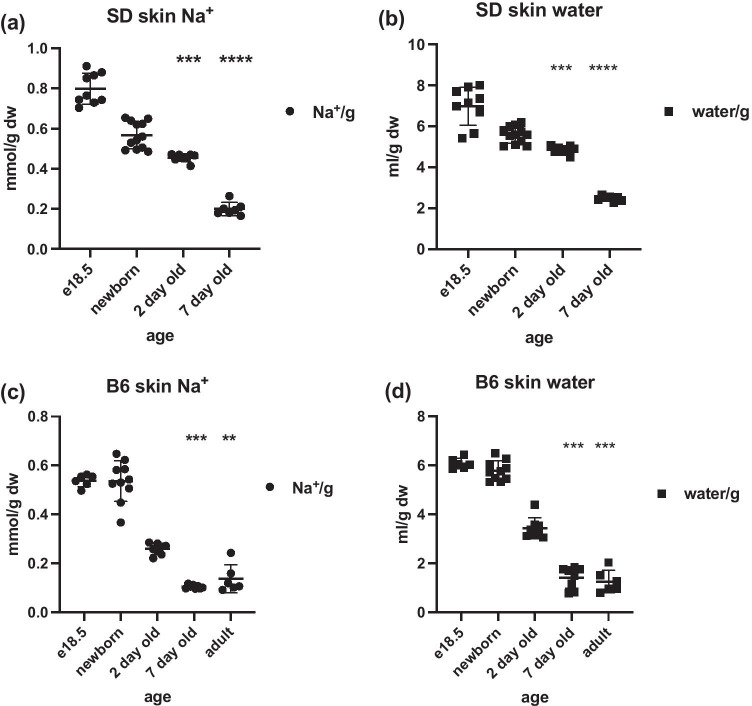
Fig. 1
Fig. 1
Skin Na+ and water content during development in Sprague–Dawley (SD) (a) skin Na+ (mmol/g dry weight; *** = 0.0002; **** < 0.0001) (b) skin water (ml/g dry weight; *** = 0.0009; **** < 0.0001), and C57Bl/6J mice (c) skin Na+ (mmol/g dry weight; *** = 0.0003; ** = 0.0047) and (d) skin water (ml/g dry weight; *** < 0.0002) (n = 6–9 per group; two-way ANOVA with Kruskal Wallis and Dunn’s multiple comparison test)
Fig. 2
Fig. 2
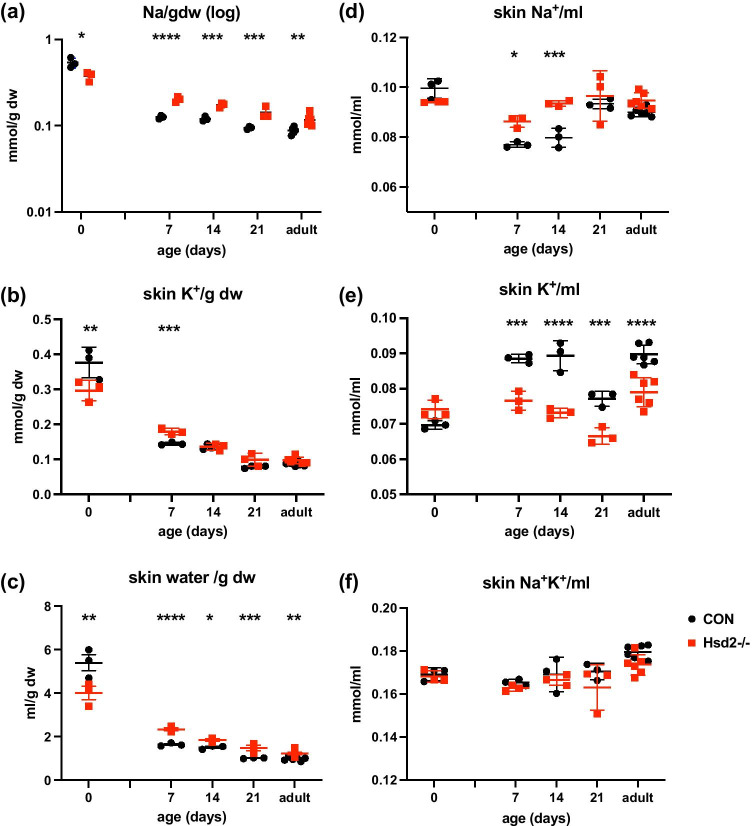
Skin electrolytes and water content during development. a skin Na+ (mmol/g dry weight; note logarithmic scale); b skin K+ (mmol/g dry weight; c skin water (ml/g dry weight); d skin Na+ (mmol/ml); e skin K+ (mmol/ml); f skin electrolytes (Na+K+(mmol/ml)). (n = 3–6 per group per time point; two-way ANOVA with Sidak’s multiple comparison test * < 0.05; ** < 0.01; *** < 0.001)
Fig. 3
Fig. 3
Developmental changes in a blood pressure b haematocrit c plasma Na+, and d plasma K+ (minimum n = 3 per time point; unpaired t test; *** 0.0009; **** < 0.0001)
Fig. 4
Fig. 4
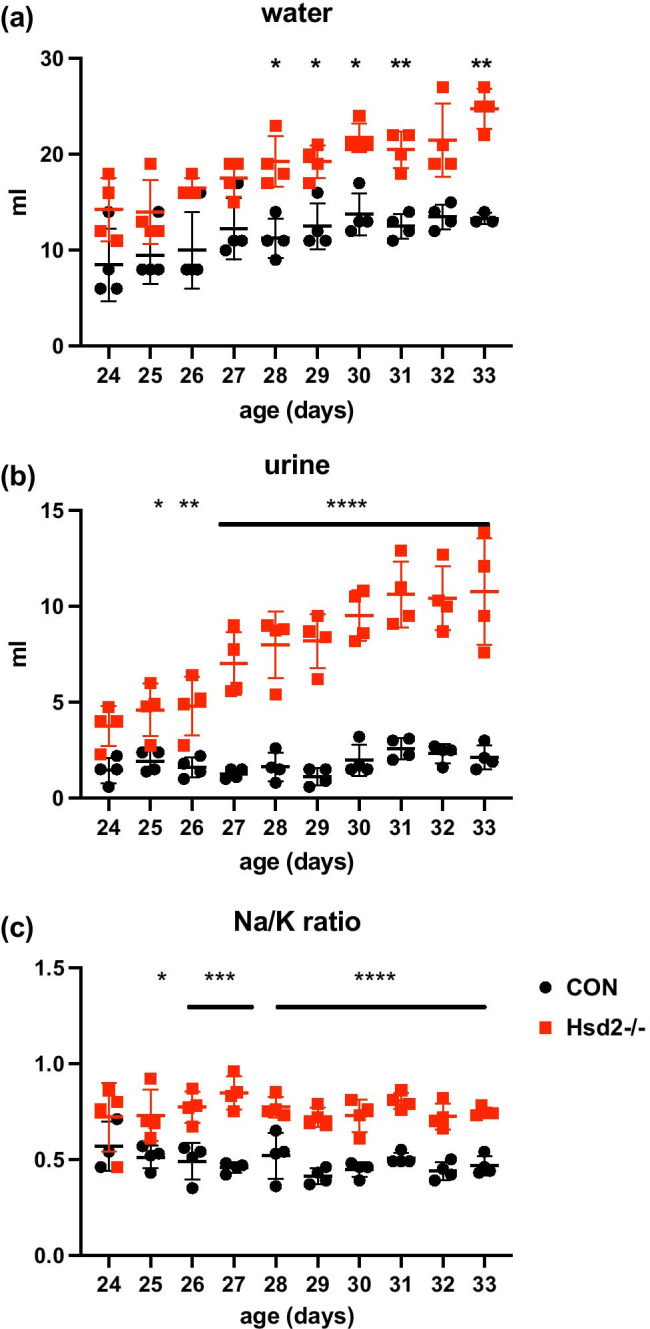
Metabolic study of post-weaned pups a daily water intake b daily urinary output c Na+/K+ ratio in urine (n = 4 per group; two-way ANOVA with Sidak’s multiple comparison test * < 0.05; ** < 0.01; **** < 0.0001)
Fig. 5
Fig. 5
Immunohistochemical analysis showing PC, IC, and intermediate cells stained with Aqp2 and V-Atpaseb1 antibodies in a control; b Hsd2−/− section. The relative proportion of cell types in collecting ducts was counted between control and Hsd2−/− rats. The log-ratio of PC: IC and intermediate: IC are reported as means ± SD, at c ~ 5 weeks (n = 4), and d 24 weeks (n = 3). Significance between groups was assessed using multiple analysis of variance (p < 0.05 *). A decrease in the log-ratio of PC:IC indicates an overall decrease in the proportion of PCs present in the CD relative to ICs (the latter did not significantly change between WT and KO). Likewise, an increase in the log-ratio of intermediate: IC indicates an overall increase in the proportion of intermediate cells relative to ICs
Fig. 6
Fig. 6
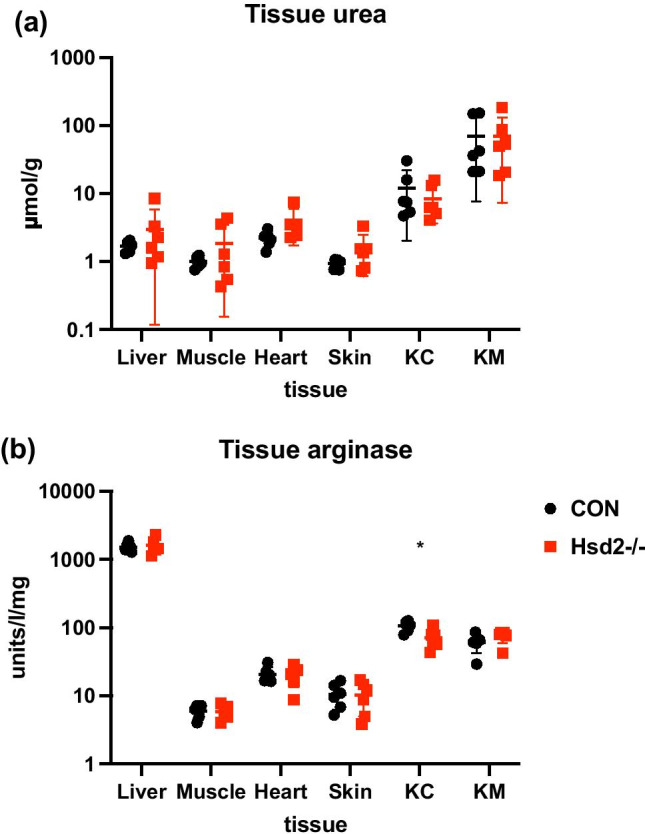
Tissue a urea and b arginase assays. (KC = kidney cortex; KM = kidney medulla; n = 6 per group; Student’s t test; * < 0.015)

References

    1. Amlal H, Krane CM, Chen Q, Soleimani M. Early polyuria and urinary concentrating defect in potassium deprivation. Am J Physiol Renal Physiol. 2000;279:F655–663. doi: 10.1152/ajprenal.2000.279.4.F655. - DOI - PubMed
    1. Bailey MA, Mullins JJ, Kenyon CJ. Mineralocorticoid and glucocorticoid receptors stimulate epithelial sodium channel activity in a mouse model of Cushing syndrome. Hypertension. 2009;54:890–896. doi: 10.1161/HYPERTENSIONAHA.109.134973. - DOI - PubMed
    1. Berl T, Linas SL, Aisenbrey GA, Anderson RJ. On the mechanism of polyuria in potassium depletion. The role of polydipsia. J Clin Invest. 1977;60:620–625. doi: 10.1172/JCI108813. - DOI - PMC - PubMed
    1. Boix J, Carceller E, Sevilla LM, Marcos-Garces V, Perez P. The mineralocorticoid receptor plays a transient role in mouse skin development. Exp Dermatol. 2016;25:69–71. doi: 10.1111/exd.12822. - DOI - PubMed
    1. Bolger AM, Lohse M, Usadel B. Trimmomatic: a flexible trimmer for Illumina sequence data. Bioinformatics. 2014;30:2114–2120. doi: 10.1093/bioinformatics/btu170. - DOI - PMC - PubMed

Publication types

MeSH terms

Substances

LinkOut - more resources