


Saliva RNA biomarkers predict concussion duration and detect symptom recovery: a comparison with balance and cognitive testing
- PMID: 34028616
- PMCID: PMC8505318
- DOI: 10.1007/s00415-021-10566-x
Saliva RNA biomarkers predict concussion duration and detect symptom recovery: a comparison with balance and cognitive testing
Abstract
Objective: The goals of this study were to assess the ability of salivary non-coding RNA (ncRNA) levels to predict post-concussion symptoms lasting ≥ 21 days, and to examine the ability of ncRNAs to identify recovery compared to cognition and balance.
Methods: RNA sequencing was performed on 505 saliva samples obtained longitudinally from 112 individuals (8-24-years-old) with mild traumatic brain injury (mTBI). Initial samples were obtained ≤ 14 days post-injury, and follow-up samples were obtained ≥ 21 days post-injury. Computerized balance and cognitive test performance were assessed at initial and follow-up time-points. Machine learning was used to define: (1) a model employing initial ncRNA levels to predict persistent post-concussion symptoms (PPCS) ≥ 21 days post-injury; and (2) a model employing follow-up ncRNA levels to identify symptom recovery. Performance of the models was compared against a validated clinical prediction rule, and balance/cognitive test performance, respectively.
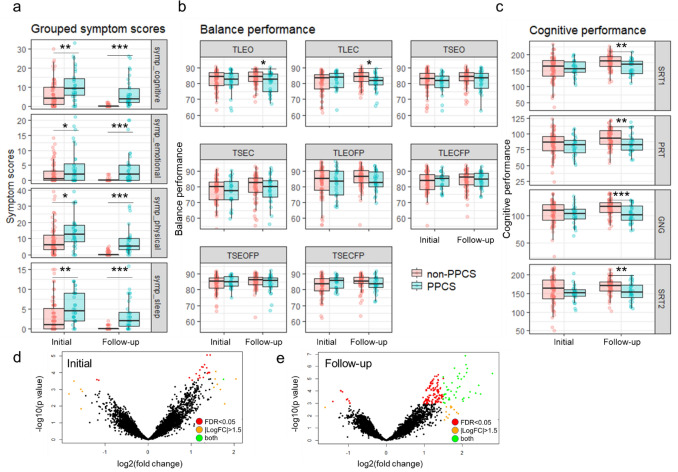
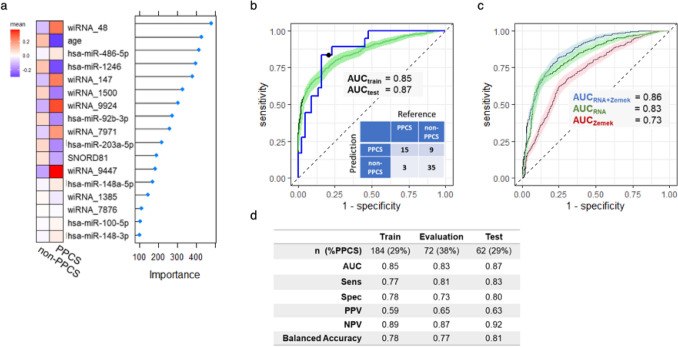
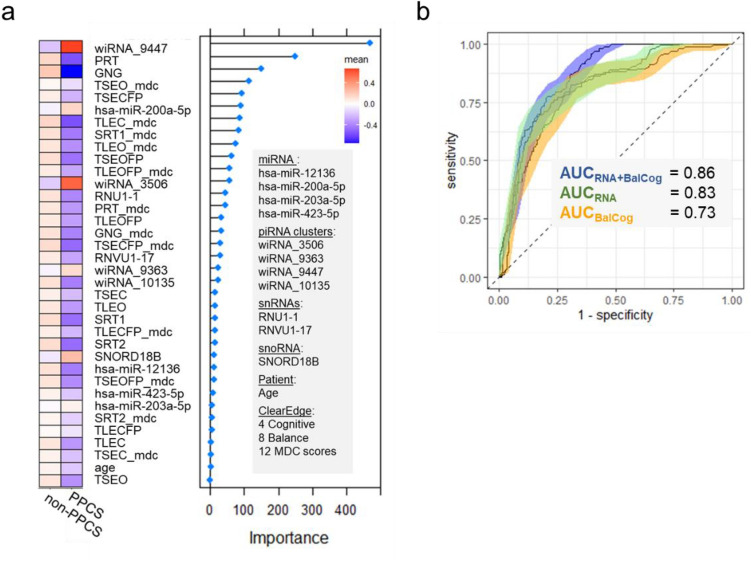
Results: An algorithm using age and 16 ncRNAs predicted PPCS with greater accuracy than the validated clinical tool and demonstrated additive combined utility (area under the curve (AUC) 0.86; 95% CI 0.84-0.88). Initial balance and cognitive test performance did not differ between PPCS and non-PPCS groups (p > 0.05). Follow-up balance and cognitive test performance identified symptom recovery with similar accuracy to a model using 11 ncRNAs and age. A combined model (ncRNAs, balance, cognition) most accurately identified recovery (AUC 0.86; 95% CI 0.83-0.89).
Conclusions: ncRNA biomarkers show promise for tracking recovery from mTBI, and for predicting who will have prolonged symptoms. They could provide accurate expectations for recovery, stratify need for intervention, and guide safe return-to-activities.
Keywords: mTBI; microRNA; prognosis; return to play; spit; traumatic brain injury.
© 2021. The Author(s).
Conflict of interest statement
SDH serves as a consultant for Quadrant Biosciences. SDH and FAM are scientific advisory board members for Quadrant Biosciences and are named as a co-inventors on intellectual property related to saliva RNA biomarkers in concussion that are patented by The Penn State College of Medicine and The SUNY Upstate Research Foundation and licensed to Quadrant Biosciences. SDV, GF, AR, and JR are paid employees of Quadrant Biosciences. RM has received funding from the NFL foundation. The other authors have no conflicts of interest to declare.
Figures
References
-
- Lumba-Brown A, Yeates KO, Sarmiento K, Breiding MJ, Haegerich TM, Gioia GA, Turner M, Benzel EC, Suskauer SJ, Giza CC. Centers for Disease Control and Prevention guideline on the diagnosis and management of mild traumatic brain injury among children. JAMA Pediatr. 2018;172:e182853–e182853. doi: 10.1001/jamapediatrics.2018.2853. - DOI - PMC - PubMed
MeSH terms
Substances
Grants and funding
LinkOut - more resources
Full Text Sources
Other Literature Sources
Medical
