


The efficacy of ultraviolet light-emitting technology against coronaviruses: a systematic review
- PMID: 34029626
- PMCID: PMC8139389
- DOI: 10.1016/j.jhin.2021.05.005
The efficacy of ultraviolet light-emitting technology against coronaviruses: a systematic review
Abstract
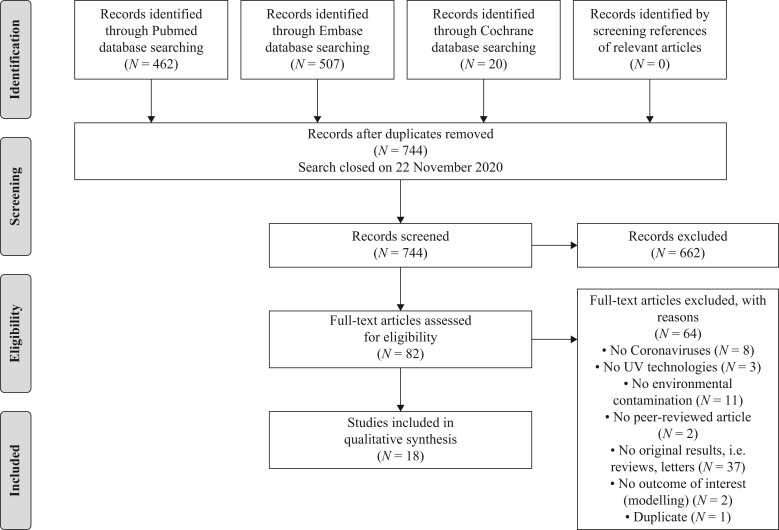
The ongoing pandemic of COVID-19 has underlined the importance of adopting effective infection prevention and control (IPC) measures in hospital and community settings. Ultraviolet (UV)-based technologies represent promising IPC tools: their effective application for sanitation has been extensively evaluated in the past but scant, heterogeneous and inconclusive evidence is available on their effect on SARS-CoV-2 transmission. With the aim of pooling the available evidence on the efficacy of UV technologies against coronaviruses, we conducted a systematic review following PRISMA guidelines, searching Medline, Embase and the Cochrane Library, and the main clinical trials' registries (WHO ICTRP, ClinicalTrials.gov, Cochrane and EU Clinical Trial Register). Quantitative data on studies' interventions were summarized in tables, pooled by different coronavirus species and strain, UV source, characteristics of UV light exposure and outcomes. Eighteen papers met our inclusion criteria, published between 1972 and 2020. Six focused on SARS-CoV-2, four on SARS-CoV-1, one on MERS-CoV, three on seasonal coronaviruses, and four on animal coronaviruses. All were experimental studies. Overall, despite wide heterogenicity within included studies, complete inactivation of coronaviruses on surfaces or aerosolized, including SARS-CoV-2, was reported to take a maximum exposure time of 15 min and to need a maximum distance from the UV emitter of up to 1 m. Advances in UV-based technologies in the field of sanitation and their proved high virucidal potential against SARS-CoV-2 support their use for IPC in hospital and community settings and their contribution towards ending the COVID-19 pandemic. National and international guidelines are to be updated and parameters and conditions of use need to be identified to ensure both efficacy and safety of UV technology application for effective infection prevention and control in both healthcare and non-healthcare settings.
Keywords: COVID-19; Coronavirus; Disinfection; Infection control; Systematic review; Ultraviolet rays light-emitting technology.
Copyright © 2021 The Healthcare Infection Society. Published by Elsevier Ltd. All rights reserved.
Figures
References
-
- Coronavirus Disease (COVID-19) Situation Reports n.d. Available at: https://www.who.int/emergencies/diseases/novel-coronavirus-2019/situatio... [last accessed July 2020].
-
- Weekly epidemiological update on COVID-19 – 16 March 2021 n.d. Available at: https://www.who.int/publications/m/item/weekly-epidemiological-update---... [last accessed March 2021].
-
- Modes of transmission of virus causing COVID-19: implications for IPC precaution recommendations. 2020. https://www.who.int/news-room/commentaries/detail/modes-of-transmission-... Available at: [last accessed August 2020]
Publication types
MeSH terms
LinkOut - more resources
Full Text Sources
Other Literature Sources
Medical
Miscellaneous
