First Course of treatment and Prognosis of Exocrine Pancreatic Cancer in Korea from 2006 to 2017
- PMID: 34030432
- PMCID: PMC8756130
- DOI: 10.4143/crt.2021.421
First Course of treatment and Prognosis of Exocrine Pancreatic Cancer in Korea from 2006 to 2017
Abstract
Purpose: Hospital-based clinical studies have limitations in holistic assessment of cancer treatment and prognosis, as they omit out-of-hospital patients including elderly individuals. This study aimed to investigate trends in initial treatment and corresponding prognosis of patients with exocrine pancreatic cancer (EPC) in Korea.
Materials and methods: The Korea Central Cancer Registry data of patients with EPC from 2006 to 2017 were retrospectively reviewed. We defined the first course of treatment (FT) as the cancer-directed treatment administered within four months after cancer diagnosis according to the Surveillance, Epidemiology, and End Results (SEER) program.
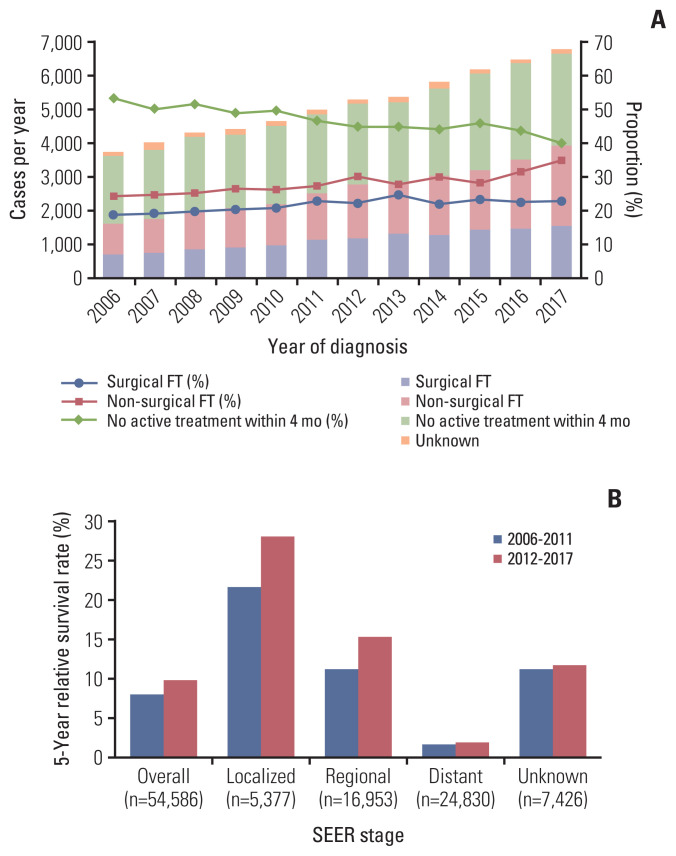
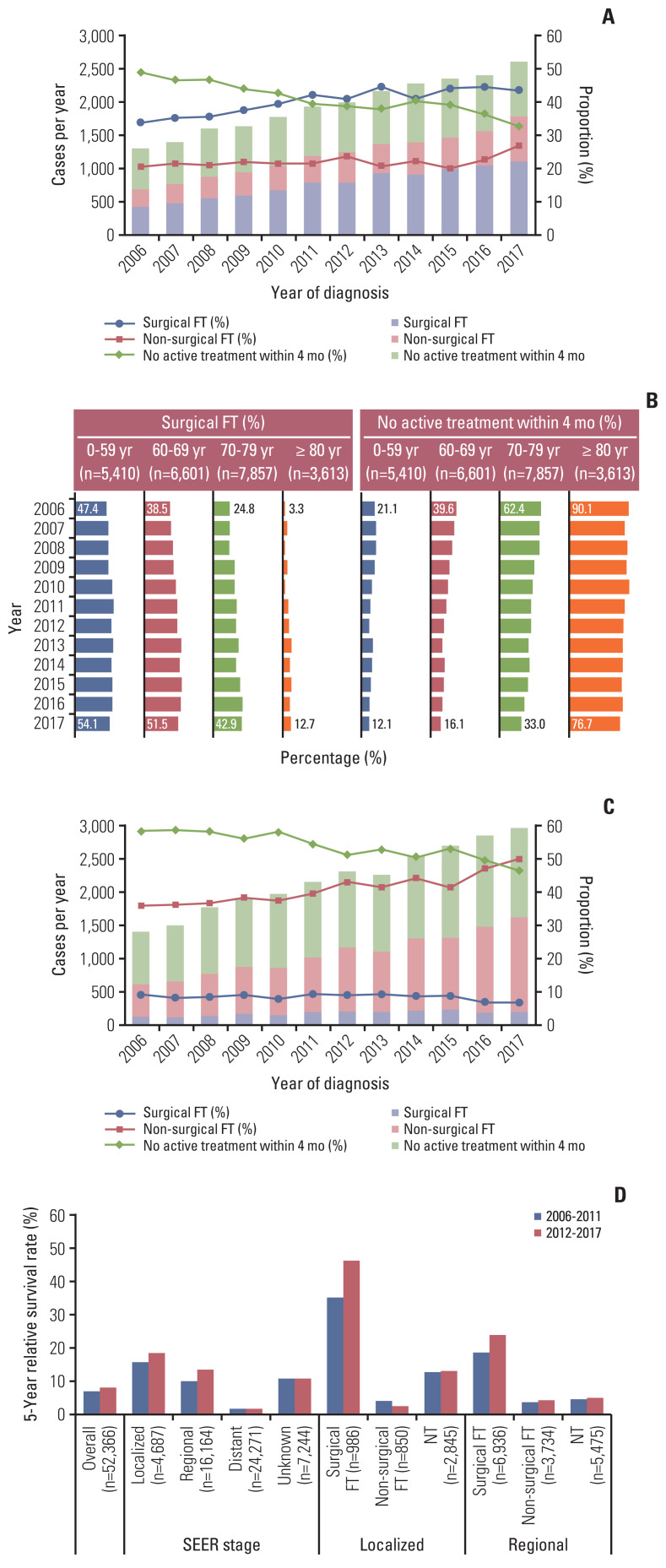
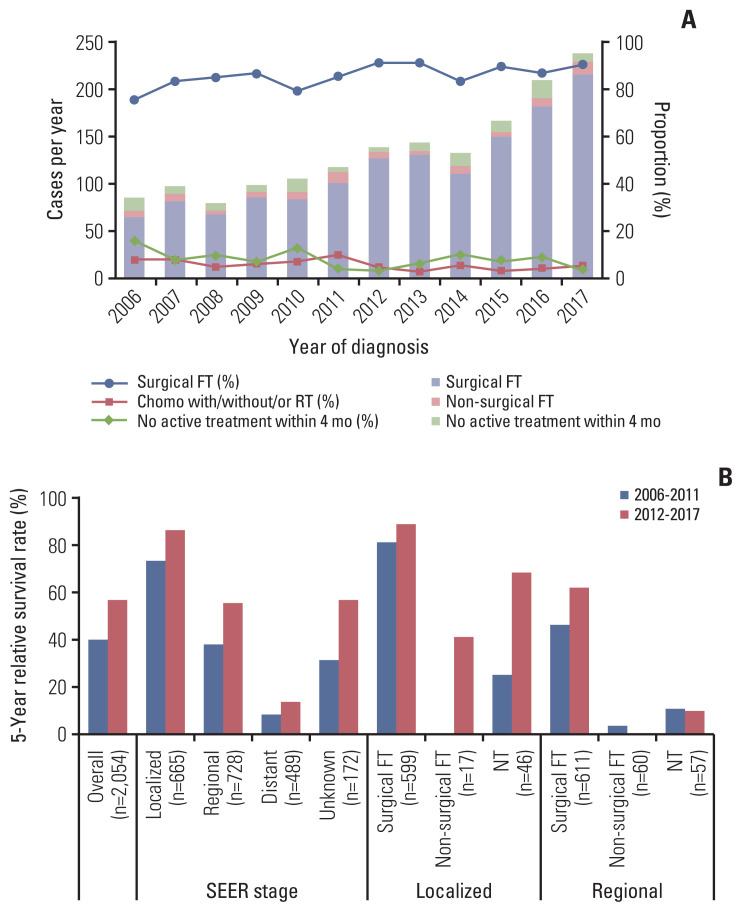
Results: Among 62,209 patients with EPC, localized and regional (LR) SEER stage; patients over 70 years old; and ductal adenocarcinoma excluding cystic or mucinous (DAC) accounted for 40.6%, 50.1%, and 95.9%, respectively. "No active treatment" (NT, 46.5%) was the most frequent, followed by non-surgical FT (28.7%) and surgical FT (22.0%). Among 25,198 patients with LR EPC, surgical FT increased (35.9% to 46.3%) and NT decreased (45.0% to 29.5%) from 2006 to 2017. The rate of surgical FT was inversely related to age (55.1% [< 70 years], 37.3% [70-79 years], 10.9% [≥ 80 years]). Five-year relative survival rates of LR DAC were higher after surgical FT than after NT in localized (46.1% vs. 12.9%) and regional stage (23.6% vs. 4.9%) from 2012 to 2017.
Conclusion: Less than half of overall patients with LR EPC underwent surgical FT, and this proportion decreased significantly in elderly individuals. Clinicians should focus attention on elderly patients with EPC to provide appropriate medical advice.
Keywords: Pancreatic neoplasms; Registries; Survival rate; Therapeutics.
Conflict of interest statement
Conflict of interest relevant to this article was not reported.
Figures
References
-
- The Global Cancer Observatory Cancer today; pancreas (C25) [Internet] Lyon: International Agency for Research on Cancer; c2020. [cited 2021 Mar 5]. Available from: https://gco.iarc.fr/today/data/factsheets/cancers/13-Pancreas-fact-sheet... .
-
- National Comprehensive Cancer Network . NCCN clinical practice guidelines in oncology: pancreatic adenocarcinoma, version 2, 2021 [Internet] Plymouth Meeting, PA: National Comprehensive Cancer Network; c2021. [cited 2021 Mar 5]. Available from: https://www.nccn.org/professionals/physician_gls/pdf/pancreatic.pdf . - PubMed
-
- Khorana AA, McKernin SE, Berlin J, Hong TS, Maitra A, Moravek C, et al. Potentially curable pancreatic adenocarcinoma: ASCO clinical practice guideline update. J Clin Oncol. 2019;37:2082–8. - PubMed
-
- Ducreux M, Cuhna AS, Caramella C, Hollebecque A, Burtin P, Goere D, et al. Cancer of the pancreas: ESMO clinical practice guidelines for diagnosis, treatment and follow-up. Ann Oncol. 2015;26(Suppl 5):v56–68. - PubMed
-
- Lutfi W, Zenati MS, Zureikat AH, Zeh HJ, Hogg ME. Health disparities impact expected treatment of pancreatic ductal adenocarcinoma nationally. Ann Surg Oncol. 2018;25:1860–7. - PubMed
MeSH terms
Grants and funding
LinkOut - more resources
Full Text Sources
Other Literature Sources
Medical
Research Materials