


Impact of Primary Tumor Size on Prognosis in Patients With Metastatic Renal Cell Carcinoma Receiving Cytoreductive Nephrectomy: A Population Study of a Chinese Center and the US SEER Database
- PMID: 34032149
- PMCID: PMC8155752
- DOI: 10.1177/15330338211019507
Impact of Primary Tumor Size on Prognosis in Patients With Metastatic Renal Cell Carcinoma Receiving Cytoreductive Nephrectomy: A Population Study of a Chinese Center and the US SEER Database
Abstract
Background: The relationship between the size of the primary tumor and the prognosis of patients with metastatic renal cell carcinoma (mRCC) is unclear. In this study, we aimed to investigate the significance of the size of the primary tumor in mRCC.
Methods: We retrospectively reviewed the data of patients with mRCC who underwent cytoreductive nephrectomy (CN) from 2006 to 2013 in a Chinese center (n = 96) and those in the Surveillance, Epidemiology, and End Results (SEER) database (from 2004 to 2015, n = 4403). Tumors less than 4 cm in size were defined as small. Prognostic factors were analyzed using univariate and multivariate Cox proportional hazards regression analyses.
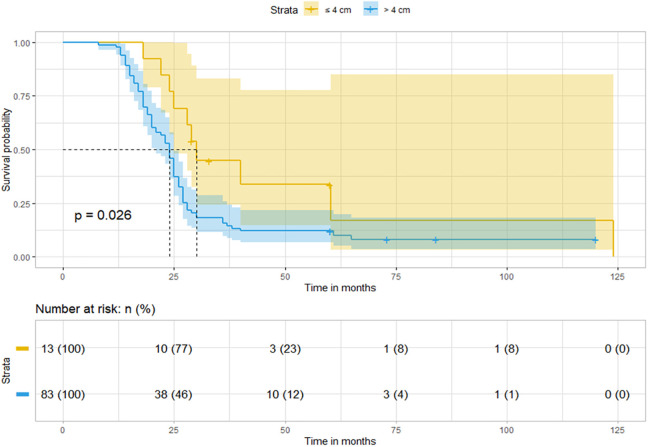
Results: Patients with small tumors had a longer overall survival than other patients, both in the Chinese cohort (median, 30.0 vs 24.0 months, P = 0.026) and the SEER cohort (median, 43.0 vs 23.0 months, P < 0.001). After adjusting for other significant prognostic factors, small tumor size was still an independent protective factor in the Chinese cohort (adjusted hazard ratio [HR], 0.793; 95% confidence interval [CI]: 0.587-0.998, P = 0.043). In the SEER cohort, multivariate analysis showed that small tumor size was also an independent protective factor (HR, 0.880; 95% CI: 0.654-0.987, P = 0.008). In addition, as a continuous variable, a 1 cm elevation in tumor size translated into a 3.8% higher risk of death (HR, 1.038; 95% CI, 1.029-1.046; P < 0.001).
Conclusion: Patients with small tumors may have a favorable prognosis after CN for mRCC. Although CN is not a standard protocol in mRCC, small tumor size may be a candidate when we are deciding to perform CN because of the potential benefit for OS.
Keywords: cytoreductive nephrectomy; metastasis; primary tumor size; prognosis; renal cell carcinoma.
Conflict of interest statement
Figures



References
-
- Siegel RL, Miller KD, Jemal A. Cancer statistics, 2019. CA Cancer J Clin. 2019;69(1):7–34. - PubMed
-
- Escudier B, Porta C, Schmidinger M, et al. Renal cell carcinoma: ESMO clinical practice guidelines for diagnosis, treatment and follow-up†. Ann Oncol 2019;30(5):706–720. - PubMed
-
- Heng DYC, Xie W, Regan MM, et al. Prognostic factors for overall survival in patients with metastatic renal cell carcinoma treated with vascular endothelial growth factor-targeted agents: results from a large, multicenter study. J Clin Oncol. 2009;27(34):5794–5799. - PubMed
-
- Powles T, Albiges L, Staehler M, et al. Updated European Association of Urology guidelines: recommendations for the treatment of first-line metastatic clear cell renal cancer. Eur Urol. 2018;73(3):311–315. - PubMed
Publication types
MeSH terms
LinkOut - more resources
Full Text Sources
Other Literature Sources
Medical
