


Intensive care unit model and in-hospital mortality among patients with severe sepsis and septic shock: A secondary analysis of a multicenter prospective observational study
- PMID: 34032762
- PMCID: PMC8154476
- DOI: 10.1097/MD.0000000000026132
Intensive care unit model and in-hospital mortality among patients with severe sepsis and septic shock: A secondary analysis of a multicenter prospective observational study
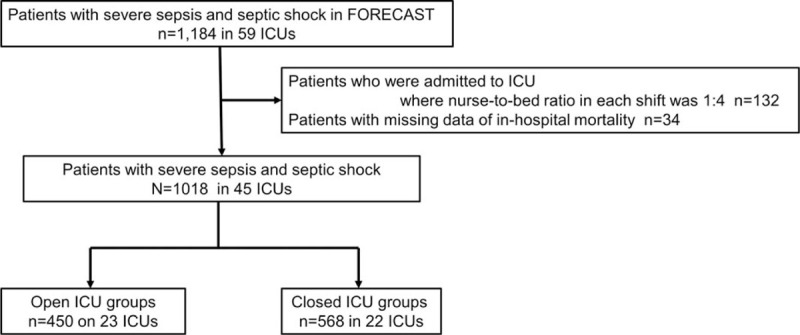
Abstract
We aimed to determine the association between the intensive care unit (ICU) model and in-hospital mortality of patients with severe sepsis and septic shock.This was a secondary analysis of a multicenter prospective observational study conducted in 59 ICUs in Japan from January 2016 to March 2017. We included adult patients (aged ≥16 years) with severe sepsis and septic shock based on the sepsis-2 criteria who were admitted to an ICU with a 1:2 nurse-to-patient ratio per shift. Patients were categorized into open or closed ICU groups, according to the ICU model. The primary outcome was in-hospital mortality.A total of 1018 patients from 45 ICUs were included in this study. Patients in the closed ICU group had a higher severity score and higher organ failure incidence than those in the open ICU group. The compliance rate for the sepsis care 3-h bundle was higher in the closed ICU group than in the open ICU group. In-hospital mortality was not significantly different between the closed and open ICU groups in a multilevel logistic regression analysis (odds ratio = 0.83, 95% confidence interval; 0.52-1.32, P = .43) and propensity score matching analysis (closed ICU, 21.2%; open ICU, 25.7%, P = .22).In-hospital mortality between the closed and open ICU groups was not significantly different after adjusting for ICU structure and compliance with the sepsis care bundle.
Copyright © 2021 the Author(s). Published by Wolters Kluwer Health, Inc.
Conflict of interest statement
The authors have no conflicts of interest to disclose.
Figures
References
-
- Donabedian A. Evaluating the quality of medical care. Milbank Mem Fund Q 1966;44:166–206. - PubMed
-
- Carson SS, Stocking C, Podsadecki T, et al. . Effects of organizational change in the medical intensive care unit of a teaching hospital: a comparison of ’open’ and ’closed’ formats. JAMA 1996;276:322–8. - PubMed
-
- Chittawatanarat K, Pamorsinlapathum T. The impact of closed ICU model on mortality in general surgical intensive care unit. J Med Assoc Thai 2009;92:1627–34. - PubMed
-
- Hackner D, Shufelt CL, Balfe DD, Lewis MI, Elsayegh A, Braunstein GD. Do faculty intensivists have better outcomes when caring for patients directly in a closed ICU versus consulting in an open ICU? Hosp Pract 2009;37:40–50. - PubMed
Publication types
MeSH terms
LinkOut - more resources
Full Text Sources
Other Literature Sources
Medical
