


Comparison between invasive and non-invasive assessment of blood pressure in hypertensive disorders of pregnancy
- PMID: 34032932
- PMCID: PMC8149773
- DOI: 10.1186/s43044-021-00172-7
Comparison between invasive and non-invasive assessment of blood pressure in hypertensive disorders of pregnancy
Abstract
Background: The management of hypertensive disorders of pregnancy (HDP) during hospitalization requires an accurate blood pressure (BP) measurement, mainly by invasive intra-arterial reading. Nevertheless, little is known about the precision of non-invasive (NI) central BP measurements in HDP. We aimed to assess the accuracy of NI central BP assessment in comparison to invasive BP measurement in HDP. This cross-sectional study included all patients with HDP that were admitted to university hospitals for high BP control, from December 2018 till December 2019, and 10 healthy matched non-hypertensive controls. Patients were compared for demographic, anthropometric, and echocardiographic data. In all subjects, invasive BP assessment was done by radial arterial cannulation and NI assessment of BP was performed by an oscillometric automated device (Mobil-O-Graph); the comparison was done after initial control of BP.
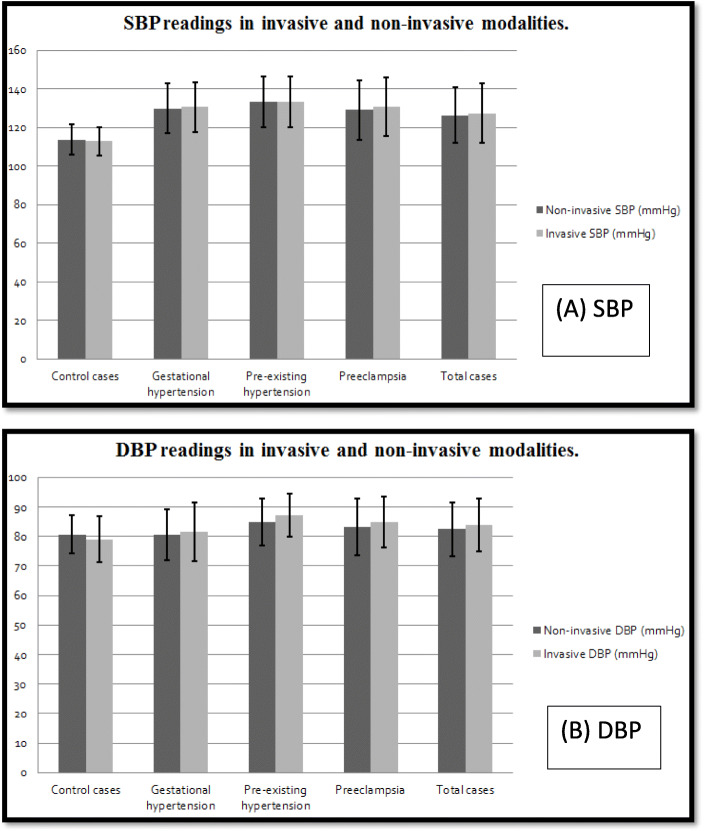
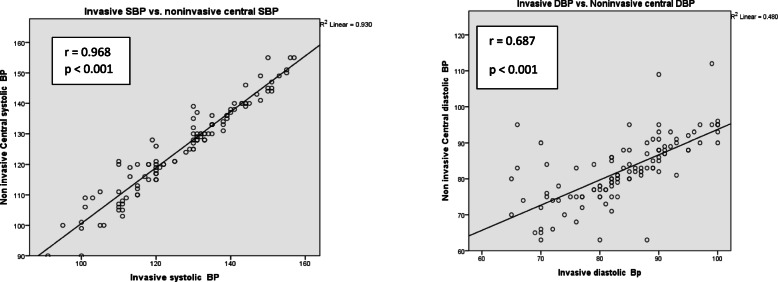
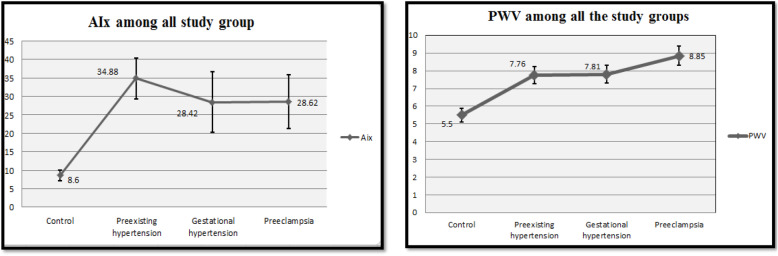
Results: One hundred patients were included and divided into 3 groups (pre-existing hypertension (HTN), gestational HTN, and pre-eclampsia). There was no statistically significant difference between NI central and invasive methods in measuring both systolic BP (SBP) (126.39 ± 14.5 vs 127.43 ± 15.3, p = 0.5) and diastolic BP (82.41 ± 9.0 vs 83.78 ± 8.9, p = 0.14) among the total studied population. A strong positive correlation was found between NI central and invasive SBP (r = 0.96, p < 0.001). HDP was associated with an increase in arterial stiffness, left ventricular diastolic dysfunction, and complications.
Conclusion: Non-invasive measurement of BP using oscillometric automated devices is as accurate as the invasive method, and it is a practical safe method in pregnant women with hypertensive disorders (CTR no. = NCT04303871).
Keywords: Hypertensive disorders of pregnancy; Invasive BP; Mobil-O-Graph; Oscillometric non-invasive BP.
Conflict of interest statement
The authors declare that they have no competing interests.
Figures
Similar articles
-
Oscillometric estimation of central blood pressure: validation of the Mobil-O-Graph in comparison with the SphygmoCor device.Blood Press Monit. 2012 Jun;17(3):128-31. doi: 10.1097/MBP.0b013e328353ff63. Blood Press Monit. 2012. PMID: 22561735
-
The impact of calibration approaches on the accuracy of oscillometric central aortic blood pressure measurement.J Hypertens. 2020 Nov;38(11):2154-2160. doi: 10.1097/HJH.0000000000002563. J Hypertens. 2020. PMID: 32649641
-
Effect of Maternal Obstructive Sleep Apnea-Hypopnea on 24-Hour Blood Pressure, Nocturnal Blood Pressure Dipping and Arterial Stiffness in Hypertensive Disorders of Pregnancy.Front Physiol. 2021 Oct 18;12:747106. doi: 10.3389/fphys.2021.747106. eCollection 2021. Front Physiol. 2021. PMID: 34733178 Free PMC article.
-
Prevention, Diagnosis, and Management of Hypertensive Disorders of Pregnancy: a Comparison of International Guidelines.Curr Hypertens Rep. 2020 Aug 27;22(9):66. doi: 10.1007/s11906-020-01082-w. Curr Hypertens Rep. 2020. PMID: 32852691 Free PMC article. Review.
-
Association between hypertensive disorders during pregnancy and elevated blood pressure in offspring: A systematic review and meta-analysis.J Clin Hypertens (Greenwich). 2022 Nov;24(11):1397-1404. doi: 10.1111/jch.14577. Epub 2022 Sep 12. J Clin Hypertens (Greenwich). 2022. PMID: 36094379 Free PMC article.
References
Associated data
LinkOut - more resources
Full Text Sources
Other Literature Sources
Medical