


Improving photosynthesis to increase grain yield potential: an analysis of maize hybrids released in different years in China
- PMID: 34032983
- PMCID: PMC8556214
- DOI: 10.1007/s11120-021-00847-x
Improving photosynthesis to increase grain yield potential: an analysis of maize hybrids released in different years in China
Abstract
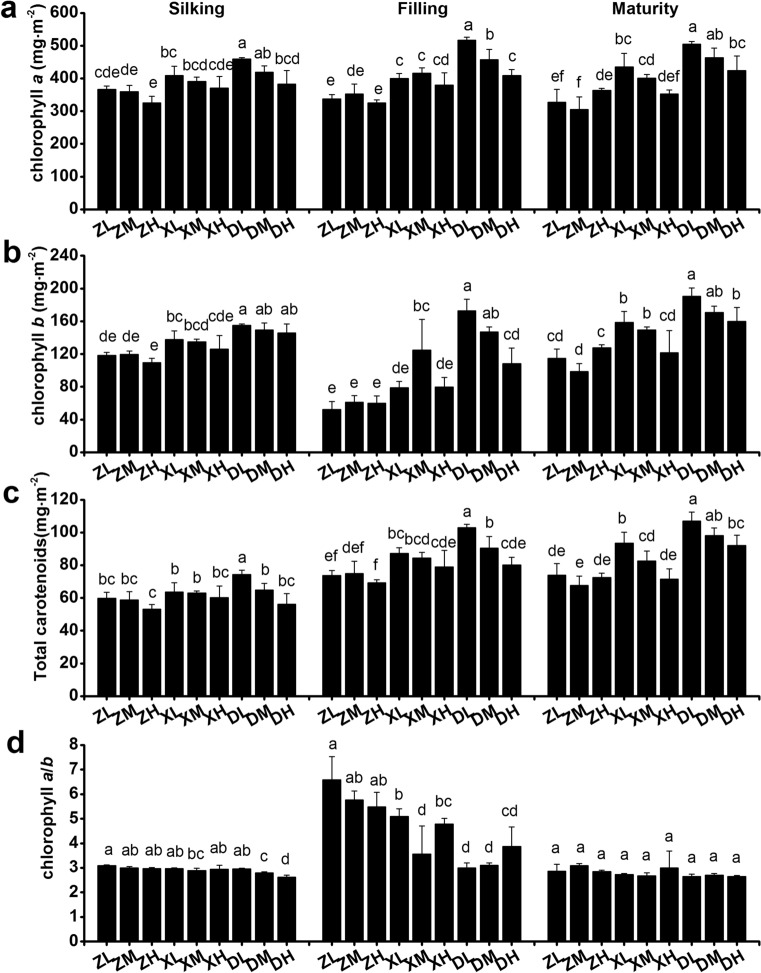
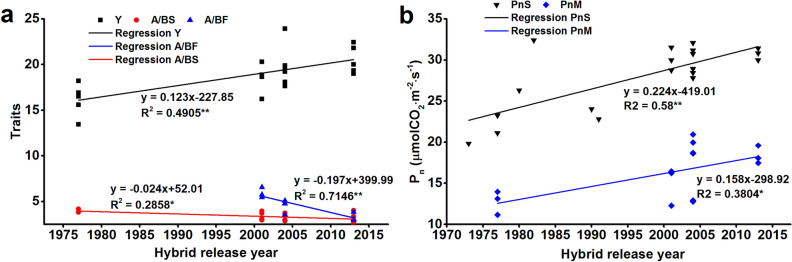
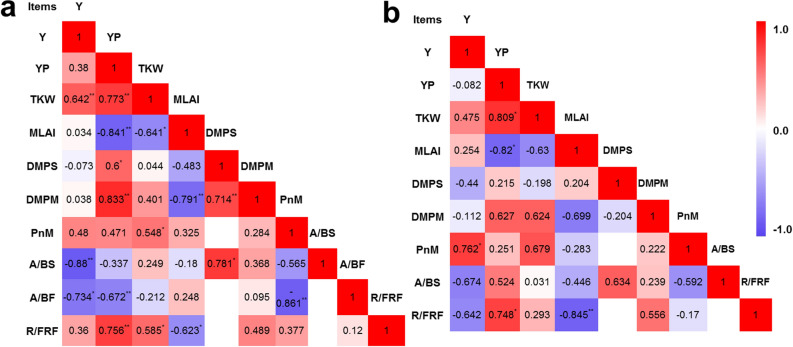
In this work, we sought to understand how breeding has affected photosynthesis and to identify key photosynthetic indices that are important for increasing maize yield in the field. Our 2-year (2017-2018) field experiment used five high-yielding hybrid maize cultivars (generated in the 1970s, 2000s, and 2010s) and was conducted in the Xinjiang Autonomous Region of China. We investigated the effects of planting density on maize grain yield, photosynthetic parameters, respiration, and chlorophyll content, under three planting density regimens: 75,000, 105,000, and 135,000 plants ha-1. Our results showed that increasing planting density to the medium level (105,000 plants ha-1) significantly increased grain yield (Y) up to 20.32% compared to the low level (75,000 plants ha-1). However, further increasing planting density to 135,000 plants ha-1 did not lead to an additional increase in yield, with some cultivars actually exhibiting an opposite trend. Interestingly, no significant changes in photosynthetic rate, dark respiration, stomatal density, and aperture were observed upon increasing planting density. Moreover, our experiments revealed a positive correlation between grain yield and the net photosynthetic rate (Pn) upon the hybrid release year. Compared to other cultivars, the higher grain yield obtained in DH618 resulted from a higher 1000-kernel weight (TKW), which can be explained by a longer photosynthetic duration, a higher chlorophyll content, and a lower ratio of chlorophyll a/b. Moreover, we found that a higher leaf area per plant and the leaf area index (HI) do not necessarily result in an improvement in maize yield. Taken together, we demonstrated that higher photosynthetic capacity, longer photosynthetic duration, suitable LAI, and higher chlorophyll content with lower chlorophyll a/b ratio are important factors for obtaining high-yielding maize cultivars and can be used for the improvement of maize crop yield.
Keywords: Density-tolerance; Grain yield; Maize; Photosynthesis; Planting density.
© 2021. The Author(s).
Conflict of interest statement
The authors wish to declare no known competing financial interests or personal relationships that have influenced the present work.
Figures
References
-
- Alton PB. Retrieval of seasonal Rubisco-limited photosynthetic capacity at global FLUXNET sites from hyperspectral satellite remote sensing: impact on carbon modelling. Agric For Meteorol. 2017;232:74–88. doi: 10.1016/j.agrformet.2016.08.001. - DOI
-
- Bernhard BJ, Below FE. Plant population and row spacing effects on corn: phenotypic traits of positive yield-responsive hybrids. Agro J. 2020;112:1589–1600. doi: 10.1002/agj2.20206. - DOI
-
- Biscoe PV, Scott RK, Monteith JL. Barley and its environment. III. carbon budget of the stand. J Appl Ecol. 1975;12:269–293. doi: 10.2307/2401733. - DOI
-
- Boomsma CR, Santini JB, Tollenaar M, Vyn TJ. Maize morphophysiological responses to intense crowding and low nitrogen availability: an analysis and review. Agron J. 2009;101:1426–1452. doi: 10.2134/agronj2009.0082. - DOI
MeSH terms
Substances
Grants and funding
LinkOut - more resources
Full Text Sources
Other Literature Sources
Research Materials
