


Abdominal lymph node metastasis by lymphatic spread through the thoracic duct in patients with non-small-cell lung cancer
- PMID: 34033231
- PMCID: PMC8287020
- DOI: 10.1111/1759-7714.14014
Abdominal lymph node metastasis by lymphatic spread through the thoracic duct in patients with non-small-cell lung cancer
Abstract
Background: Abdominal lymph node metastasis (ALNM) is common in patients with metastatic non-small-cell lung cancer (NSCLC). However, its mechanism of spread remains to be elucidated. We investigated whether thoracic duct has the role as a pathway for ALNM in NSCLC using clinical data.
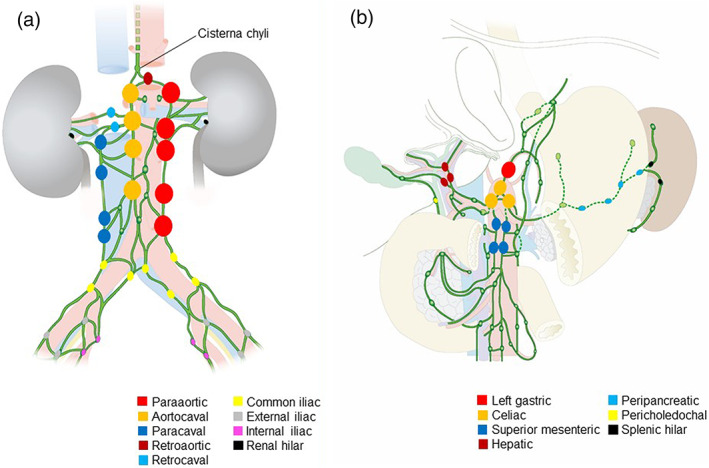
Methods: We classified ALNM into subgroups by their location and evaluated its prevalence and association with clinical characteristics in 892 patients with metastatic NSCLC. The abdominal lymph nodes were classified into direct or indirect groups depending on whether they drain directly into the trunk (intestinal trunk or lumbar trunks) connected to the cisterna chyli.
Results: One hundred-five patients (11.8%) had ALNM. The paraaortic lymph node was most commonly involved, followed by the aortocaval, left gastric, paracaval, and celiac lymph nodes. After grouping the patients by location of ALNM, 56 patients (53.3%) with ALNM were in the "direct only" group, only seven patients (6.7%) were in the "indirect only" group, and 42 patients (40.0%) were in "both" groups. In patients whose intrathoracic lesions were limited to the right thorax, there was a significantly lower prevalence of ALNM (3.4% vs. 14.3%, p < 0.001). On multivariate logistic regression analysis of clinical variables, higher N category was associated with increased risk of ALNM.
Conclusions: This study suggests that the thoracic duct is one of the potential routes of lymphatic spread to the abdominal lymph nodes. Clinicians should assess for the presence of ALNM during staging work-up and follow-up for NSCLC patients with intrathoracic lesion in left thorax and with high N category.
Keywords: abdominal lymph nodelymphatic spreadmetastasisnon-small-cell lung cancerthoracic duct.
© 2021 The Authors. Thoracic Cancer published by China Lung Oncology Group and John Wiley & Sons Australia, Ltd.
Conflict of interest statement
The authors declare that they have no competing interests to disclose.
Figures
References
-
- Mountain CF. Revisions in the international system for staging lung cancer. Chest. 1997;111:1710–7. - PubMed
-
- Funazo T, Nomizo T, Kim YH. Liver metastasis is associated with poor progression‐free survival in patients with non–small cell lung cancer treated with nivolumab. J Thorac Oncol. 2017;12:e140–e1. - PubMed
Publication types
MeSH terms
LinkOut - more resources
Full Text Sources
Other Literature Sources
Medical
