Review
. 2021 Aug;191(8):1374-1384.
doi: 10.1016/j.ajpath.2021.05.007. Epub 2021 May 23.

COVID-19 Vasculopathy: Mounting Evidence for an Indirect Mechanism of Endothelial Injury

Affiliations
Review

COVID-19 Vasculopathy: Mounting Evidence for an Indirect Mechanism of Endothelial Injury

Roberto F Nicosia et al. Am J Pathol. 2021 Aug.

Abstract

Patients with coronavirus disease 2019 (COVID-19) who are critically ill develop vascular complications characterized by thrombosis of small, medium, and large vessels. Dysfunction of the vascular endothelium due to the severe acute respiratory syndrome coronavirus 2 (SARS-CoV-2) infection has been implicated in the pathogenesis of the COVID-19 vasculopathy. Although initial reports suggested that endothelial injury was caused directly by the virus, recent studies indicate that endothelial cells do not express angiotensin-converting enzyme 2, the receptor that SARS-CoV-2 uses to gain entry into cells, or express it at low levels and are resistant to the infection. These new findings, together with the observation that COVID-19 triggers a cytokine storm capable of injuring the endothelium and disrupting its antithrombogenic properties, favor an indirect mechanism of endothelial injury mediated locally by an augmented inflammatory reaction to infected nonendothelial cells, such as the bronchial and alveolar epithelium, and systemically by the excessive immune response to infection. Herein we review the vascular pathology of COVID-19 and critically discuss the potential mechanisms of endothelial injury in this disease.


Figures

Figure 1
Figure 1
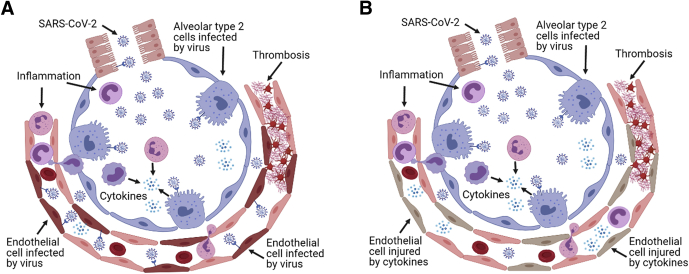
Proposed causes of endothelial injury in coronavirus disease 2019 vasculopathy. A: Direct injury of the endothelium by severe acute respiratory syndrome coronavirus 2 (SARS-CoV-2). B: Indirect injury of the endothelium by an excessive inflammatory reaction to the viral infection of alveolar and bronchiolar epithelial cells. The injured endothelium in both scenarios develops a proinflammatory phenotype and loses its antithrombogenic properties. The hypothesis that endothelial cells are directly injured by the virus has been challenged by recent studies reporting that endothelial cells do not express the angiotensin-converting enzyme 2 receptor or express it at low levels and are resistant to the SARS-CoV-2 infection. Image created with BioRender software (BioRender, San Francisco, CA).
Figure 2
Figure 2
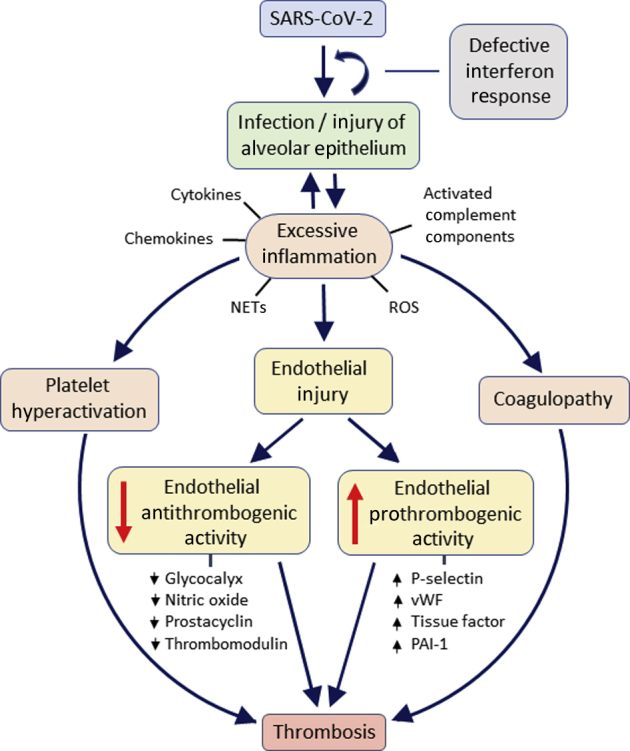
Putative mechanisms of endothelial injury and thrombosis in critically ill patients with coronavirus disease 2019 (COVID-19). The schematic summarizes key processes implicated in the pathogenesis of COVID-19 vasculopathy. Angiotensin-converting enzyme 2 (ACE2)–positive alveolar epithelial cells infected by severe acute respiratory syndrome coronavirus 2 trigger an inflammatory response, which, in the setting of defective antiviral interferon signaling, fails to suppress the infection and misfires, leading to overproduction of cytokines and chemokines, activation of complement, and recruitment of leukocytes, which release reactive oxygen species (ROS) and neutrophilic extracellular traps (NETs). Endothelial cells injured indirectly by the cytokines and other inflammatory products lose their antithrombogenic properties and release factors that promote coagulation and platelet aggregation. Hyperactivation of platelets and systemic coagulopathy induced by the inflammatory reaction to the infection contribute to the formation of thrombi. The same mechanisms of inflammation-mediated endothelial injury can create a permissive prothrombogenic environment in peripheral organs that contain ACE2-positive nonendothelial cells. PAI1, plasminogen activator inhibitor 1; vWF, von Willebrand factor.

References

    1. Zhu N., Zhang D., Wang W., Li X., Yang B., Song J., Zhao X., Huang B., Shi W., Lu R., Niu P., Zhan F., Ma X., Wang D., Xu W., Wu G., Gao G.F., Tan W., China Novel Coronavirus Investigating and Research Team A novel coronavirus from patients with pneumonia in China, 2019. N Engl J Med. 2020;382:727–733. - PMC - PubMed
    1. Coronaviridae Study Group of the International Committee on Taxonomy of Viruses The species severe acute respiratory syndrome-related coronavirus: classifying 2019-nCoV and naming it SARS-CoV-2. Nat Microbiol. 2020;5:536–544. - PMC - PubMed
    1. Pollard C.A., Morran M.P., Nestor-Kalinoski A.L. The COVID-19 pandemic: a global health crisis. Physiol Genomics. 2020;52:549–557. - PMC - PubMed
    1. Ejaz H., Alsrhani A., Zafar A., Javed H., Junaid K., Abdalla A.E., Abosalif K.O.A., Ahmed Z., Younas S. COVID-19 and comorbidities: deleterious impact on infected patients. J Infect Public Health. 2020;13:1833–1839. - PMC - PubMed
    1. Zhou F., Yu T., Du R., Fan G., Liu Y., Liu Z., Xiang J., Wang Y., Song B., Gu X., Guan L., Wei Y., Li H., Wu X., Xu J., Tu S., Zhang Y., Chen H., Cao B. Clinical course and risk factors for mortality of adult inpatients with COVID-19 in Wuhan, China: a retrospective cohort study. Lancet. 2020;395:1054–1062. - PMC - PubMed

Publication types

MeSH terms

Substances