. 2021 May;18(178):20210049.
doi: 10.1098/rsif.2021.0049. Epub 2021 May 26.

A novel approach for predicting risk of vector-borne disease establishment in marginal temperate environments under climate change: West Nile virus in the UK

Affiliations

A novel approach for predicting risk of vector-borne disease establishment in marginal temperate environments under climate change: West Nile virus in the UK

David A Ewing et al. J R Soc Interface. 2021 May.

Abstract

Vector-borne diseases (VBDs), such as dengue, Zika, West Nile virus (WNV) and tick-borne encephalitis, account for substantial human morbidity worldwide and have expanded their range into temperate regions in recent decades. Climate change has been proposed as a likely driver of past and future expansion, however, the complex ecology of host and vector populations and their interactions with each other, environmental variables and land-use changes makes understanding the likely impacts of climate change on VBDs challenging. We present an environmentally driven, stage-structured, host-vector mathematical modelling framework to address this challenge. We apply our framework to predict the risk of WNV outbreaks in current and future UK climates. WNV is a mosquito-borne arbovirus which has expanded its range in mainland Europe in recent years. We predict that, while risks will remain low in the coming two to three decades, the risk of WNV outbreaks in the UK will increase with projected temperature rises and outbreaks appear plausible in the latter half of this century. This risk will increase substantially if increased temperatures lead to increases in the length of the mosquito biting season or if European strains show higher replication at lower temperatures than North American strains.

Keywords: West Nile virus; climate change; delay-differential equations; mathematical model; mosquito; vector-borne diseases.


Figures
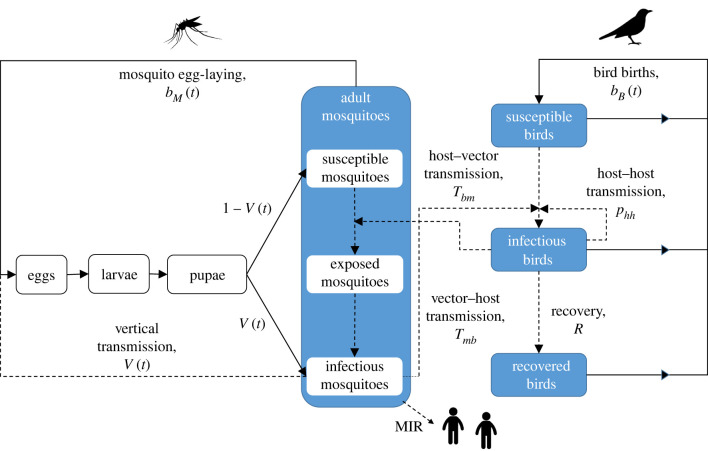
Figure 1.
Figure 1.
Flowchart showing the relationships between the mosquito, bird and human populations, as defined in the model, and highlighting the processes by which individuals transition between infection classes, subject to the disease-related parameters. All stages have an associated death rate, which is not displayed here for clarity. All disease transmission processes are shown by dashed lines, while life cycle processes are shown by solid lines. Many of the processes are temperature-dependent.
Figure 2.
Figure 2.
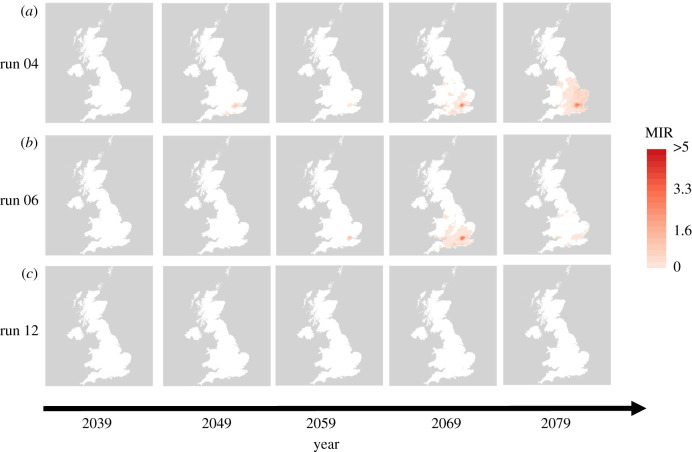
Risk of WNV introduction via late May migrants: risk of WNV outbreak via the arrival of migratory birds at the end of May for the temperatures simulated using UKCP18 model runs 04 (a), 06 (b) and 12 (c). The five plots correspond to results from 2039, 2049, 2059, 2069 and 2079 from left to right. Due to very low estimated risk only maps from 2039 onwards are shown.
Figure 3.
Figure 3.
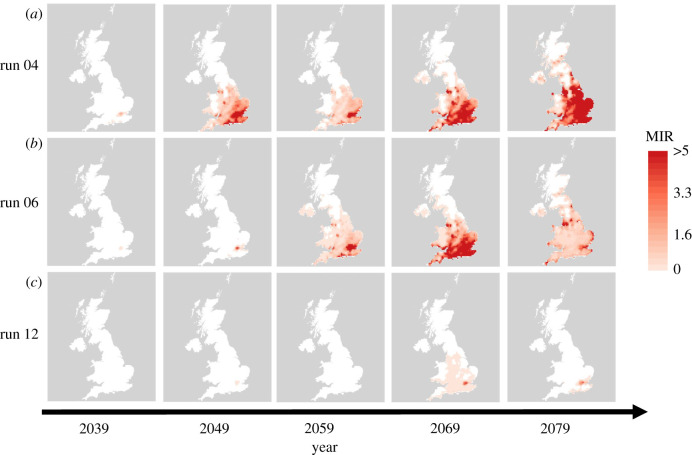
Upper limit of WNV risk given lower thermal minimum for WNV replication: This figure shows the risk of WNV outbreaks via the arrival of migratory birds at the end of May for the temperatures simulated using UKCP18 model runs 04 (a), 06 (b) and 12 (c). The five columns correspond to results from 2039, 2049, 2059, 2069 and 2079 from left to right. In this case, the thermal minimum for WNV transmission has been set to the lower limit of the estimated 95% CI for the parameter, which is 7.3°C [37]. Due to very low estimated risk only maps from 2039 onwards are shown.
Figure 4.
Figure 4.
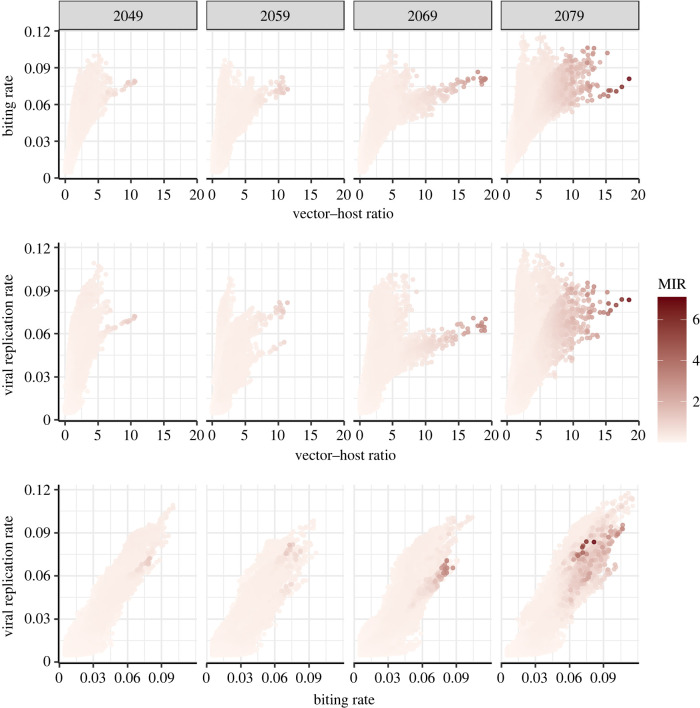
Relationships of viral replication rate, biting rate and vector–host ratio with MIR: the median viral replication rate (1/EIP), biting rate and vector–host ratio over the main vector biting season (June, July and August) are plotted with the resultant peak MIR for that season shown by the colour of the data point. The data points correspond to the simulated results across all UK grid squares and all models runs (as shown in the maps).
Figure 5.
Figure 5.
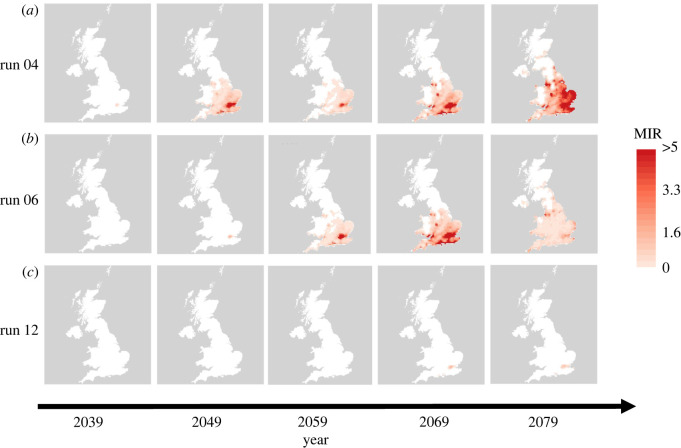
Risk of WNV outbreak under lengthened biting season: the photoperiod at which 50% of adult female mosquitoes entered diapause was decreased by 1 h, corresponding to an approximate two-week delay in diapause initiation dependent on the latitude. The plots correspond (a) runs 04, (b) 06 and (c) 12 and to years 2039, 2049, …, 2079.

References

    1. Institute of Medicine (US) Forum on microbial threats. vector-borne diseases: understanding the environmental, human health, and ecological connections, workshop summary. Washington, DC, 2008. (10.17226/11950) - DOI - PubMed
    1. doi: 10.17226/21792. National Academies of Sciences Engineering and Medicine. Global health impacts of vector-borne diseases: workshop summary. Washington, DC, 2016. ( ) - DOI - PubMed
    1. James SL et al. 2018. Global, regional, and national incidence, prevalence, and years lived with disability for 354 diseases and injuries for 195 countries and territories, 1990–2017: a systematic analysis for the Global Burden of Disease Study 2017. Lancet 392, 1789-1858. (10.1016/S0140-6736(18)32279-7) - DOI - PMC - PubMed
    1. Gubler DJ. 1998. Resurgent vector-borne diseases as a global health problem. Emerg. Infect. Dis. 4, 442-450. (10.3201/eid0403.980326) - DOI - PMC - PubMed
    1. Caminade C, McIntyre KM, Jones AE. 2019. Impact of recent and future climate change on vector borne diseases. Ann. N. Y. Acad. Sci. 1436, 157-173. (10.1111/nyas.13950) - DOI - PMC - PubMed

Publication types