


Risk perceptions and attitudinal responses to COVID-19 pandemic: an online survey in Ethiopia
- PMID: 34034694
- PMCID: PMC8148408
- DOI: 10.1186/s12889-021-10939-x
Risk perceptions and attitudinal responses to COVID-19 pandemic: an online survey in Ethiopia
Abstract
Background: Effective risk communication is one of the critical strategies in the response to COVID-19. This study examined risk perceptions and attitudinal responses to COVID-19 among the educated section of the society in Ethiopia.
Methods: An internet-based survey was conducted from April 22 to May 04, 2020, in Ethiopia. A questionnaire addressing the perception of health threat-combination of perceived vulnerability (PV) and perceived seriousness (PS), and perceived efficacy-combinations of perceived response efficacy (PRE), perceived self-efficacy (PSE), and perceived collective efficacy (PCE). The data were analyzed using SPSS 21.0. Descriptive statistics were computed after the standardization of the scores. The scores for overall efficacy and threat were split by median value and response classifications were generated through threat by efficacy interactions. For statistical significance, 95% CI and p-value < 0.05 were used.
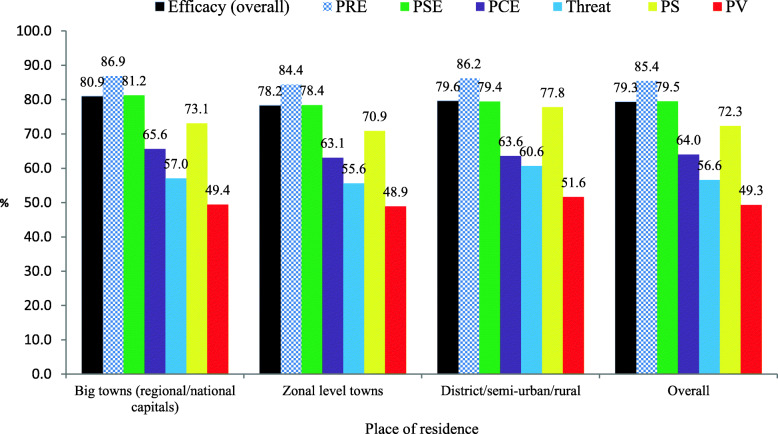
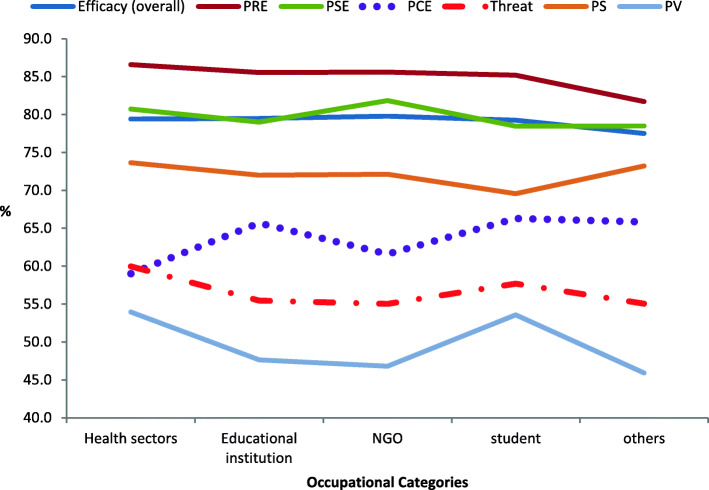
Results: A total of 929 respondents submitted their responses. Eight hundred and twenty-eight (89.1%) of the respondents were male and 753 (81.1%) were Christian. The perceived threat to COVID-19 was generally low (median = 58.3). The median score for overall efficacy, PRE, and PSE were 79.8, 87.5, and 80.0, respectively. However, the median value (66.7) for PCE was relatively low. Perceived threat significantly varied by age, education, occupation, and place of residence (p < 0.05). Perceived efficacy significantly differed by gender, residence, and use of some sources of information (p < 0.05). In terms of response to COVID-19, 290 (31.2%), 239 (25.7%), 175 (18.8%) and 225 (24.2%) of the respondents were in the responsive, pro-active, avoidant, and indifferent attitudinal categories, respectively. The avoidant and indifferent groups constituted a fear control response (mal-adaptive motivation towards COVID-19 protective behavior) whereas responsive and pro-active categories formed a danger control response (self-protective motivation). These responses varied significantly by residence, region, religion, and sources of information (p < 0.05).
Conclusions: Understanding people's perceived health threat and efficacy is a critical step toward creating risk communication campaigns. Hence, this study provided an insight that has the potential to inform the COVID-19 risk communication campaigns targeting the educated section of the society, by ensuring a balanced combination of threat appeals and efficacy messages for improved self-protective responses.
Keywords: Attitude; Attitudinal response; COVID-19; Collective efficacy; Coronavirus; Efficacy; Ethiopia; Extended parallel process model; Health threat; Perceived severity; Risk communication; Risk perception; Self-efficacy; Vulnerability.
Conflict of interest statement
The authors declared that they have no competing interests.
Figures
References
-
- Zhu N, Zhang D, Wang W, Li X, Yang B, Song J, Zhao X, Huang B, Shi W, Lu R, Niu P, Zhan F, Ma X, Wang D, Xu W, Wu G, Gao GF, Tan W, China Novel Coronavirus Investigating and Research Team A novel coronavirus from patients with pneumonia in China, 2019. N Engl J Med. 2020;382(8):727–733. doi: 10.1056/NEJMoa2001017. - DOI - PMC - PubMed
-
- Li Q, Guan X, Wu P, Wang X, Zhou L, Tong Y, Ren R, Leung KSM, Lau EHY, Wong JY, Xing X, Xiang N, Wu Y, Li C, Chen Q, Li D, Liu T, Zhao J, Liu M, Tu W, Chen C, Jin L, Yang R, Wang Q, Zhou S, Wang R, Liu H, Luo Y, Liu Y, Shao G, Li H, Tao Z, Yang Y, Deng Z, Liu B, Ma Z, Zhang Y, Shi G, Lam TTY, Wu JT, Gao GF, Cowling BJ, Yang B, Leung GM, Feng Z. Early transmission dynamics in Wuhan, China, of novel coronavirus–infected pneumonia. N Engl J Med. 2020;382(13):1199–1207. doi: 10.1056/NEJMoa2001316. - DOI - PMC - PubMed
-
- World Health Organization. Coronavirus (COVID-19) events as they happen. Rolling Updates on coronavirus disease. 2020 [cited 2020 May 26]. Available from: https://www.who.int/emergencies/diseases/novel-coronavirus-2019/events-a...
-
- World Health Organization . COVID-19 situation reports. 2020.
MeSH terms
LinkOut - more resources
Full Text Sources
Other Literature Sources
Medical
Research Materials
Miscellaneous
