


Measuring the global, regional, and national burden of multiple myeloma from 1990 to 2019
- PMID: 34034700
- PMCID: PMC8152089
- DOI: 10.1186/s12885-021-08280-y
Measuring the global, regional, and national burden of multiple myeloma from 1990 to 2019
Abstract
Background: Multiple myeloma (MM) is a major health concern. Understanding the different burden and tendency of MM in different regions is crucial for formulating specific local strategies. Therefore, we evaluated the epidemiologic patterns and explored the risk factors for MM death.
Methods: Data on MM were collected from the 2019 Global Burden of Disease study. We used incidence, mortality, and disability adjusted life-years to estimate the global, regional, and national burden of MM.
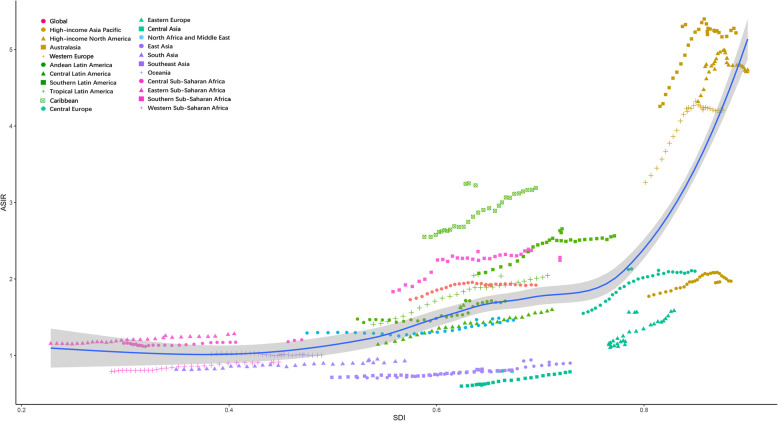
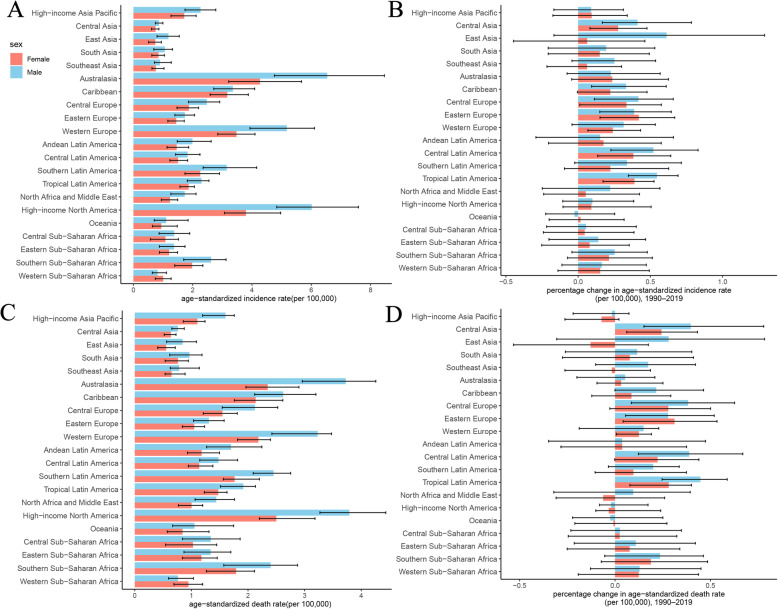
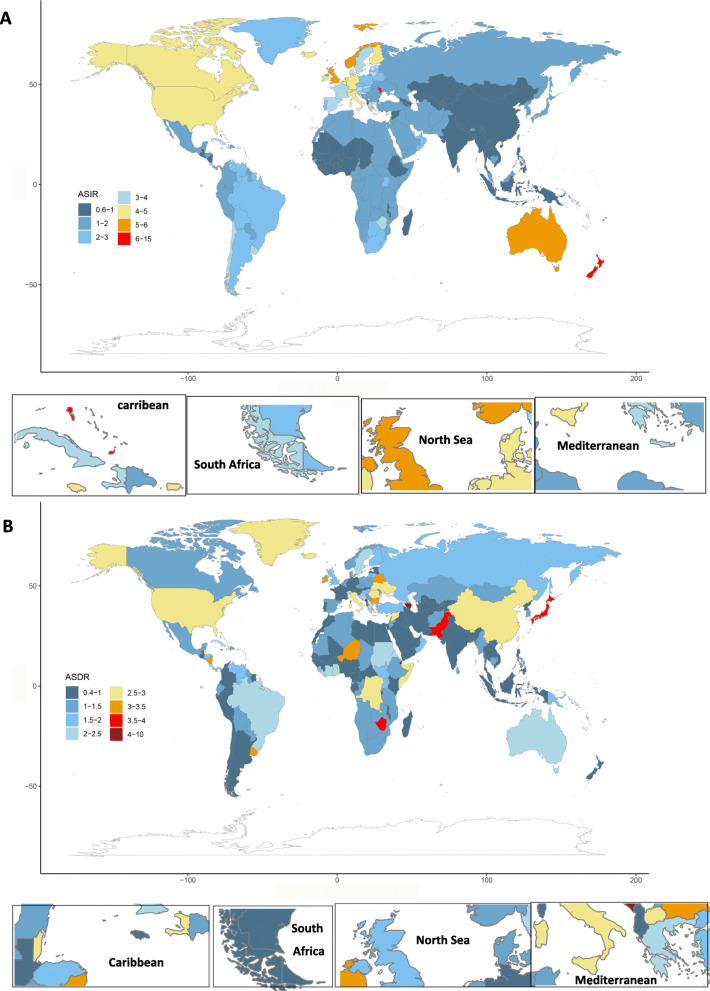
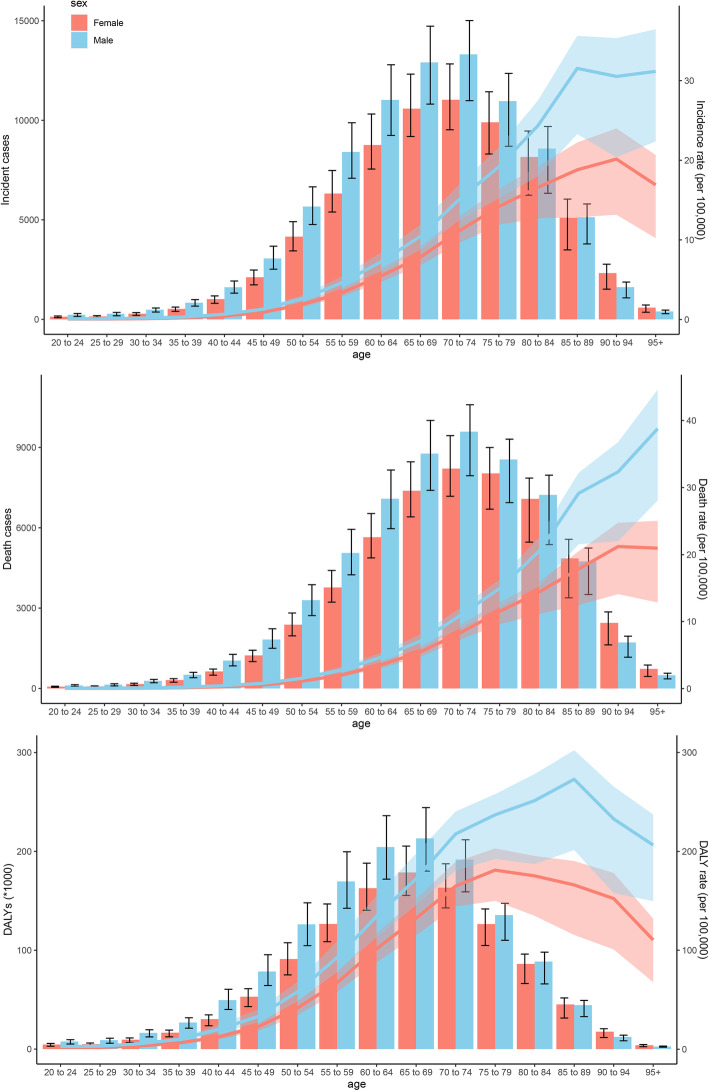
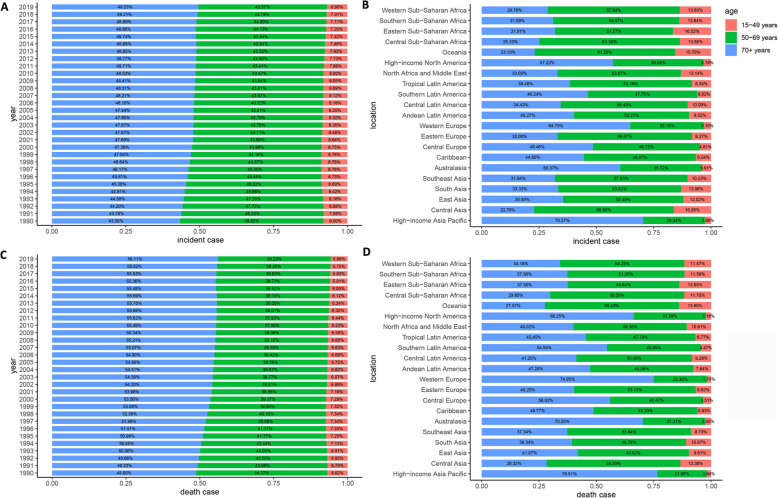
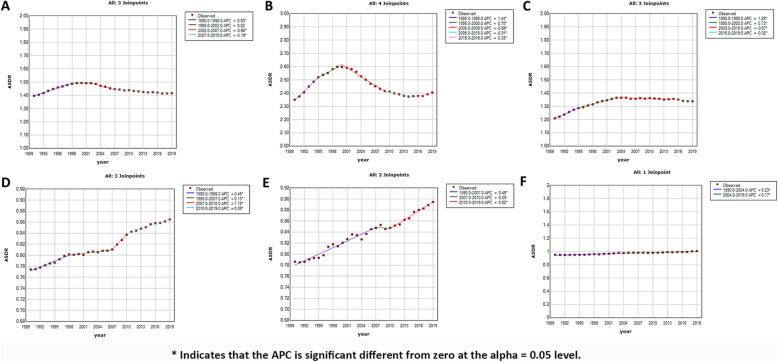
Results: In 2019, there were 155,688 (95% UI, 136,585 - 172,577) MM cases worldwide, of which 84,516 (54.3%, 70,924 - 94,910) were of men. The age-standardized incidence rate (ASIR) was 1.72/100,000 persons (95% UI, 1.59-1.93) in 1990 and 1.92/100,000 persons (95% UI, 1.68-2.12) in 2019. The number of MM deaths increased 1.19-fold from 51,862 (95% UI, 47,710-58,979) in 1990 to 113,474 (95% UI, 99,527 - 121,735) in 2019; the age-standardized death rate (ASDR) was 1.42/100,000 persons (95% UI, 1.24-1.52) in 2019. In recent 15 years, ASDR showed a steady tendency for men, and a downward tendency for women. Countries with high social-demographic indexes exhibited a higher ASIR and ASDR. Australasia, North America, and Western Europe had the highest ASIR and ASDR, with 46.3% incident cases and 41.8% death cases. Monaco had the highest ASIR and ASDR, which was almost half as high as the second highest country Barbados. In addition, United Arab Emirates and Qatar had the largest growth multiple in ASIR and ASDR, which was twice the third country Djibouti.
Conclusions: Globally, incident and death MM cases have more than doubled over the past 30 years. The increasing global burden may continue with population aging, whereas mortality may continue to decrease with the progression of medical technology. The global burden pattern of MM was diverse, therefore specific local strategies based on different burden patterns for MM are necessary.
Keywords: Death; Disability adjusted life-years; Global burden of disease; Incidence; Multiple myeloma.
Conflict of interest statement
The authors report no conflicts of interest.
Figures
References
-
- Kristinsson SY, Landgren O, Dickman PW, Derolf AR, Björkholm M. Patterns of survival in multiple myeloma: a population-based study of patients diagnosed in Sweden from 1973 to 2003. Journal of clinical oncology : official journal of the American Society of Clinical Oncology. 2007;25(15):1993–1999. doi: 10.1200/JCO.2006.09.0100. - DOI - PubMed
MeSH terms
LinkOut - more resources
Full Text Sources
Other Literature Sources
Medical
Miscellaneous
